

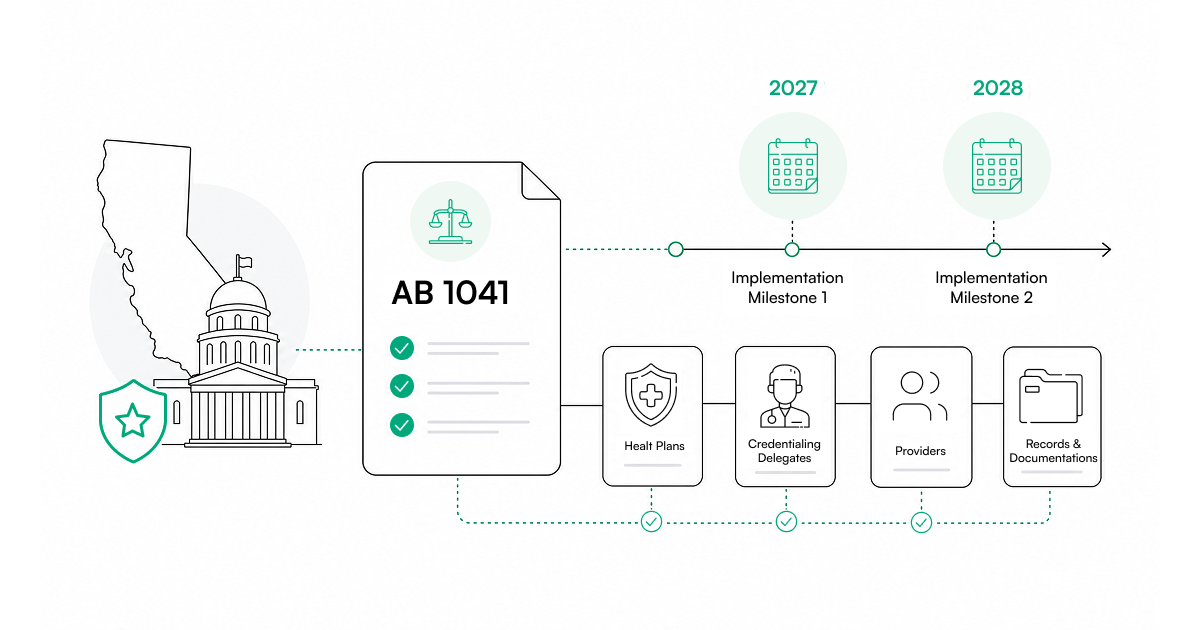
California AB 1041: What Health Plans and Credentialing Delegates Need to Know Before 2027 and 2028

Varun Krishnamurthy
September 28, 2026

Cigna's medical credentialing review typically takes 45 to 60 days once a complete application packet is received, per Cigna's own published guidance. On a roster, most of the delay you actually feel happens before that, while a file is still sitting in your own queue.
Cigna's specific about when it starts counting. Once it receives a complete application packet, the credentialing process typically takes 45 to 60 days, per Cigna's published guidance. That's a typical range, not a guaranteed timeline. All the prep you do before that doesn't count toward the number.
That's why a roster can run so much slower than the published figure. A lapsed CAQH attestation or a missing declarations page keeps that file sitting on your side, and Cigna's own process is to close the application by email if the missing piece is never sent, so a file can end without an earlier warning.
Tono Health got its board-certified dermatologists credentialed and in-network within weeks rather than months. Birches Health went from application to seeing patients in under a month, then expanded across 40 states.
We're an NCQA-certified Credentials Verification Organization, conducting primary source verification across 2,000+ sources, including medical schools, state boards, the AMA, ECFMG, the DEA, and prior employers. Cigna verifies against the same kinds of sources, so we know where files stall.
A Cigna credentialing application is the process by which Cigna verifies a provider against a fixed set of elements before a committee votes. The exact process and the submission channel you'll use vary by line of business, state, and provider type, so treat what follows as the general shape. Cigna accesses your existing CAQH profile electronically once you give permission, rather than requiring you to download a document and mail it in.
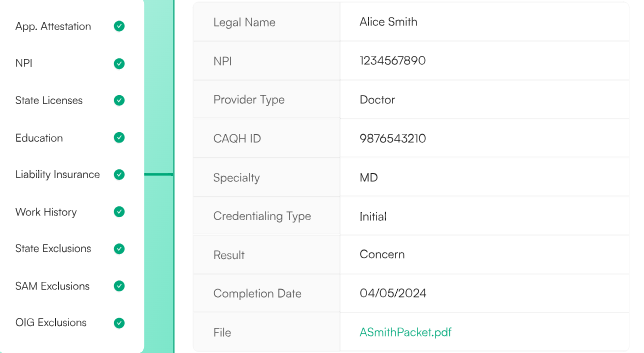
Cigna screens what it collects against standards set by states, Medicare, Cigna, and NCQA. The committee, community physicians conducting peer review alongside the health plan medical director, weighs the following: signed agreement and application, state license, liability coverage, admitting privileges (if applicable), DEA/CDS licensure (if applicable), education and training, sanction activity, and employment history.
One distinction matters before you start. Credentialing is Cigna vetting the provider, ending in the committee's decision. Contracting is the separate agreement and fee schedule that makes the provider in-network. Payer enrollment registers a credentialed provider so that claims are processed and paid correctly. How these three relate, and in what order, varies by Cigna network and provider type; don't assume one fixed sequence applies everywhere.
There are six steps, and this is the order in which a credentialing team works through them. As with the process overview above, the exact order and requirements can vary by line of business and state.
Cigna runs separate intakes for medical, dental, behavioral, and international. Filing on the wrong route can delay or complicate processing.
Eligibility shifts by network too. This requirement applies only to the Evernorth Behavioral Health network: every provider, except a physician assistant, must be licensed to practice independently in the state and maintain a minimum of 24 clinical hours per week. Check part-time clinicians before submitting, since no later document fixes this.
While you've got someone on the phone, ask whether the panel is open for that specialty and geography. Log the representative's name and the date for when you start chasing.
Cigna pulls from CAQH on two conditions: the provider authorizes Cigna specifically, and the profile shows Initial Profile Complete or Re-attestation. Both break quietly: profiles are private by default, and attestations lapse roughly every 120 days. On a roster, that cycle belongs on a shared calendar, since every provider runs on their own clock.
Note: CAQH rebranded to "DataSpring, powered by CAQH" in June 2026. Same login, portal, and 120-day cycle, just new branding alongside caqh.org.
Before submitting, confirm for each provider: the correct status, Cigna authorization, the current attestation date, and the latest version of every document.
Cigna confirms every document with its issuer, so anything expired, restricted, or mismatched stops the file. Find these gaps yourself: Cigna finding them costs a full round trip.
The checklist below covers licensure, insurance, hospital privileges, and history; Cigna's list also includes an on-site visit for PCPs, OB/GYNs, and high-volume behavioral specialists.
Then run a consistency check: name, degree, and practice address must match exactly across the license, CAQH profile, and W-9.
| Document | Requirement |
|---|---|
| Signed application and agreement | Standard or state-mandated |
| State license | Active, unrestricted, every practicing state |
| DEA certificate | Unrestricted, per state (waived for orthodontists) |
| CDS certificate | Where state-required |
| Liability declarations page | $1M/$3M minimum |
| Admitting privileges | Cigna-participating hospital, if applicable |
| Board certification | ABMS or AOA |
| Work history | 5 years; gaps over 6 months explained |
| Sanction/malpractice disclosure | Full disclosure |
| W-9 | Must match license and CAQH |
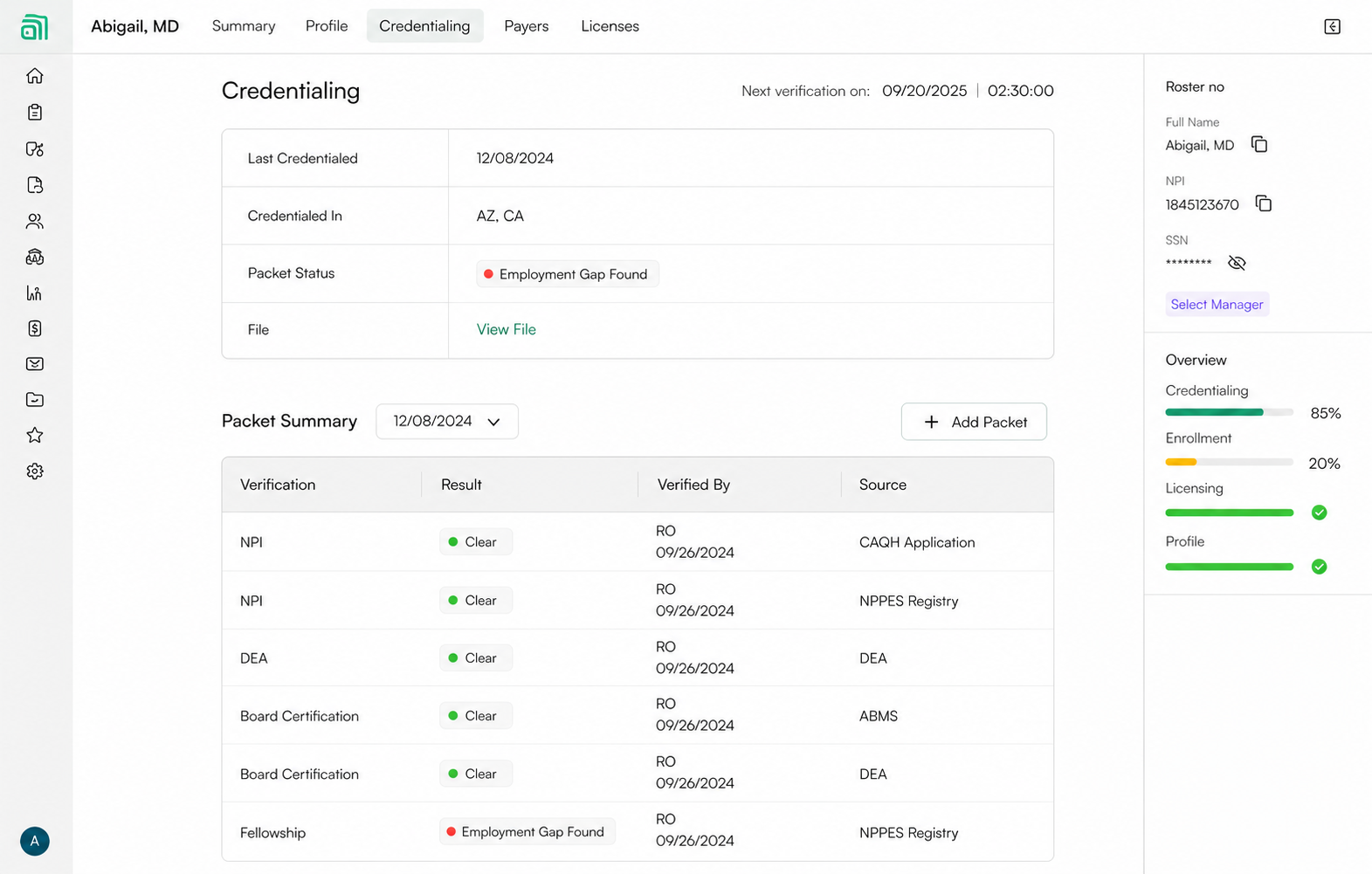
Doing this by hand across twenty or fifty providers is where a credentialing team loses its way. That's what Assured automates. We import provider data from CAQH, NPPES, the DEA, and state boards, run verifications in parallel so one slow source doesn't hold up the rest, and return a standardized, committee-ready packet with ongoing expiration tracking. We handle multi-state licensing alongside it; Cigna's committee still makes its own decision.
Cigna accepts credentials through CAQH, One Healthport, or Medversant (a state-mandated application) or a direct application packet. Dental applicants also receive an e-onboarding tool to complete, sign, and submit documents electronically in a single pass.
If your state mandates its own application, that route takes precedence over CAQH. So check the state rule before you default to CAQH out of habit.
Pick one channel per provider and stay with it. It sounds obvious, but sending the same application two ways just creates two records that can disagree. Log the channel next to the provider, because whoever chases status in three weeks may not be the person who submitted it.
Most of the 45 to 60 days is verification that doesn't involve you: Cigna confirming licenses, certifications, education, and malpractice history directly with the source. A slow state board means a slow file.
You do control your own response time:
As a practical habit, many teams check in around the two-week mark and then every couple of weeks after; this is a suggested cadence, not a Cigna-published deadline. When a discrepancy notice does arrive, log its deadline on a shared calendar immediately.
Across a full roster and several payers, follow-up is the first thing to slip. We track every submission on a live dashboard and chase payer follow-ups through Assured's payor enrollment product, so a response window doesn't quietly expire in someone's inbox.
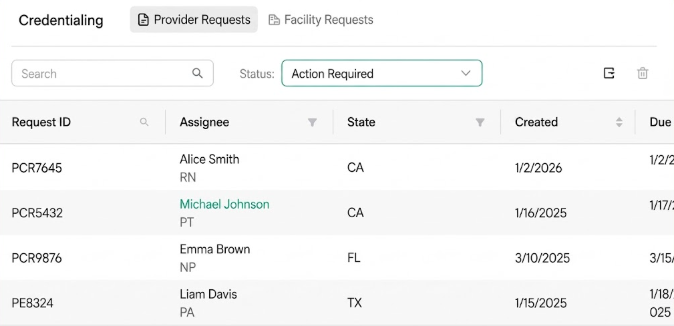
Committee approval only confirms the provider is qualified; billing requires the contract, a separate signature on the participation agreement, and a fee schedule.
Once approved, Cigna emails to confirm the effective date. For medical providers specifically, Cigna's own page states that the provider is typically uploaded to directories and claims systems within 10 business days of approval; this specific timeframe isn't confirmed for dental, behavioral, or international lines of business. A welcome letter follows within 60 days. Do not assume in-network reimbursement before Cigna confirms the participation effective date in writing.
Put recredentialing on the calendar for the same week you sign. Cigna reassesses every three years in most states, sending up to three reminder emails to verify CAQH data and re-sign; a lapse ends network participation.
Delegated credentialing lets a large roster's payer accept your decisions, with a monthly roster replacing individual applications once a certain provider count is reached. Assured's delegated credentialing calculator estimates roughly where that break-even point sits.
| When | What happens |
|---|---|
| Before submission | Split roster, confirm CAQH, close element gaps: on your clock |
| Day 0 | Cigna receives the complete packet; the typical decision window begins |
| ~Day 14 (suggested, not published) | A practical first status check-in |
| Confirm directly | Deadline for written corrections on a flagged error, not stated on Cigna's main page |
| Confirm directly (behavioral only) | Deadline for an Evernorth Behavioral Health discrepancy response |
| Day 45–60 (medical, typical) | Typical committee decision window per Cigna's published guidance |
| Within 10 business days of approval (medical) | Provider uploaded into directories, claim systems; not confirmed for other lines of business |
| Within 60 days of the decision | Welcome letter issued |
| Every 3 years | Recredentialing repeats |
Pull the roster and split it by Cigna line of business first; the wrong intake can delay or complicate processing. Then run the CAQH check on every provider before you touch a single application. That's the failure that hides best. Everything after that runs on Cigna's timeline, and your job is to answer within the windows.
If you're doing this across several payers, including Cigna, the follow-up calendar breaks first. That goes for a dental group, a digital health platform, a health plan, or a health system opening new sites.
Book a demo, and we'll go through your current Cigna files with you. We'll tell you which attestations are current, which response windows are still open, and what changes once the verification work runs automatically.
Cigna states 45 to 60 days for medical, typically, once a complete packet is received. This is a typical range, not a guaranteed timeline. Behavioral facility applications run for up to 90 days.
Most often, a CAQH profile Cigna can't read has the wrong status, or Cigna never authorized it. After that, a missing element: a declarations page, an unexplained work gap, or a DEA certificate not current everywhere the provider practices.
Email PSSCentral@Cigna.com or call 1 (800) 882-4462 with the provider's name and Tax ID. Assured tracks status automatically on a live dashboard.
Do not assume in-network reimbursement before Cigna confirms the participation effective date in writing.
Every three years in most states, with up to three reminder emails to verify CAQH data and re-sign. Current attestations make recredentialing close to routine.
Not for individual or clinic providers, as of June 1, 2026. That intake is paused and expected to reopen after September 1, 2026. Facilities can still apply separately; applications started before June 1, 2026, are unaffected. Confirm this status directly before relying on it, since the reopen date is approaching.

Assured Health, Inc.
333 Seventh Ave, Suite 1701
New York, NY 10001



.svg)