
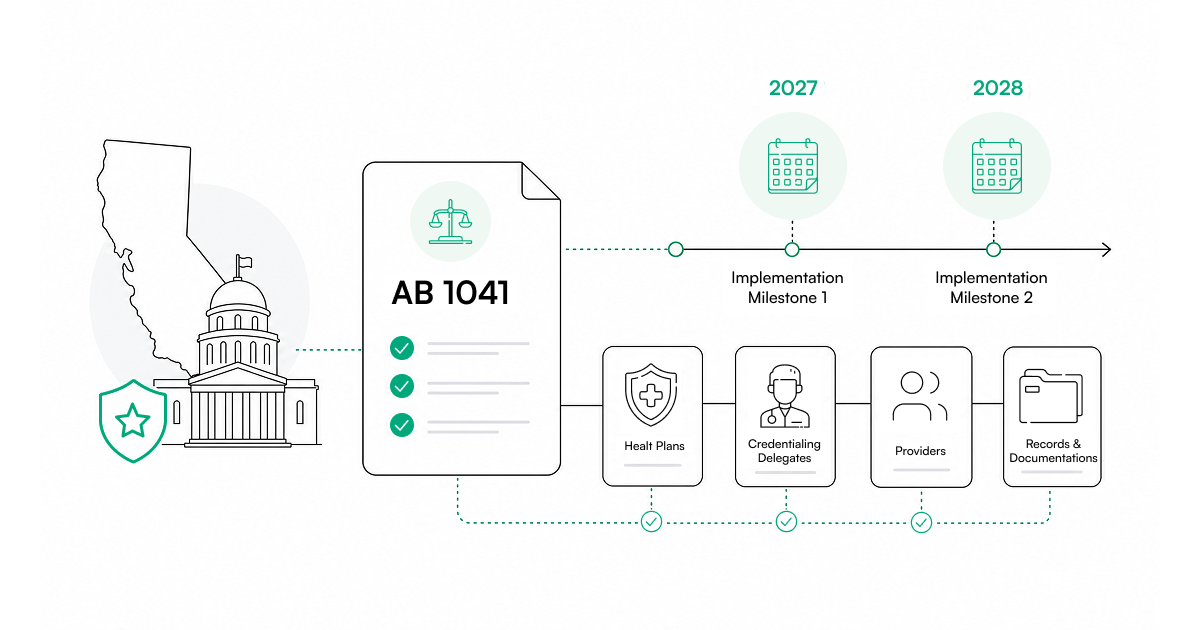
California AB 1041: What Health Plans and Credentialing Delegates Need to Know Before 2027 and 2028

Varun Krishnamurthy
September 28, 2026
This guide covers primary source verification (PSV): confirming a provider's credentials directly with the issuing body. The Joint Commission, NCQA, URAC, and CMS all require it. PSV underpins payer reimbursement, accreditation, and patient safety.
You'll learn how PSV works end to end, how to verify each credential element, how to pick the right verification method, how to document your work, and how to build a program that survives accreditation surveys and delegated credentialing audits
Every credentialed provider in your network has a chain of qualifications behind them. None of that means anything until someone confirms it directly with the body that issued it.
That confirmation is called primary source verification (PSV). It is the difference between trusting a self-reported document and proving the credential exists. It is also the foundation on which payer contracts, accreditation surveys, and patient safety policies rest.
This guide is written for credentialing managers, compliance leaders, and operations teams at enterprise health systems, multi-entity provider groups, and growth-stage digital health organizations.
Assured runs primary-source verification at scale for enterprise health systems like Houston Methodist, multi-entity provider groups operating across multiple states, and growth-stage digital health organizations.
As an NCQA-certified CVO across all 11 verification elements with direct connections to 2,000+ primary sources, the guidance here reflects how PSV operates in practice, grounded in current Joint Commission, NCQA, URAC, and CMS requirements (including the July 2025 NCQA changes).
Primary source verification is the process of confirming a provider's credentials directly with the issuing body. Instead of accepting a copy of a license or a CV, the credentialing team contacts the state medical board, the medical school, the certification body, or the federal database that actually issued the credential.
The Joint Commission defines PSV as the verification of a practitioner's reported qualifications by the source or by an approved agent of that source. NCQA and URAC use similar definitions in their respective credentialing standards.
PSV is a regulatory requirement, but the stakes are wider than that.
The exact list depends on provider type and the accreditation body involved, but a standard PSV file usually includes:
For providers with international training, additional verifications may apply, including ECFMG certification for foreign medical graduates.
Primary sources fall into a few broad categories.
State licensing boards (one per state, sometimes multiple per provider type), the DEA, the NPDB, OIG LEIE, SAM.gov, NPPES, CMS Medicare and Medicaid databases, and the Social Security Administration Death Master File.
Medical schools, residency programs, fellowship programs, the Educational Commission for Foreign Medical Graduates (ECFMG), and continuing medical education providers.
The American Board of Medical Specialties (ABMS) and its member boards, the American Osteopathic Association (AOA), the National Commission on Certification of Physician Assistants (NCCPA), and other specialty certification bodies.
Hospitals, medical staff offices, and prior clinical practices.
The Federation of State Medical Boards (FSMB), the AMA Physician Masterfile (an approved Designated Equivalent Source under Joint Commission rules), and state medical and dental councils.
Where a primary source is unavailable or impractical, accreditation bodies allow verification through a Designated Equivalent Source: a third party that maintains credential information identical to that of the primary source. Common DES options include the AMA Physician Masterfile, ABMS, ECFMG, AOA, and the FSMB Disciplinary Action Databank.
DES is not a shortcut. The Joint Commission no longer publishes a specific DES list; instead, it requires the accredited organization to determine whether the source meets its CVO criteria. NCQA and URAC each define their own approved DES list. Every use must be documented and justified in accordance with the relevant accreditation body's rules.
The PSV process is sequential, but several steps can be parallelized with the right tools.
If the provider is a foreign medical graduate, capture ECFMG certification details at this stage. The cleaner the intake, the fewer downstream verification failures.
For each credential element on the file, identify the correct primary source and the accepted method of verification.
Build a per-provider checklist. Every active state license means a separate board lookup; medical school, residency, and fellowship each need a source; board certification maps to the specific specialty board, and sanctions screening covers OIG LEIE, SAM.gov, state Medicaid exclusion lists, etc.
Contact each source through its accepted method.
Log every attempt with date, method, and status. That way, a survey trail exists even for pending verifications.
Where a primary source is unavailable or impractical, use an approved Designated Equivalent Source. Document the justification in accordance with your accreditation body's rules.
When the source confirms a credential, capture proof and document the verification with the date, source, verifier, and result.
The Joint Commission requires that documentation include who completed the verification and what was specifically verified. Files missing those elements can fail review even when the credential itself has been confirmed.
The Joint Commission and NCQA accept four methods:
A photocopy of a license is not a PSV on its own. PSV requires evidence of contact with the issuing source.
Here is how each element is typically verified in an audit-defensible way.
Contact the registrar of each educational institution the provider attended and request written verification of enrollment, degree conferred, and graduation date.
For foreign medical graduates, verify ECFMG certification through the ECFMG's Certification Verification Service.
Use ABMS Certification Matters for physicians certified through an American Board of Medical Specialties (ABMS) member board.
Run parallel checks against the OIG LEIE (List of Excluded Individuals and Entities), SAM.gov, the Medicare opt-out list, the Medicare preclusion list, every applicable state Medicaid exclusion list, and every state licensing board sanction record. Document each check with the date, the database, and the result. Any adverse finding must be escalated to a peer-review body, not resolved inside the credentialing team.
Review the provider's CV against the application. Any gap of six months or more must be explained in writing before the file goes to the committee. Under NCQA standards, CV-based documentation is typically sufficient to document the required 5 years of work history.
For Joint Commission privileging, or where your organization requires it, contact prior employers directly for written verification of dates and role. Document any gap explanation in the file.
Look up the provider's NPI in the NPPES (National Plan and Provider Enumeration System) registry. Confirm that the NPI is active, the taxonomy code matches the provider's specialty, and the address on file matches the current practice address. Capture the NPPES record as documentation. Cross-check the NPI against every state license and DEA registration to catch identity mismatches early.
PSV is governed by several overlapping bodies. Knowing which applies to your organization is the starting point for a defensible program.
The Joint Commission requires accredited organizations to perform PSV at hire and at renewal. For hospitals and critical access hospitals, the requirements are in the Human Resources and Medical Staff chapters. Other Joint Commission programs use parallel standards for behavioral health and for ambulatory care.
NCQA sets the credentialing standards used by most commercial health plans and managed care organizations. The CR 3 standard covers PSV. NCQA's standards changed substantially on July 1, 2025: the PSV window was reduced from 180 days to 120 days for Credentialing Accreditation and 90 days for CVO Certification.
NCQA also added monthly monitoring requirements for license expirations, OIG and SAM exclusions, and sanctions, with escalation to a peer-review body.
See our full breakdown of the 2025 NCQA credentialing standards updates for the operational implications.
URAC accredits health plans and CVOs against its own credentialing standards. Like NCQA, URAC requires PSV for specified credential elements and continuous monitoring between cycles. URAC accreditation is widely accepted by commercial payers as evidence of credentialing rigor.
The Centers for Medicare and Medicaid Services requires PSV for providers participating in Medicare and Medicaid programs. Federal regulations under 42 CFR govern revalidation cycles and exclusion screening.
State medical boards are the primary source for medical licensure. They also impose their own verification rules, especially for providers practicing across multiple states or under interstate compacts like the Interstate Medical Licensure Compact (IMLC).
Under accreditation rules, the accredited organization is responsible for PSV, not the provider. That responsibility cannot be transferred to the provider, even when the provider has a complete CAQH profile or maintains their own credential file.
In practice, day-to-day execution falls to one of three setups.
Medical staff services at enterprise health systems, credentialing managers at multi-entity provider groups, and operations leaders or credentialing coordinators at growth-stage digital health organizations may form an in-house credentialing team. This setup works well when volumes are predictable and the team is staffed accordingly.
A CVO is a specialized partner that performs PSV on behalf of the accredited organization. NCQA-certified CVOs operate under defined standards and can be certified across all 11 NCQA evaluation elements.
Health plans seeking NCQA Health Plan Accreditation can receive automatic credit for verification work performed by an NCQA-certified CVO, thereby simplifying delegation and reducing the audit scope.
Larger provider organizations can sign delegated credentialing agreements with health plans. The provider organization (or its CVO partner) performs the verification on behalf of the plan.
Delegation requires an NCQA-aligned program, audit-ready documentation, and annual oversight reviews. For more on this, see our guide to building a delegation-ready credentialing program.
Regardless of structure, accountability stays with the accredited organization. Outsourcing the work does not outsource the responsibility, which is why oversight, audit trails, and documentation matter as much as the verifications themselves.
PSV is not a one-time event. NCQA, The Joint Commission, and URAC all require recredentialing on a defined cycle (typically every 36 months for NCQA). Every recredentialing cycle requires a fresh PSV for the relevant elements.
Between cycles, organizations also have to continuously monitor credentials, which is where network management workflows take over from the initial credentialing process. Under the 2025 NCQA standards, monthly monitoring is required for:
Findings must be escalated to a peer-review body and not handled within the credentialing team. This shift from periodic checks to continuous monitoring is one of the most significant operational changes credentialing teams have undergone in the last decade.
For a deeper walkthrough of recredentialing requirements, see our guide.
Most PSV failures come from the same handful of patterns.
Manual PSV breaks at scale. Modern programs rely on two layers: automation that handles verification and expert support that resolves what automation cannot.
A purpose-built credentialing platform connects directly to primary sources and runs verification in parallel. For most credential elements, this collapses what was once a multi-week manual process into a same-day digital exchange. The strongest platforms also:
Automation handles the predictable work. Managed services handle the edge cases. For example, a school that does not appear in the National Student Clearinghouse, a state board with a unique verification process, a CAQH profile with stale data, or a payer-specific submission that needs a phone call.
The right managed services partner has subject matter experts across credentialing, licensing, and payer enrollment, weekly check-ins with the customer team, and a shared communication channel for escalations.
Assured is an AI-native credentialing platform built for enterprise health systems like Houston Methodist, multi-entity provider groups operating across many states, and growth-stage digital health organizations. The platform runs PSV across 2,000+ primary sources in parallel, automatically pulls provider data from CAQH, and validates submissions before they go out. Assured is an NCQA-certified CVO across all 11 verification elements, which means delegated credentialing partners can rely on Assured's PSV work without re-verification.
A few specifics:
Customers, including Tono Health, Blossom Health, Prosper Health, Birches Health, and Platinum Dermatology Partners, use Assured to scale credentialing across multiple states and provider types without adding internal headcount.
For a deeper comparison of manual and automated approaches, see our breakdown of manual vs. automated PSV.
.png)
A defensible PSV program shares a few common attributes:
The goal is a program that withstands a survey, a delegated credentialing audit, and a regulator's question without requiring file rebuilds after the fact.
Primary source verification is one of the highest-leverage controls in healthcare operations. Done well, it protects patients, defends revenue, and clears the path to in-network status. Done poorly, it stalls billing, creates audit risk, and exposes the organization to liability.
For enterprise health systems, multi-entity provider groups, and growth-stage digital health organizations running PSV at volume, the right combination of automation and managed expertise is the difference between a defensible program and one that is constantly catching up.
Book a demo to see how Assured runs PSV across 2,000+ primary sources, with NCQA-certified coverage across all 11 verification elements.

Assured Health, Inc.
333 Seventh Ave, Suite 1701
New York, NY 10001


.svg)