

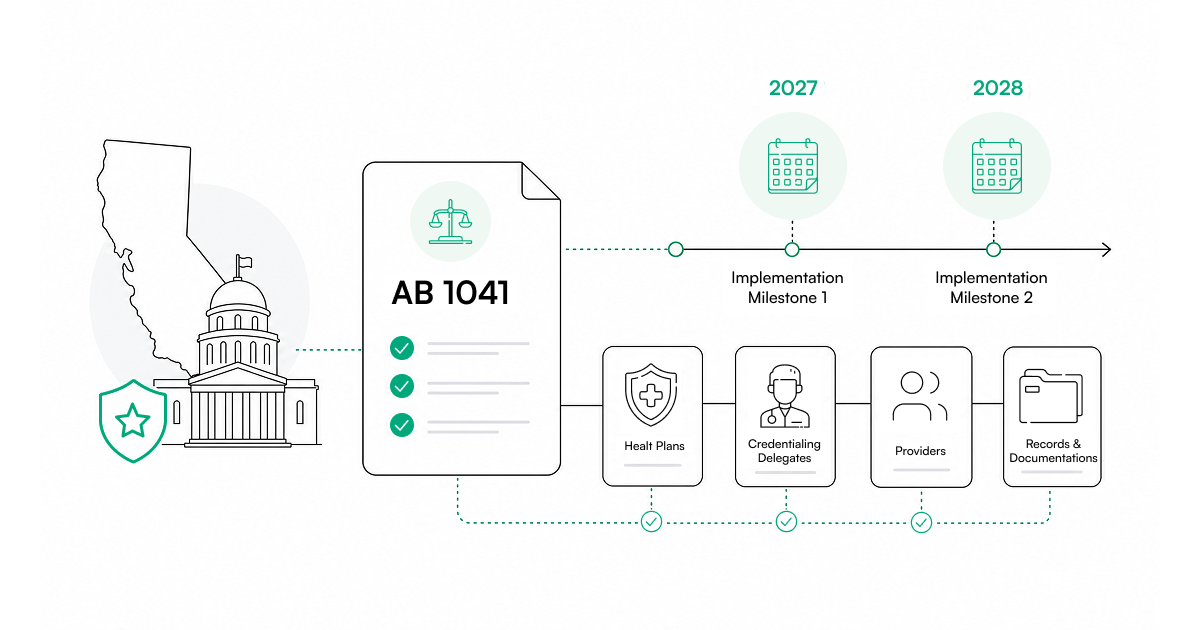
California AB 1041: What Health Plans and Credentialing Delegates Need to Know Before 2027 and 2028

Varun Krishnamurthy
September 19, 2026

Delegated credentialing is a formal agreement between a payor and a provider organization. The payor authorizes the organization to credential its own clinicians. Providers get into networks within weeks, not months. Organizations submit rosters in bulk instead of one application at a time. To qualify, you typically need 100 or more providers. NCQA-aligned policies, a credentialing committee, and ongoing monitoring are also required. It is a core capability for enterprise health systems and growth-stage organizations alike.
Have you ever tried to hand off credentialing tasks only to end up double-checking everything?
One missing document, one unclear responsibility, or one undocumented step can slow approvals, trigger compliance issues, or create rework you did not plan for.
The truth is that delegation only works when your credentialing program is built for it. That means clear workflows, documented requirements, defined ownership, and systems that do not rely on tribal knowledge to function.
In this guide, we walk through how to build a credentialing program your team can run without micromanagement. You will learn how to structure your processes, set expectations, and create repeatable, scalable systems.
Assured is an NCQA-certified Credentials Verification Organization. We are certified across all 11 verification elements, not a subset. We support delegated credentialing for enterprise health systems and growth-stage organizations. Houston Methodist, Platinum Dermatology Partners, Blossom Health, and Birches Health work with us.
Our co-founders built and scaled a multi-state provider network before starting Assured. They lived the credentialing problem firsthand. That experience shaped how the platform works. It also shaped how we support clients through audits, delegation requests, and ongoing oversight.

Delegated credentialing is when a healthcare organization is authorized to credential its own providers instead of submitting individual applications to each payor. Rather than repeating the same paperwork across payors, the organization follows an approved process that payors trust and accept. Once delegation is granted, the organization credentials providers internally and submits them as complete, verified files.
Delegated credentialing reduces provider activation timelines, cuts administrative costs, and simplifies roster submissions compared to one-off applications. Providers get credentialed faster, teams spend less time chasing documents, and payors receive more consistent submissions.
Underneath the benefits is a specific structure with defined roles. Delegated credentialing involves two parties. The payor is called the delegating entity. The provider organization is called the delegated entity.
The payor grants formal authority to credential providers on its behalf. That authority is established through a Delegated Credentialing Agreement. The agreement defines roles, responsibilities, and oversight expectations on both sides.
The delegated entity takes on the credentialing work. This includes primary source verification, committee review, and ongoing monitoring. Every step must follow NCQA standards or equivalent payor-approved standards. The payor retains the right to audit at any time. It also retains the right to terminate the agreement if performance slips.
What changes operationally is how providers reach in-network status. Without delegation, every payor credentials every provider individually. Each application moves through that payor's own review queue.
This shifts the work from one-by-one applications to bulk operations. It also shifts where the bottleneck sits. Activation no longer depends on per-provider payor review cycles. It depends on how well the provider organization runs its own credentialing program.
When that internal program runs well, the benefits are significant. Delegated credentialing solves problems that one-off applications cannot.
The size of the impact depends on the payor mix and provider volume. Larger organizations with multi-state operations see the biggest returns.
Getting to that point follows a clear sequence. Most organizations move through five stages.
Before approaching any payor, confirm the basics. You need formal policies, a credentialing committee, primary source verification, and ongoing monitoring. You also need at least three months of committee meeting minutes. Payors will ask for these in the audit package.
Not every payor is ready to delegate to you on day one. Start with payors where you have meaningful provider volume. Larger commercial plans often have established delegation pathways. Some Medicaid managed care organizations also offer delegation. Map your top contracts and rank them by likelihood of approval.
The request introduces your organization and your credentialing program. It typically includes a program overview. It also includes your committee structure and a description of your monitoring systems. If you work with a Credentials Verification Organization, the request describes that relationship. It should also explain the oversight in place.
This is the gating step.
Some payors ask for documentation of any sub-delegation arrangements. Larger payors sometimes send auditors on-site. Others run the audit entirely remotely. Either way, the standards are the same. Most audits take four to eight weeks to complete. Findings come in writing and require a remediation response within a defined window.
Once the audit passes, both sides sign a formal agreement. The agreement defines reporting cadence, roster submission timing, audit rights, and termination terms. Some agreements name specific committees and reporting deadlines. Read the agreement carefully before signing. Small differences here can affect the ongoing reporting load. From that point forward, providers move through your credentialing process. You then submit them to the payor on the agreed roster cadence.
The full timeline usually runs six to twelve months per payor. Organizations with mature programs often compress that significantly. Working with a Credentials Verification Organization can also shorten the timeline. That happens when the infrastructure and audit discipline already exist on the partner side. The organization keeps committee authority. The CVO carries the operational load.
Assured was built to carry that operational load. We work with enterprise health systems and growth-stage organizations on the same platform. Both buyer types share the same underlying needs.
That coverage matters when payors evaluate your CVO during their audit.
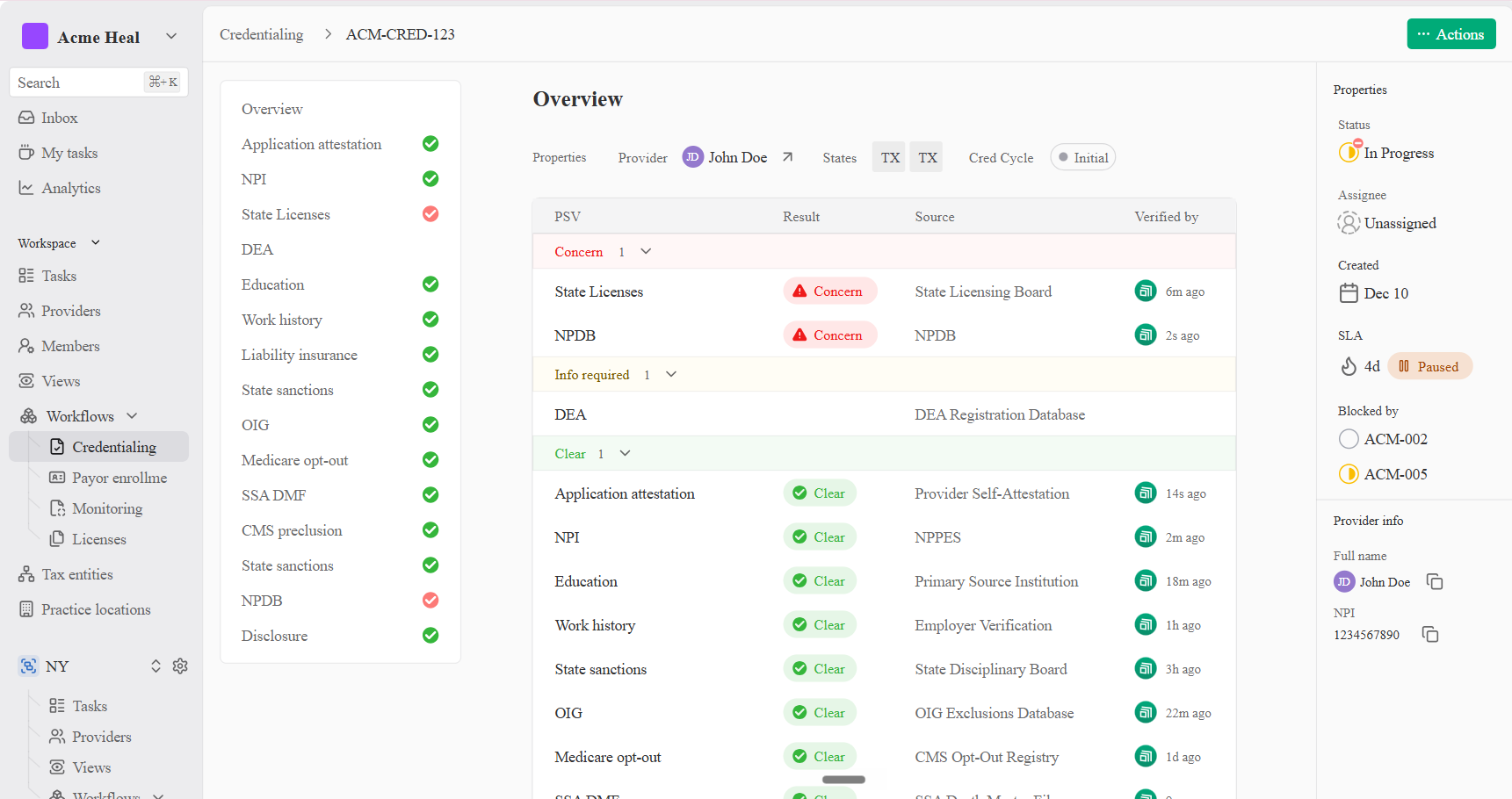
Every check returns dated evidence and a screenshot. Verifications run in parallel, not one after another. That keeps the turnaround predictable even at high volume.
Every action sits inside a tracked timeline. When a payor asks how a verification was completed, the timeline shows how it was completed. That removes the back-and-forth that slows audits.
Our team members are full-time employees, not subcontractors. We also maintain onshore staffing for payors that require it. That stability matters when payors audit the people behind your file.
We have never failed a delegation audit. No corrective action plans are on record. That history reduces risk for organizations relying on our CVO certification.
If you are not yet delegation-ready, we help you get there. That includes policies, procedures, committee setup, and meeting minute templates. That work often shortens the delegation timeline by months.
Your credentialing committee keeps decision authority. Assured runs verifications, monitoring, and documentation. Roster submissions and follow-ups also stay with us.
Whether your organization is ready for that handoff depends on a few specific signals.
Delegated credentialing is not something organizations pursue overnight. It is a capability built as scale and complexity increase. Three common indicators signal readiness.
You should consider delegated credentialing if you have:
Scale matters: If you manage 100 or more practitioners, many payors begin to view you as a credible candidate for delegation. At that size, handling individual credentialing files, verifications, and submissions becomes time-consuming and expensive. Delegation centralizes that work and reduces repetition.
Operational complexity matters: When providers are licensed in multiple states, credentialing volume multiplies quickly. Each state introduces its own timelines, renewal cycles, and verification requirements. Without standardized processes, teams end up reacting instead of planning. Delegated credentialing introduces consistency and control.
Payor mix matters: Organizations contracted with five or more payors benefit most from delegation. Instead of tailoring submissions to each payor, the organization uses a single, approved credentialing system.
Starting early is critical. Delegation contracts typically take six to twelve months to complete, including audits, policy reviews, and operational assessments. Building readiness before credentialing becomes a bottleneck puts organizations in a stronger position to scale without delays.
If payors are going to trust your organization with delegated credentialing, your program must look and operate like theirs. That means having the right structure, documentation, and controls in place before applying.
There are five core components payors expect to see.
A delegation-ready program starts with clear, written policies and procedures. Payors expect documented standards aligned with NCQA, CMS, and applicable state regulations. These policies must clearly define how credentialing works inside your organization, including application processing, verification standards, approval criteria, provider appeals, timelines, roles, and escalation paths.
The goal is consistency. If two credentialing specialists handle the same provider file, they should reach the same outcome using the same rules. Payors review these documents closely during delegation audits to ensure proof that your process is structured, repeatable, and compliant.
Payors require a formal credentialing committee with documented authority and oversight.
The committee is responsible for reviewing completed files and making final credentialing decisions. It typically includes a licensed physician (MD or DO) and, at a minimum, a compliance or quality leader. Some organizations also include legal or operations leadership, depending on size and risk profile.
The committee must meet at least monthly, and those meetings must be documented. Agendas, attendance, voting outcomes, and rationale for approvals or denials all matter. From a payor's perspective, this committee serves as a safeguard to ensure credentialing decisions are not rushed, biased, or inconsistent.
Primary Source Verification is one of the most important and heavily audited parts of delegated credentialing. Payors are explicit on this point: self-reported information is not sufficient.
Organizations must verify credentials directly from the original source. This includes:
Every verification must be dated, sourced, and retained in accordance with the documentation requirements. Missing or expired PSV evidence is one of the most common reasons delegation applications fail.
This is also where scale becomes challenging. Managing PSV across dozens or hundreds of providers quickly turns into a data problem. Platforms like Assured, which handle PSV across 2,000+ primary sources, are designed to support this volume without sacrificing accuracy or audit readiness.
Delegated credentialing does not stop once a provider is approved. Payors expect continuous monitoring to identify issues in real time.
At a minimum, this includes ongoing sanctions monitoring across OIG, SAM, NPDB, and state exclusion lists, as well as active tracking of license and certification expirations. Most payors require monthly monitoring logs that document when checks were performed and what actions were taken if issues were identified.
This system protects both the payor and the organization. If a provider becomes excluded or a license lapses, delays in detection create immediate compliance exposure. Effective monitoring demonstrates that the organization is actively managing risk, not just credentialing providers.
Payors also require a formal re-credentialing process, typically every 36 months in line with NCQA standards. All primary sources must be re-verified, current performance and history reviewed, and the provider file presented back to the credentialing committee for approval. Documentation standards are just as strict as during initial credentialing.
Organizations that underestimate re-credentialing often struggle after delegation is granted. Without a structured process, files pile up, and deadlines are missed. A delegation-ready program plans for re-credentialing with clear timelines, ownership, and tracking built into daily operations.
Together, these five components form the foundation that payors use to evaluate delegation readiness. If even one is weak or informal, securing approval becomes significantly harder.
A delegation-ready credentialing program must include:
Before granting delegated credentialing authority, payors conduct a pre-delegation audit to confirm your program operates consistently, complies with regulations, and maintains complete documentation. Passing this audit is essential.
Provide a program overview highlighting policies, committee structure, monitoring systems, and oversight of any sub-delegated entities.
Payors evaluate written standards to confirm alignment with NCQA, CMS, and state requirements.
Submit a committee roster and at least three months of meeting minutes showing attendance, voting outcomes, and decision rationale.
Payors review a sample of provider files to confirm that PSV documentation is complete and current.
Provide monthly monitoring logs and evidence of corrective actions. If a CVO is involved, payors verify that oversight procedures are in place.
Payors issue a pass/fail determination and execute a Delegated Credentialing Agreement if the requirements are met.
Payors do not delegate credentialing based on promises. They look for proof that a program already works.
Draft formal policies and procedures, establish the credentialing committee, and define authority and meeting cadence.
Implement PSV workflows, set up ongoing monitoring, and standardize provider file templates.
Begin credentialing providers under the new program and hold documented committee meetings.
Accumulate at least three months of committee history, assemble provider file samples, and conduct internal audits.
Submit delegation requests, complete pre-delegation audits, remediate findings, and negotiate delegation agreements.
Partnering with a Credentialing Verification Organization can shorten this timeline. In many cases, what takes six to twelve months internally can be compressed into weeks because the infrastructure and audit discipline are already in place.
Delegation is an ongoing operational commitment.
Delegation failures most often stem from documentation gaps or process drift, including:
Treating audit readiness as part of daily operations is the most reliable way to avoid these issues.
Once you decide to pursue delegation, the next decision is how to execute.
Build in-house: if you have experienced credentialing staff, internal tools, and sufficient time to reach operational maturity.
Partner with a CVO: if speed, efficiency, and reduced operational burden are priorities and internal expertise is limited.
Use a hybrid model: if you want to retain credentialing committee authority while outsourcing PSV, monitoring, and documentation discipline to a partner like Assured.
The right choice depends on readiness, resources, and timelines.
If you are preparing for delegated credentialing and want support with Primary Source Verification, monitoring, and audit-ready documentation, talk to our team.

Assured Health, Inc.
333 Seventh Ave, Suite 1701
New York, NY 10001



.svg)