
Symplr vs MD-Staff vs Assured: Which Credentialing Platform Actually Works in 2026?

Quick Summary
Every day a provider sits credentialed but not enrolled is a day of lost billing. Traditional credentialing takes 60 to 120 days, and payer enrollment can drag on for months. We compared the three most-named platforms - Symplr Provider, MD-Staff, and Assured across speed, payer enrollment depth, AI, and verified user reviews.
The short version: Symplr and MD-Staff are built for hospital medical staff offices; Assured works across organization types across outpatient and digital health teams to health systems with credentialing completed in 48 hours and ~95%+ first-pass payer enrollment approvals..
Why Are Teams Looking For An Alternative?
Teams arriving at this comparison usually fall into one of three camps. The first is a pattern we hear commonly about Symplr’s support quality that has declined since the Cactus acquisition. It is followed by slow implementations and payer enrollment that hasn't kept pace with credentialing.
The second is on MD-Staff,where the privileging module is excellent and enrollment isn’t a core focus. And the team needs a solution built around time-to-billing across states.
The third camp is an enterprise health system, digital health, outpatient, DSO, or MSO operator looking at hospital-built platforms and finding that the workflows don’t align with how they onboard providers in 2026.
Symplr and MD-Staff are established and respected products designed specifically for hospital medical staff offices. However, they may not fully meet a broader set of needs that show up across both enterprise health systems and growth-stage organizations - multi-state licensing, simultaneous payer submissions, continuous monitoring with a single data model, and customer support not managed through a ticketing system.
This suggests an opportunity for a purpose-built solution to address these specific requirements.
Assured was built for that gap. The rest of this guide breaks down where each platform wins, where each falls short, and which one fits how your organization actually credentials, enrolls, and bills.
Why Listen To Us
Assured is NCQA-certified across all 11 verification elements and is used by organizations such as Houston Methodist, Tono Health (31 states), Blossom Health, Birches Health (40 states), and Prosper Health. We’ve spent the past three years talking to teams coming off Symplr, MD-Staff, Medallion, and in-house spreadsheet setups, and we’ve migrated dozens of them. The comparisons below are grounded in that experience, vendor documentation, and verified user reviews.
Symplr Provider: Pros and Cons
What Symplr does well
Symplr’s strongest asset is depth. It’s built for enterprise hospital environments where privileging, committee review, and performance data need to live in one system, and it delivers at scale.
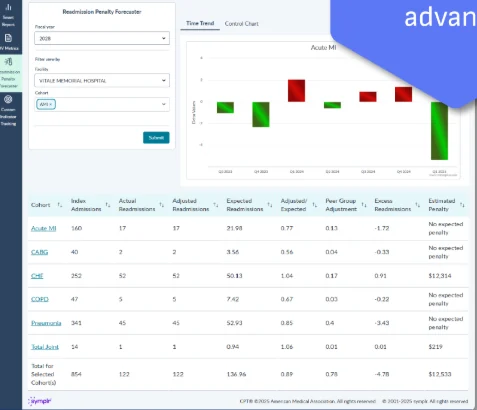
- Privileging library: Has 9,600+ delineated privileges with embedded ICD/CPT codes, developed with content from over 40 trusted sources.
- Native integrations: Peer review, OPPE, FPPE, and privileging data connect natively, supporting committee review and performance improvement workflows without manual handoffs.
- Battle-tested: Symplr Provider has been in the market for decades with solutions trusted by 9 out of 10 U.S. hospitals and health systems.
- Compliance features: Audit trails, expiration tracking, and configurable alerts are mature and designed to meet enterprise audit requirements.
- NCQA-accredited and certified CVO: The CVO service covers all 11 NCQA verification elements and supports delegated credentialing audits.
- Efficiency claims: Workflows shorten credentialing timelines by up to 60%, committee review times by up to 50%, and the CVO service reduces overall credentialing turnaround by up to 75%.
Where Symplr struggles
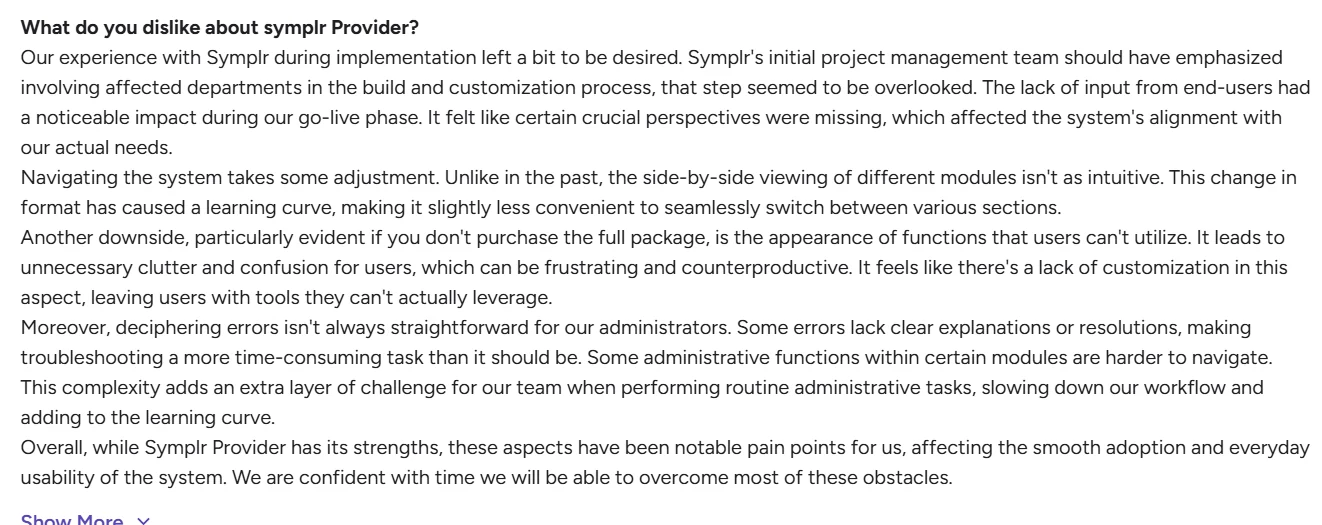
That said, reviewer feedback across G2, Capterra, and GetApp points to consistent friction: slow support, a cluttered interface, persistent bugs, complex reporting, and implementation that puts data clean-up on the customer.
- Support & expertise: Response times and product knowledge have declined since the Cactus acquisition, per multiple reviewers.
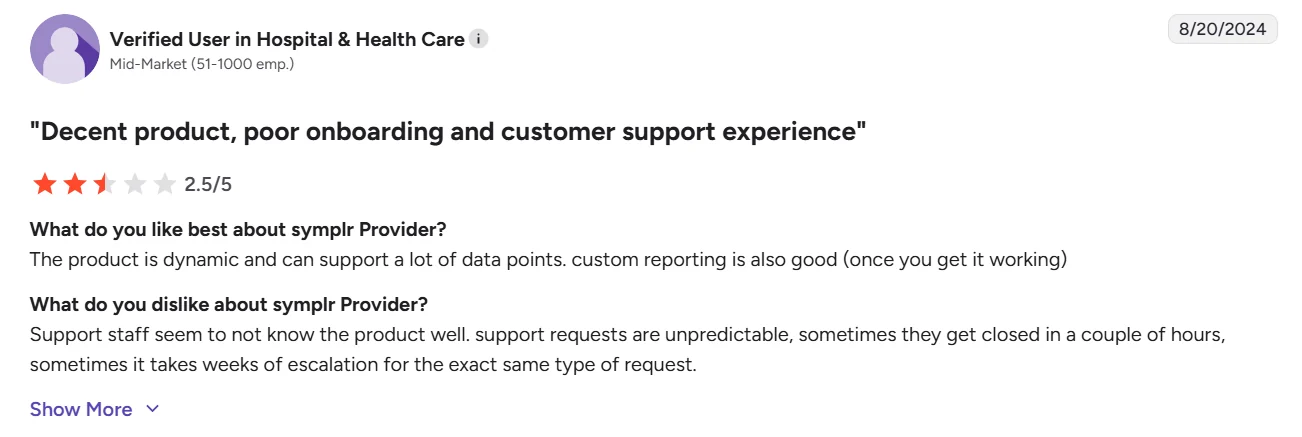
- Interface: Too many clicks, cluttered navigation, and bugs that take time to resolve.
- Implementation: Data migration burden falls heavily on the customer.
- Payer enrollment depth: CAQH management, task routing, and roster generation are present, but auto-fill, parallel portal submissions, and active follow-up on stalled applications are not core to the platform.
For outpatient and digital health organizations, that last point matters most. Symplr’s enrollment features are built for hospital workflows, not for compressing time-to-billing across multiple payers and states.
For a fuller breakdown, see our Symplr alternatives guide.
MD-Staff: Pros and Cons
What MD-Staff does well
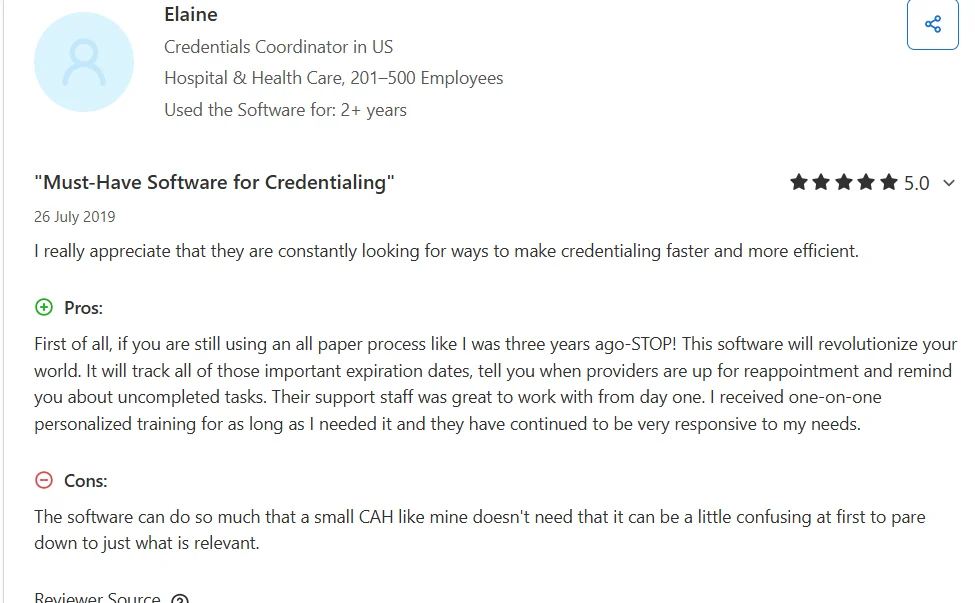
MD-Staff has earned Best in KLAS for credentialing six consecutive years (2021–2026). It is the clearest third-party signal that hospital credentialing teams consistently rate it above every competitor.
- Privileging module: Drag-and-drop interface for building core and laundry-list privilege forms. It is widely regarded as the strongest in the market, simple enough for new coordinators.
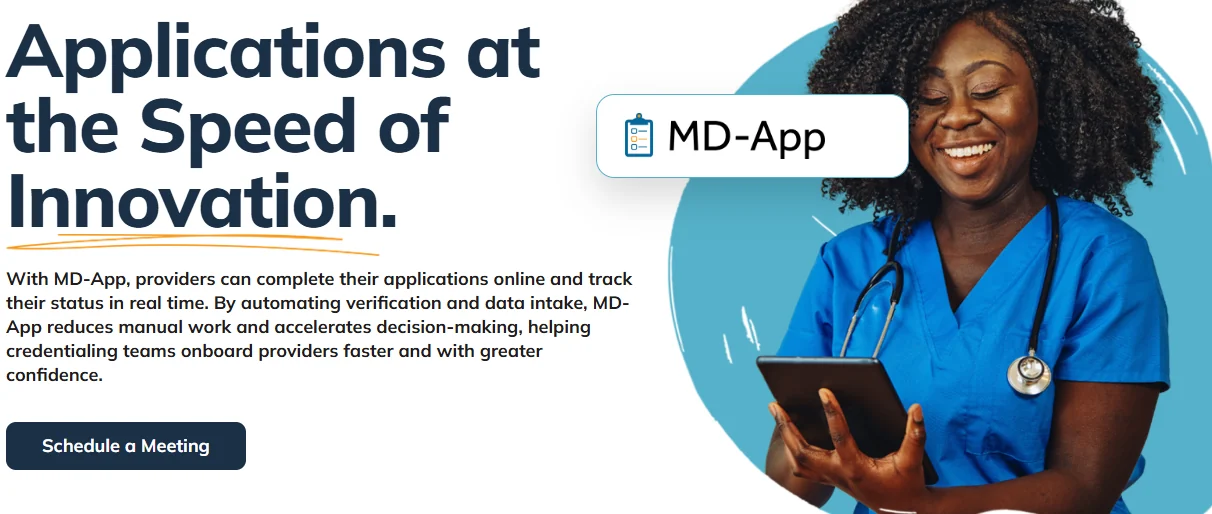
- MD-App: Provider-facing portal for completing applications, uploading documents, and checking status online.
- PSV automation: Integrates with Aiva Credentialing for automated primary source verification, with direct connections to NPDB, OIG, SAM, AMA, and state licensing boards.
- Scale: Used by 3,000+ facilities across both small community hospitals and large health systems.
- Customer support: Consistently praised on G2 and Capterra for personalized training, responsive help desk, and long-tenured account teams.
- Integrations: Supports EHR, HRIS, payroll, and DocuSign, with OPPE and FPPE reporting through MD-Stat.
Where MD-Staff struggles
MD-Staff's deepest strengths include privileging, peer review, and hospital compliance. For outpatient and digital health organizations whose bottleneck is payer enrollment across multiple states, that's a meaningful gap.
- Enrollment as a module, not a core workflow: The Managed Care/Enrollment module offers automation and tracking, but payer enrollment isn't the product's primary focus. Auto-filled applications, parallel portal submissions, and proactive follow-up cadences are not where MD-Staff is built to compete.
- Customization: Highly specific workflows may require additional development work beyond the base platform.
- Learning curve: MD-Staff offers its own certification program. It can be useful, but also a signal of platform complexity.

- Pricing: Quote-based and can be a constraint for smaller or growth-stage organizations.
A credentialed provider who isn’t enrolled with payers can’t bill. Platforms where payer enrollment is the primary workflow close that gap faster.
For a deeper breakdown, see our MD-Staff alternatives guide.
Assured: Pros and Customer Proof
Assured was built from the ground up as an AI-native platform where AI does the work, not just the tracking. CAQH profiles auto-import, PSV runs in parallel across 2,000+ sources, payer applications are auto-filled, and browser-agent automation removes portal copy-paste work.
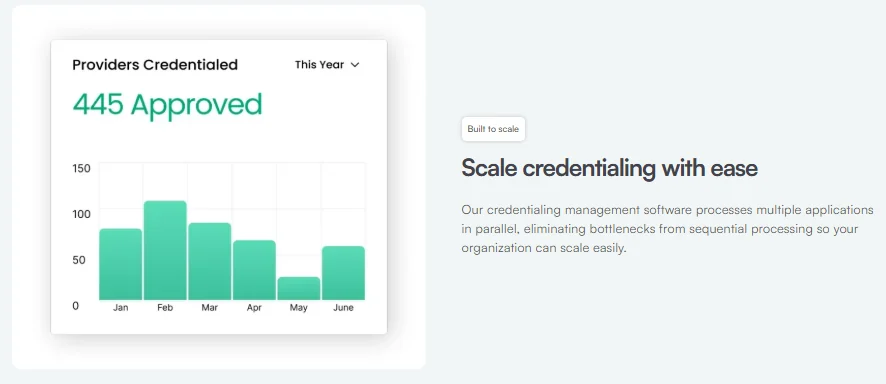
- 48-hour credentialing: Customers report that credentialing files are ready in 48 hours, compared with the 60–120-day industry standard.
- 95%+ first-pass approval rates: Pre-submission validation catches data mismatches, closed panels, and missing documentation before applications go out.
- 30% faster in-network: Providers reach in-network status roughly 30% faster than the industry average.
- Full-stack, one data model: Credentialing, licensing (all 50 states plus IMLC), payer enrollment, and continuous network monitoring run in one system.
- NCQA-certified CVO across all 11 verification elements: Meets payer audit requirements for delegated credentialing. Check the financial impact with our Delegated Credentialing Calculator.
- Dedicated support: Every customer gets a named specialist and not a ticket queue. Also, with sub-24-hour response times and most answers within 1-2 hours.
What customers say
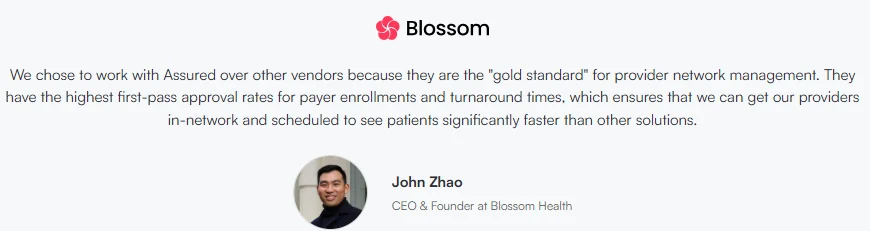
John Zhao, CEO & Founder at Blossom Health: "We chose to work with Assured over other vendors because they are the gold standard for provider network management. They have the highest first-pass approval rates for payer enrollments and turnaround times."
Bryson Tombridge, CEO & Co-founder at Tono Health: "Expanding our dermatology network into 31 states created a mountain of licensing and payer enrollment work. Assured streamlined the entire process on one platform. Now our board-certified dermatologists are credentialed and in-network within weeks instead of months."
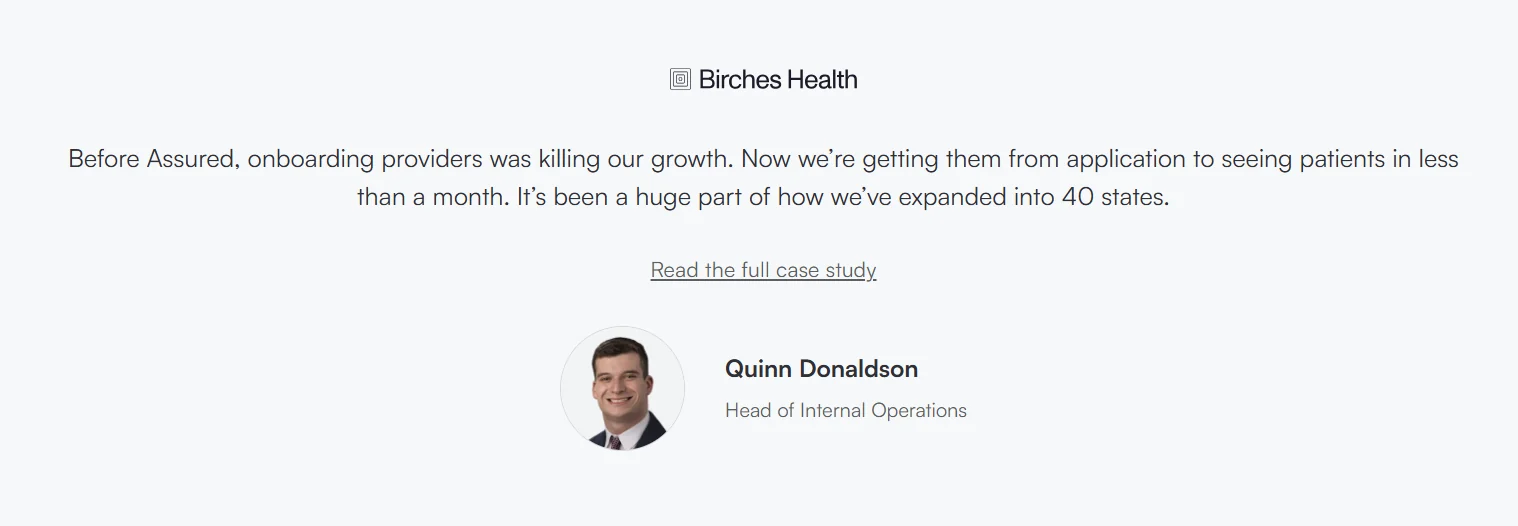
Quinn Donaldson, Head of Internal Operations at Birches Health: "Before Assured, onboarding providers was killing our growth. Now we're getting them from application to seeing patients in less than a month. It's been a huge part of how we've expanded into 40 states."
Three-Way Side-by-Side Comparison
How to Choose: The Decision Framework
Before signing with any of the three, answer these five questions:
Where does your revenue actually get stuck?
If the bottleneck is privileging, lean Symplr or MD-Staff. If credentialing is fine, but providers sit for weeks waiting to get in-network, and no one is following up on stalled applications, Assured is built for that.
How fast do new providers need to bill?
Symplr and MD-Staff can get you to a signed credentialing packet; translating that into billing depends on internal enrollment staffing. Assured commits to credentialing files in <48 hours and enrollment submissions within 72 hours of intake, with the two workflows running in parallel.
How much internal credentialing expertise do you have?
Symplr and MD-Staff assume a trained medical staff services team. Assured is built for enterprise teams that want to augment an existing credentialing department, and for growth-stage organizations that don’t want to staff one up.
What's the total cost of ownership?
Implementation fees, module-by-module pricing, API access charges, and IT overhead quietly add up. Assured's usage-based pricing scales with provider volume.
Are you running just credentialing, or do you also need licensing, payer enrollment, and ongoing monitoring?
Symplr and MD-Staff are credentialing-and-privileging platforms first; payer enrollment and licensing live in adjacent modules. If you need all four (credentialing, licensing, payer enrollment, and ongoing monitoring) running on one data model, Assured is the only one of the three built that way end-to-end.
The bottom line
Symplr fits large multi-facility health systems (300+ providers) where committee review, OPPE/FPPE, and a 9,600+ privilege library are core to how you operate. MD-Staff fits hospitals where privileging is the dominant workflow and Best-in-KLAS support matters more than payer enrollment depth. Assured fits enterprise health systems and growth-stage organizations credentialing providers across many states or entities, where revenue is measured in time-to-billing, ~95%+ first-pass payer approvals are the bar, and a dedicated specialist beats a ticket queue.
Conclusion
Symplr and MD-Staff are the right call for hospitals whose bottleneck is privileging and committee review. But if you're scaling providers across states and your revenue is stuck behind slow credentialing and payer enrollment, you need a platform built for exactly that problem.
See demo. In 20 minutes, we’ll show the AI submitting to a real payer portal and what your time-to-billing looks like at 48-hour credentialing
1. Is Symplr better than MD-Staff?
2. What's the best credentialing software for digital health companies?
3. How long does credentialing actually take with Symplr, MD-Staff, or Assured?
4. Which platform handles payer enrollment best?

Assured Health, Inc.
333 Seventh Ave, Suite 1701
New York, NY 10001