The 8 Best Physician Onboarding Software Tools in 2026
Rahul Shivkumar
Updated
October 1, 2026
Published
July 15, 2026
Quick Summary
Many health systems still run 20-week physician onboarding cycles. At roughly $8,000–$9,000 per provider per day in lost billing, that's over $100,000 in unrealized revenue before a new hire sees their first patient. We compared 8 physician onboarding platforms on credentialing speed, first-pass rates, privileging depth, and payer enrollment to help you find one that actually shortens that cycle. Our top three:
Large hospital systems needing credentialing within a broader GRC suite
9,600+ delineated privileges library for hospital privileging
MD-Staff
Hospitals and mid-to-large health systems wanting modular credentialing
Best in KLAS for Credentialing 6 consecutive years (2021–2026)
How These 8 Tools Actually Differ
Most physician onboarding listicles treat these platforms as interchangeable. They aren't. The 8 below split across three very different jobs: credentialing and payer enrollment execution, hospital privileging tied to OPPE/FPPE committees, and continuous compliance monitoring. A handful attempt all three. None do all three well.
Picking the right one starts with knowing which job is actually slowing you down. The rest of this comparison is built around that.
Why Listen to Us
We built Assured after scaling Dawn Health’s provider network from 0 to 150+ clinicians across 15 states and living every credentialing bottleneck ourselves. Today we’re an NCQA-certified CVO working with enterprise health systems like Houston Methodist, multi-entity provider groups operating across many states, and digital health organizations nationwide. We know the tools, the gaps, and what actually compresses time-to-first-patient.
Side-by-Side Comparison of All 8 Tools
Here's how the 8 platforms compare at a glance before we go deep on each one:
Continuous exclusion monitoring across 46+ federal and state sources
Orgs prioritizing compliance monitoring
The 8 Best Physician Onboarding Software Tools
1. Assured — AI-native physician onboarding for enterprise health systems and growth-stage organizations
Best for: Enterprise health systems and growth-stage organizations onboarding physicians at scale
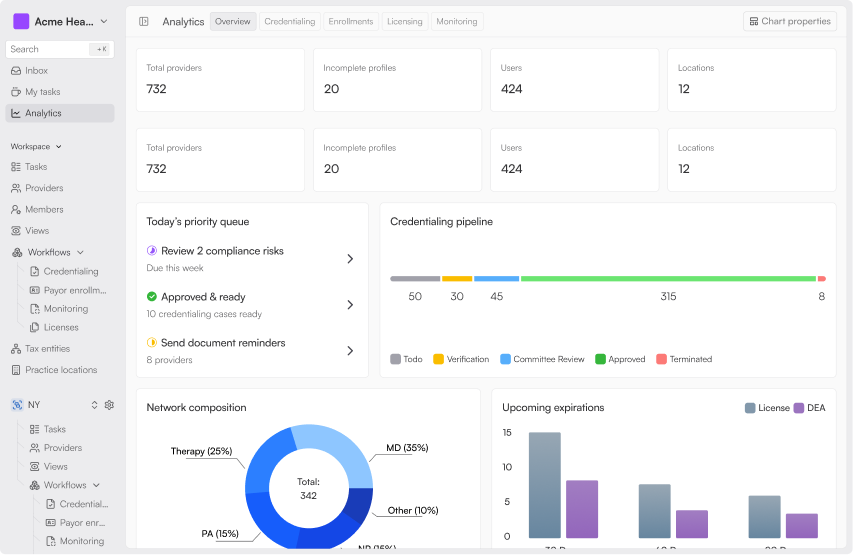
We built Assured for the part of physician onboarding that takes the longest and loses the most revenue: credentialing, payer enrollment, and multi-state licensing. Our AI runs primary source verification across 2,000+ sources, auto-fills payer-specific applications, and pre-validates every submission.
The result is credentialing files in 48 hours (not 60 to 120 days) and enrollment applications submitted within 72 hours of handoff.
Our AI catches data mismatches, specialty conflicts, and closed panels before an application goes out, which is why our customers see ~95%+ first-pass approvals. Every rejection adds two to four weeks to the timeline, so that number is where the real compounding savings live.
John Zhao, co-founder of an AI-native psychiatry platform and an Assured customer, put it this way: "It's the gold standard of what a vendor-customer relationship should look like." He rates us 9 out of 10 overall.
Key Features
Automated PSV: Parallel verification across 2,000+ primary sources, completing credentialing files in <48 hours
Payer enrollment execution: Applications submitted within 72 hours with automated follow-up until in-network
Multi-state licensing: Managed across all 50 states, with IMLC eligibility and auto-initiated renewals
NCQA-certified CVO: Certified across all 11 verification elements for delegated credentialing
Pros
Fastest published credentialing turnaround at 48 hours, vs. the 60 to 120-day standard
95%+ first-pass approval rates that cut the rework cycle, adding weeks to every rejection
Full-stack platform covering credentialing, payer enrollment, and multi-state licensing in one system
All fulfillment staff are direct Assured employees, not BPO subcontractors
Usage-based pricing that scales with provider volume
Cons
Newer to market than legacy hospital-focused incumbents
Best for: Hospitals invested in the Symplr workforce management suite needing credentialing, privileging, and enrollment in one GRC platform
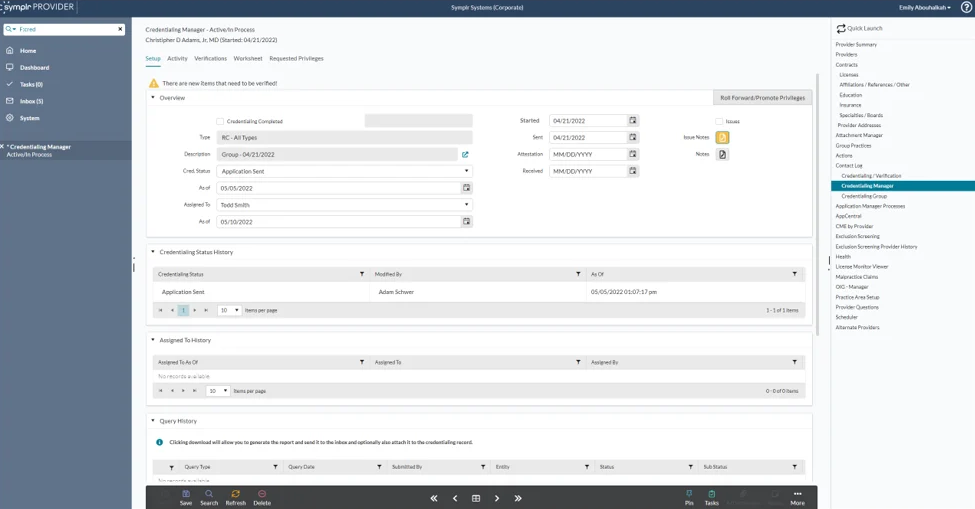
Symplr is the legacy enterprise player in hospital credentialing, built on the Cactus Software platform, which it acquired in 2016. Symplr Provider covers PSV, credentialing, privileging, enrollment tracking, and OPPE/FPPE in one system.
Key Features
Full provider lifecycle: Credentialing, privileging, enrollment, and performance monitoring in one system
9,600+ privileges library: Industry-leading depth with embedded ICD/CPT codes
OPPE/FPPE integration: Performance data tied to privilege renewals
Downstream integration: Connects with EHR, HRIS, and billing platforms
Pros
Broadest GRC suite in the category
Long track record with large hospital systems and AMCs
Built for legacy hospital workflows, not modern AI-native physician onboarding
Pricing
Custom enterprise pricing based on size and modules.
3. HealthStream CredentialStream — Unified credentialing, privileging, and enrollment
Best for: Hospitals invested in HealthStream’s broader platform ecosystem needing credentialing integrated with EHR workflows
CredentialStream is HealthStream's flagship provider lifecycle platform, consolidating credentialing, privileging, payer enrollment, and monitoring into a single record, with a library of 7,000 pre-populated payer forms.
Key Features
Unified provider record: One data layer across credentialing, privileging, enrollment, and monitoring
~7,000 payer form library: Pre-populated, continuously updated enrollment forms
Committee management: Structured routing for review and approval workflows
EHR integration: Connects with Epic and other major EHR/HRIS platforms via hStream
HITRUST r2 certified: Highest standard of healthcare data security
Pros
Deep enterprise footprint with a strong hospital customer base
Strong EHR integration ecosystem
Enterprise-grade audit trails and compliance reporting
Cons
Complex report-building per G2
Enterprise pricing excludes smaller practices
Less agile than modern AI-first platforms across enterprise and growth-stage healthcare
Pricing
Custom enterprise pricing. A separate CredentialStream for Groups product is available for smaller practices.
4. MD-Staff — Hospital and mid-market onboarding with modular design
Best for: Hospitals needing credentialing-only software with modular privileging configuration
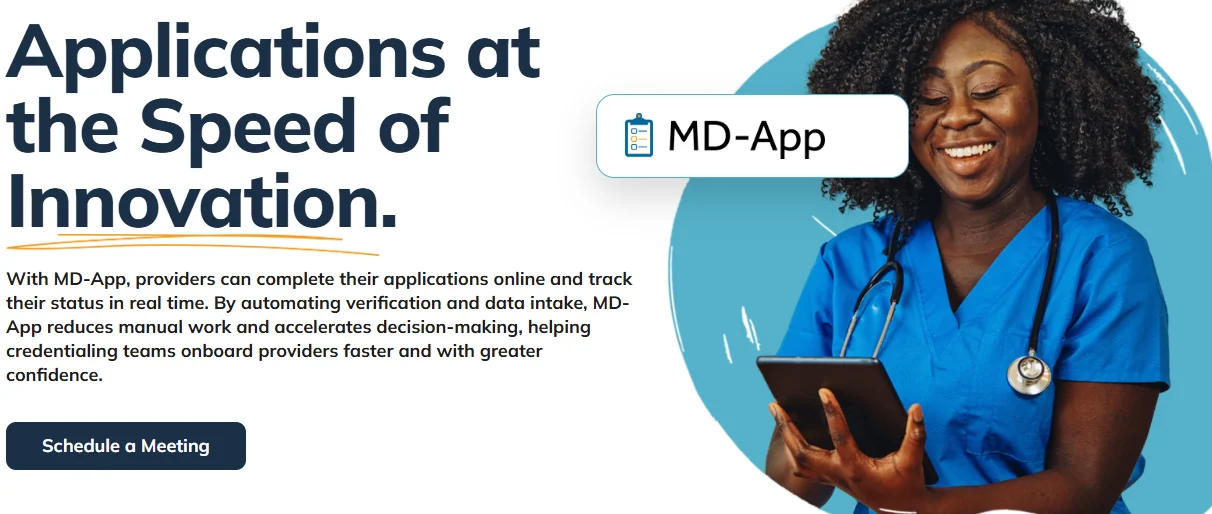
MD-Staff, built by ASM, focuses on credentialing-specific product development for healthcare facilities. The Aiva Credentialing engine runs AI automation for PSV and flags incomplete files, while MD-App provides a paperless provider portal. OPPE and FPPE reporting are native, and implementation is a multi-month process.
Key Features
Aiva Credentialing engine: AI-powered PSV automation that flags incomplete files
MD-App provider portal: Paperless application and document submission
OPPE/FPPE reporting: Performance evaluation tied to credentialing decisions
Modular architecture: Start with core modules and expand as you grow
Pros
Best in KLAS for Credentialing six consecutive years (2021–2026)
30+ years of credentialing-specific product development under ASM
Scales from community hospitals to large multi-entity systems
Cons
Implementation is multi-month, with dedicated oversight
Feature depth can feel excessive for smaller outpatient groups
Enrollment module isn't as deep as dedicated platforms
Pricing
Custom pricing based on modules and organization size.
5. Credentially — AI-driven clinical onboarding with role-flexible compliance
Best for: Fast-growing clinical teams and staff banks needing automated onboarding across multiple role types
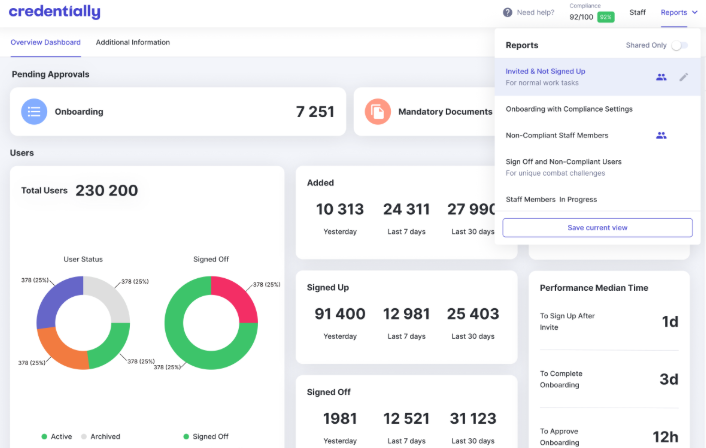
Credentially is an AI-driven clinical onboarding platform originally built for the UK's NHS market and adapted for US healthcare. License verification, reference requests, and compliance checks are automated to cut credentialing timelines from weeks to days.
Key Features
AI-automated credentialing: Compresses clinical onboarding from weeks to days
Flexible compliance: Tailored credential checklists per role
US compliance integrations: Direct connections to SAM, OIG, UNA, Nursys, and Checkr
White-labeled branding: Candidates see the employer's branding throughout
Pros
Fast onboarding across diverse clinical role types
Role-flexible architecture adapts to how the org actually hires
Setup typically in around three weeks
Cons
UK NHS origins; NCQA CVO workflows are less central than at US-native incumbents
Recommended minimum of 25 users, prices out smaller practices
Payer enrollment is not a core focus
Pricing
Custom pricing based on size and modules.
6. Incredable — Flat-fee credentialing software with a provider mobile app
Best for: Rural and regional hospitals, surgical centers, and FQHCs that want physicians to finish onboarding paperwork from their phones
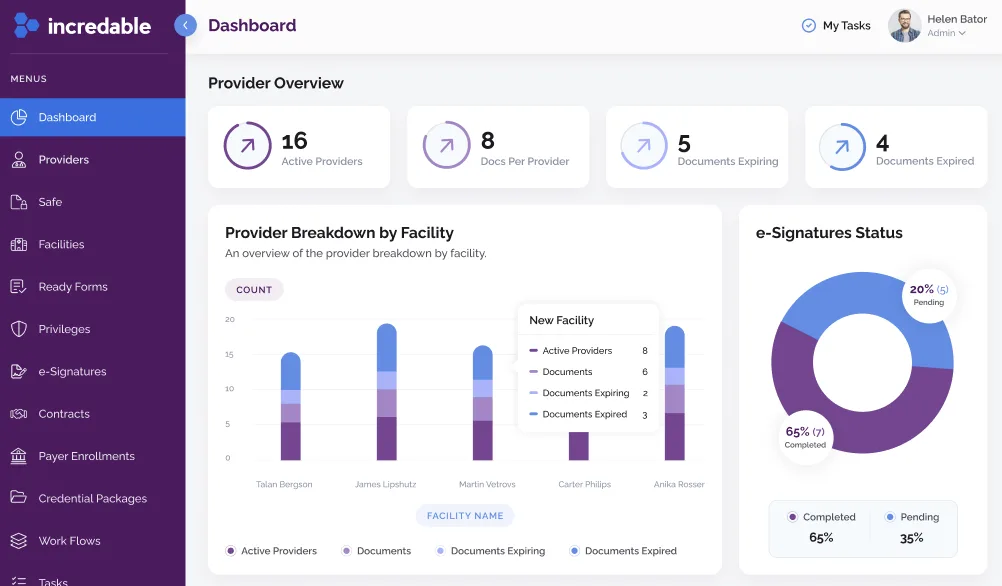
Incredable is credentialing software built around a provider mobile app. Physicians upload documents, sign Ready Forms electronically, and get expiration alerts on their phones. Your team tracks PSV, sanctions, and payer enrollment in a shared dashboard. Each credentialed provider also gets a digital Credential ID with a scannable QR code that links to their verified credentials.
Key Features
Provider app: Lets physicians upload documents, e-sign forms, and track expirations from their phones
Ready Forms: Auto-fills onboarding, CAQH, and payer enrollment forms from the provider profile
Primary source verification: Checks state licenses, DEA, NPI, and OIG exclusions
Task management: Tracks each onboarding step on a Kanban board with time tracking
Pros
Flat-fee plans with unlimited provider profiles
Implementation typically takes about a week once Incredable receives your data
The QR-code Credential ID lets a facility confirm a physician's verified credentials on the spot
Cons
There's no mention of outsourced CVO or enrollment service, so your team still does the work inside the software
Licensing support covers renewal tracking, not filing new state license applications
Pricing isn't published
Pricing
Flat-fee plans with no per-provider charges; prices on request.
7. PayrHealth — Managed credentialing plus payer contracting specialist
Best for: Practices that want credentialing, enrollment, and payer contract negotiation handled as a managed service
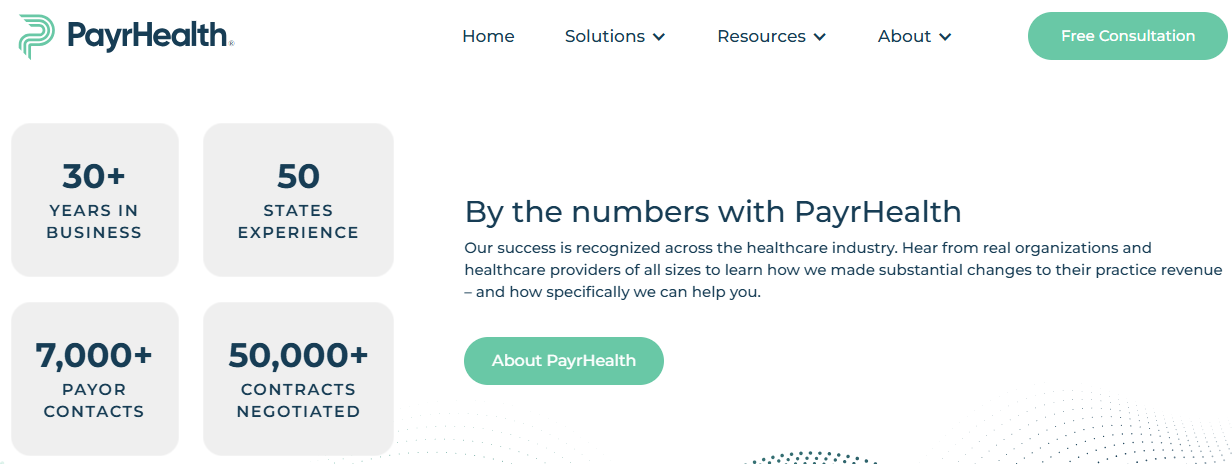
PayrHealth is different from most platforms here. It is a managed services firm with a software layer rather than a SaaS product with optional services. The Austin-based team takes over the full lifecycle. Paperless intake through the PayrHealth Cred System, application preparation and submission, follow-up until contracts are loaded, recredentialing, and CAQH re-attestation every 120 days.
Key Features
Managed credentialing: Dedicated team handles preparation, submission, and follow-up
Payer contracting: Rate negotiation and contract review
PayrHealth Cred System: Cloud portal for status, documents, and contract access
CAQH re-attestation: Handles the 120-day re-attestation cycle proactively
Pros
Payer contracting and rate negotiation are rare in this category
Fully managed model removes execution burden from internal teams
Strong fit for practices without in-house contracting expertise
Cons
Service-led unit economics get less efficient at very high volumes
Automation depth can be improved
Slow approval rates due to manual effort and competitive slowness
Pricing
Custom pricing based on scope. Free consultation available on request.
8. ProviderTrust — Continuous compliance monitoring and sanctions screening
Best for: Organizations whose biggest onboarding risk is ongoing compliance monitoring rather than initial credentialing
Most credentialing platforms stop once a provider is in-network. ProviderTrust picks up from there.
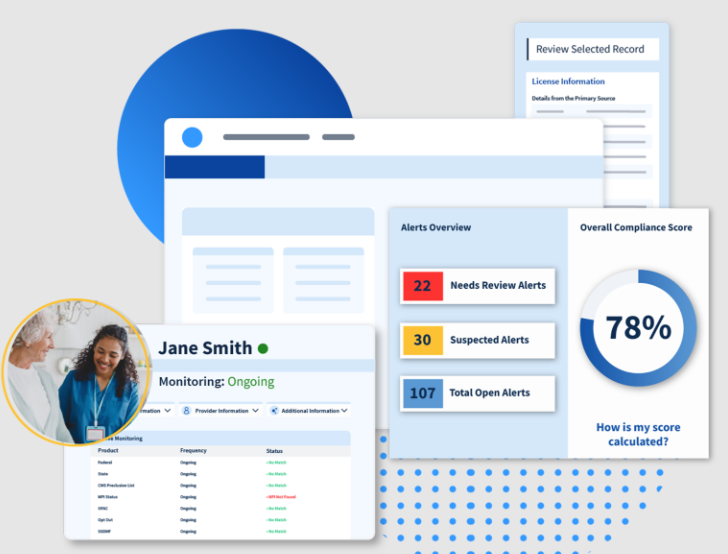
ProviderTrust pairs with a credentialing platform rather than replacing one. It doesn't handle intake or enrollment; it closes the compliance window that opens the moment onboarding ends.
Key Features
Continuous exclusion monitoring: Ongoing screening across 46+ federal and state exclusion sources
Real-time alerts: Immediate notifications when compliance status changes
State board action monitoring: Coverage across all state licensing boards
Audit-ready reporting: Documented monitoring history for CMS and payer audits
Pros
Continuous monitoring coverage
Purpose-built for the compliance piece, other platforms underserve
Reduces exclusion-related clawback and penalty risk
Cons
Not a full-onboarding platform, needs pairing with credentialing tools
Doesn't handle privileging or payer enrollment
Best used as a layer on top of a credentialing system
Pricing
Custom pricing based on provider volume and monitoring scope.
How to Choose the Right Physician Onboarding Software
The right platform depends on which part of the job you're trying to fix. A few things to weigh:
Credentialing turnaround: When evaluating platforms, ask for a published SLA on credentialing turnaround. Vendors who consistently hit their numbers publish them.
First-pass approval rate: Request the number and ask how it's calculated. Vague answers here are a signal.
PSV coverage: Confirm full coverage of the NCQA 11 elements if delegated credentialing is on the roadmap.
Platform breadth: Think about platform breadth in terms of handoffs eliminated, not features added. Consolidating credentialing, enrollment, and licensing into a single workflow saves more time than optimizing any one tool in isolation.
Monitoring and renewals: A credentialing file is only valid at the moment it's built. Ongoing monitoring protects revenue continuity.
Support responsiveness: Two hours, same day, and next business day sound like minor variations until a payer rule changes mid-application and the clock is running.
Transparency: Transparency is what separates modern platforms from legacy BPOs. Real-time dashboards mean your team can see exactly where every application stands.
Pricing structure: It matters more at scale than on day one. Usage-based pricing grows with your provider headcount without penalizing expansion. Per-seat models do the opposite. The faster you grow, the more the unit economics work against you.
Still on the Fence? Here's How We'd Sum It Up
The platforms here each handle different parts of physician onboarding. For enterprise health systems and growth-stage organizations alike, the question isn’t which is “best?” It fits the part of the process costing that you time and revenue right now.
If the bottleneck is credentialing, payer enrollment, and multi-state licensing, book a demo with Assured. We'll show you how 48-hour credentialing, 72-hour enrollment submissions, and ~95%+ first-pass approvals change the math on onboarding a new physician.
Frequently Asked Questions
1. What's the difference between physician onboarding software and HR onboarding software?
HR tools handle I-9s, tax forms, and orientation. Physician onboarding software handles credentialing, payer enrollment, state licensing, and sanctions monitoring.
2. How long does physician onboarding typically take?
Traditional physician onboarding runs 60 to 120 days for credentialing alone and 20 weeks end-to-end, including enrollment, licensing, and IT provisioning. Modern AI-first platforms can compress credentialing to 48 hours.
3. Can physician onboarding software integrate with our EHR and HRIS?
Enterprise platforms like Assured, Symplr, CredentialStream, and MD-Staff offer EHR and HRIS integrations, though the depth varies. Ask for a reference customer using your specific EHR version before committing.
4. How do these tools handle multi-state licensing?
The best tools automate applications, submissions, renewals, and IMLC management across all 50 states and not just track them. Assured, for instance, auto-initiates renewals 60 days before expiration and handles DEA/CSR licensing in the same platform.
5. How much does physician onboarding software cost?
Practice-level credentialing tools cost $20 to $50 per user per month; enterprise platforms cost $25K–$100K+ annually. The higher cost is delay. Every day a provider sits in credentialing costs roughly $7,000 to $9,000 in lost billing per CompHealth industry data.








.svg)