Credentialing Committee Process: A Complete Guide for Streamlined Management
Rahul Shivkumar
Updated
September 25, 2026
Published
May 9, 2025
A credentialing committee is a peer-review group that evaluates a provider's verified credentials and recommends approval, conditional approval, or denial.
The committee recommends, and the governing body holds final authority. That split trips up many teams and shapes how your committee should run.
If you run or support one, you already know the meeting itself is rarely what slows things down. It's the files. A packet turns up missing a license verification, so it gets tabled, and the provider has to wait another cycle before they can start seeing patients.
This guide covers who does what, who actually makes decisions, how often committees meet, and what it takes to keep files complete so decisions don't slip through the cracks.
Foundation of Effective Credentialing
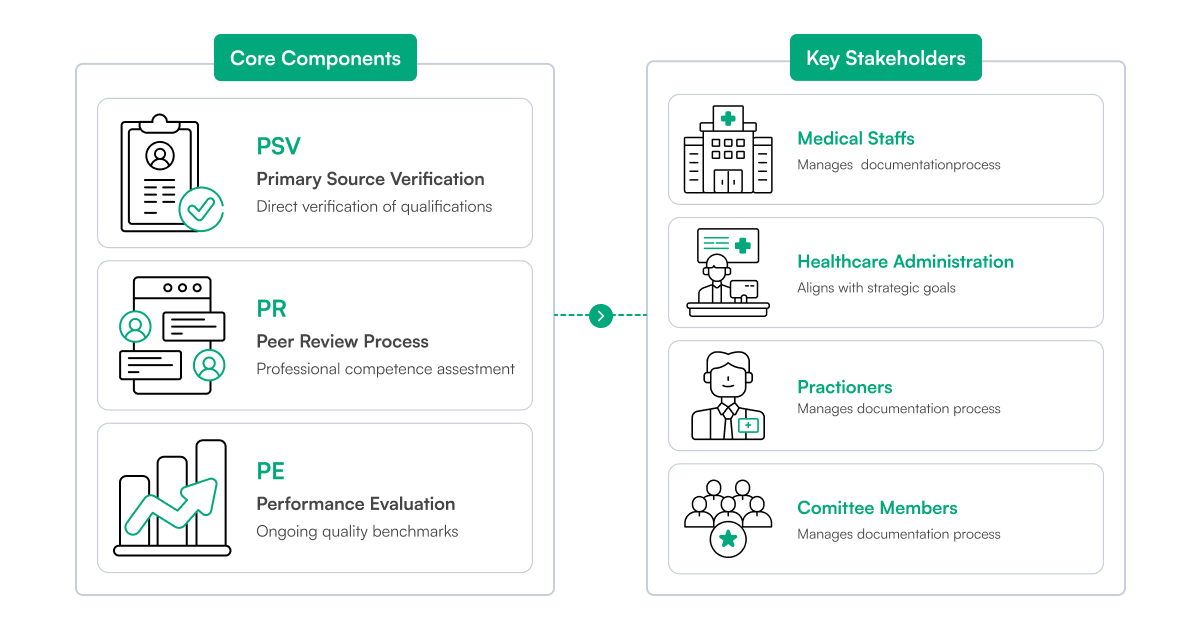
An effective credentialing process starts with clearly understanding its core components and stakeholders.
A. Core Components
Primary Source Verification (PSV): This involves verifying a practitioner’s qualifications directly with the source, such as confirming medical school completion with the institution
Peer Review Process: Peer reviews assess a practitioner’s professional competence by evaluating their performance through colleague feedback. For instance, when a new cardiologist joins a hospital, peers can assess their procedural success rates or bedside manner. This step ensures that standards of care align with the organization’s expectations
Performance Evaluation: Ongoing performance evaluations ensure practitioners continue to meet quality benchmarks. These may include patient outcomes, protocol adherence, and professional development activities
Regulatory Compliance: Organizations must ensure that all credentialing processes comply with national and local regulations to avoid penalties. This step ensures the organization adheres to licensing requirements and accreditation standards
B. Key Stakeholders
Credentialing involves a network of individuals working together. These individuals include:
Medical Staff Services: This team manages the administrative side, ensuring that documentation is complete and accurate before it is presented to the committee
Healthcare Administration: Administrators ensure the credentialing process aligns with the organization's strategic goals
Practitioners: The credentialing process focuses on physicians, nurses, and other providers, ensuring they meet the qualifications to deliver care
Quality Management Team: This team monitors the credentialing process to ensure it supports the organization’s overall quality improvement initiatives
Committee Members: These members are responsible for evaluating applications and recommending privileges, with final decisions resting with the governing body
C. Roles and responsibilities, and who holds final authority
Four groups have a hand in every credentialing file, and only one of them makes the final call. Getting that clear early saves you an argument later about who signed off on what.
Role
Primary responsibility
Decision authority
Credentialing committee
Reviews verified files, evaluates flagged issues, and votes on applications.
Recommends approval, conditional approval, or denial. Final authority rests elsewhere.
Does not decide on applications. Ensures files are complete and ready for committee review.
Credentials Verification Organization (CVO)
Performs primary source verification (PSV) and prepares committee-ready credentialing files.
Does not make decisions. Establishes and verifies the supporting facts.
Governing body (board)
Reviews the credentialing committee's recommendation and takes final action.
Holds final approval authority and the associated legal accountability.
In hospitals, the recommendation usually goes to the Medical Executive Committee first, then on to the board. On the health plan side, a medical director often approves clean files that clearly meet the criteria, and the full committee reviews those that don't.
So, how does one build an effective credentialing committee?
Building a High-Performing Credentialing Committee
A credentialing committee is built on three core components: strong structure, thoughtful member selection, and ongoing development.
Below is a deeper insight into these properties.
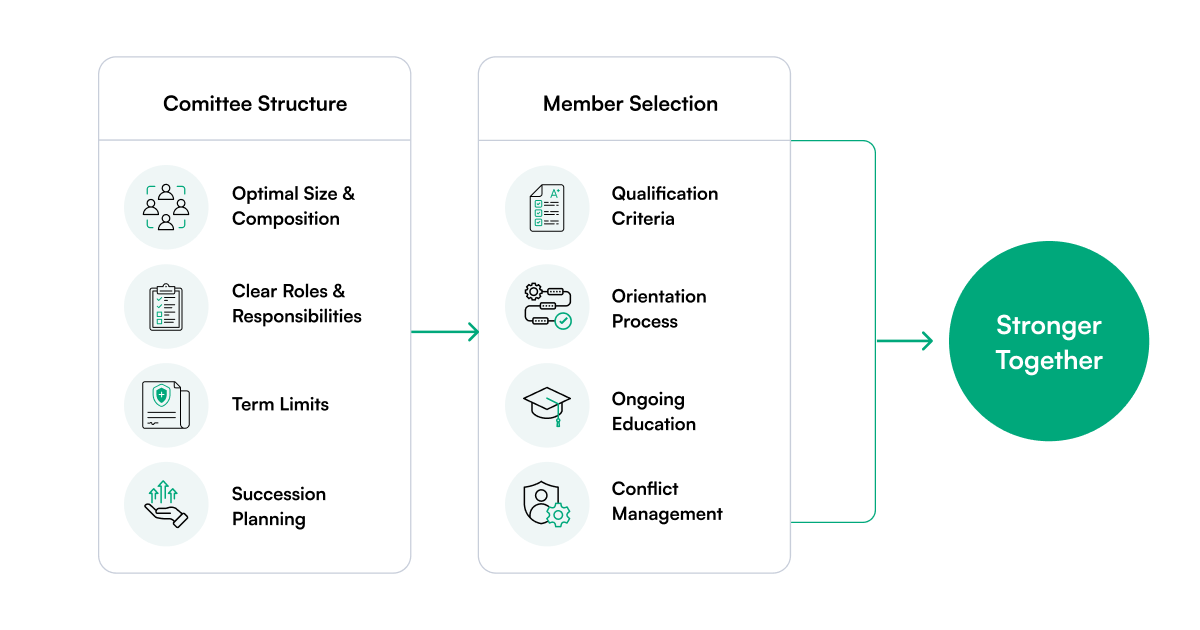
A. Committee Structure
Optimal Size and Composition: The committee size should balance efficiency and representation. A group of at least five members, including physicians from various specialties and administrative staff, often works well
Roles and Responsibilities: Each member should have clear duties.Roles such as chairperson, recorder, and peer reviewers help ensure accountability. For example, the chairperson leads discussions, while the recorder ensures accurate documentation
Term Limits and Succession Planning: Implement term limits for committee members to maintain fresh perspectives. Plan for transitions to ensure continuity when experienced members step down
B. Member Selection and Training
Qualification Criteria: Committee members should possess expertise in credentialing, regulatory requirements, and quality assurance
Orientation Process: When new members join, provide an orientation covering the organization’s policies, credentialing workflows, and decision-making frameworks
Ongoing Education Requirements: Schedule training sessions regularly to keep members informed about updates in healthcare laws, technology, and best practices
Conflict of Interest Management: Establish protocols to handle conflicts of interest. For example, a cardiologist on the committee should recuse themselves from reviewing a close colleague’s file
How often do credentialing committees meet
NCQA doesn't publish a required meeting frequency for credentialing committees. Your interval comes from your own medical staff bylaws instead, or from the terms of your delegated credentialing agreement. Check both of those first, because they're what an auditor will hold you to.
In practice, monthly is the most common rhythm, and organizations that don't process many applications often drop to quarterly. Teams credentialing roughly 20 or more providers a month tends to meet every two weeks, so files don't sit waiting for an agenda slot.
If you leave too much time between meetings, a verified file can pass its verification window before the committee ever sees it. If you're credentialing under NCQA, check your interval against the 2025 standards updates before you set it. Recredentialing files go on the same agenda as well, and they follow a fixed 36-month cycle. So your calendar has to fit them in alongside new applications.
What happens in a meeting
The medical staff office circulates the completed files in advance, so nobody's reading a packet cold in the room. The chair then goes through the agenda file by file, and anything flagged gets taken first. Employment gaps, malpractice claims, and disciplinary actions all get discussed on the record before the committee votes.
Each file ends in one of three outcomes, approval, conditional approval, or denial. The recorder logs the decision and the reasoning behind it in the minutes. That's the record you'll be asked for during an audit or an appeal.
Getting complete files in front of the committee
Most of what makes a meeting run long happens before anyone sits down. If three of nine files arrive with an unverified license or an unexplained gap, those three get tabled and come back next cycle.
That's the part we built Assured around. We're an NCQA-certified CVO, and we run primary source verification automatically, checking 2,000+ primary sources in parallel. That covers state licensing boards, medical schools, the DEA, OIG, and NPDB. Anything that looks off comes back to your team while there's still time to chase it, instead of turning up as a surprise in the room. Your committee receives a standardized digital packet, so the discussion focuses on the provider's qualifications rather than what's missing from the file.
Streamlining the Credentialing Workflow
Now that you’ve learned how to step up a credentialing committee, let’s explore ways to maximize it by streamlining the workflow to improve decision-making and reduce delays.
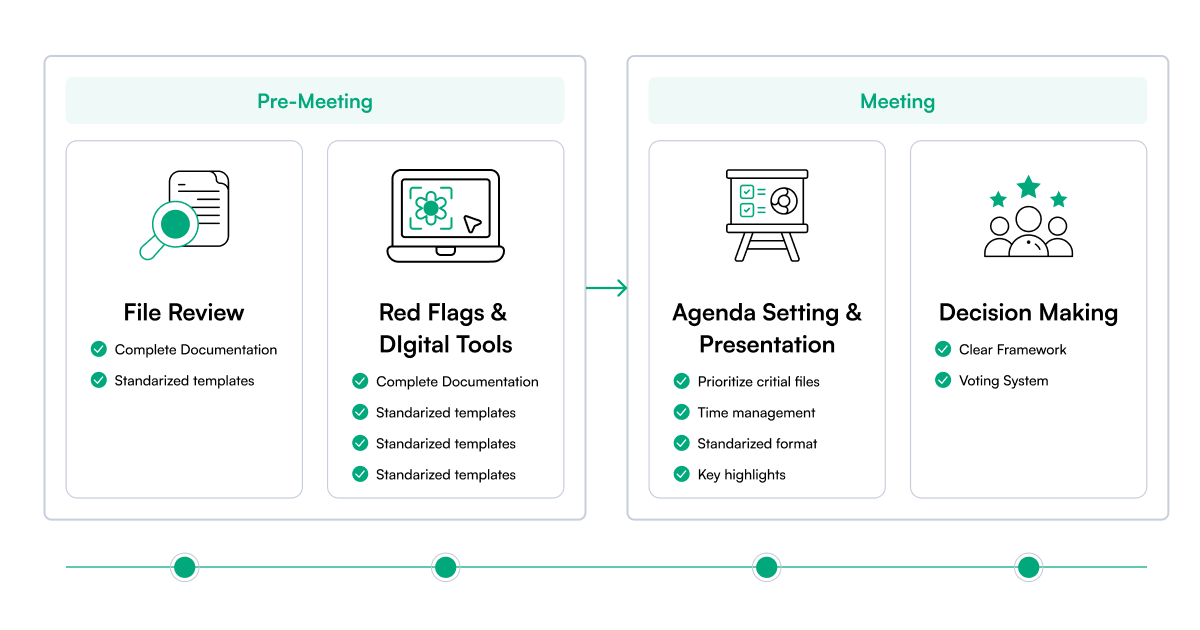
A. Pre-Meeting Preparation
File Review Process: Thoroughly review practitioner files in advance to ensure all necessary documentation is included
Documentation Standards: Use standardized templates for resumes, licenses, and certifications. These reduce confusion and improve consistency
Red Flag Identification: Use Assured to automate primary source verification (PSV) in seconds. Check for gaps in employment, malpractice claims, or disciplinary actions that may require further investigation
Digital Tools and Resources: Use credentialing software to handle multiple credentialing applications simultaneously, eliminating delays from sequential processing and enabling your organization to scale efficiently
B. Meeting Management
Agenda-setting Best Practice: Start by prioritizing critical files, such as those flagged for potential issues or requiring urgent review. Each item on the agenda should have a designated time slot to avoid rushing through important decisions or letting discussions drag unnecessarily
File Presentation Methods: Use standardized templates to present credentials, outlining key details such as education, certifications, work history, and any flagged concerns. For instance, a file for a new surgeon might highlight their residency program, procedural success rates, and malpractice history in a clear, concise format
Decision-Making Framework: Decisions should be guided by a consistent framework that considers all available evidence. To streamline the decision-making process, use a voting system or consensus-based approach
Documentation Requirements: Accurate minutes should capture all key discussions, decisions, and rationales. These records are important for audits, appeals, or any legal challenges that may arise later
C. Post-Meeting Actions
Communication Protocols: Once decisions are finalized, notify providers promptly whether their application was approved, conditionally approved, or denied. For conditional approvals, detailed feedback should be provided, explaining what additional steps are required for full credentialing
Follow-Up Procedures: Establish clear follow-up protocols for applications requiring further action. For example, if a physician is conditionally approved pending updated license submission, assign a deadline and track progress to ensure timely resolution
Appeals Process Management: Clearly outline the steps practitioners can take to challenge a decision, such as submitting additional evidence or requesting a formal hearing. This ensures due process and protects the organization from legal risks
Record-Keeping Requirements: Maintain files in a secure yet accessible system, ensuring they are readily available for audits or legal inquiries. This includes meeting minutes, practitioner files, and communication logs
Risk Management and Quality Assurance
Credentialing directly impacts financial health and patient safety, making risk management and quality assurance non-negotiable components of the process.
The exposure is real even when it doesn't show up until it's too late. A negligent-credentialing claim can become one of the larger malpractice settlements a hospital faces. Regulators can fine an organization for compliance gaps tied to inadequate verification. And a suspended Medicare billing privilege cuts off revenue immediately, well before any appeal is resolved.
Here are major things to look out for in this process.
A. Legal Considerations
Regulatory Compliance: Regularly review updates to licensing requirements, especially those of Medicare and Medicaid, to ensure compliance and avoid penalties
Fair Hearing and Appeals: Adhere to fair hearing procedures to protect practitioners' rights. For instance, if a surgeon’s privileges are denied due to performance concerns, offer a formal review process to demonstrate procedural fairness
Documentation Requirements: Detailed documentation, such as decision rationales and communication logs, defends against potential legal challenges and provides transparency for internal and external audits
Confidentiality Protocols: Given the sensitive nature of credentialing data, confidentiality must be strictly maintained. Invest in secure systems for file storage and limit access to authorized personnel only
B. Quality Metrics
Key Performance Indicators (KPIs): Track error rates, compliance rates, and practitioner satisfaction to evaluate credentialing performance
Turnaround Time Standards: Set clear timelines for completing initial applications, re-credentialing, and expedited cases to minimize delays and ensure provider availability
Quality Assessment Tools: Use audits, scorecards, process simulations, and feedback mechanisms to measure and improve credentialing quality
Continuous Improvement Strategies: Regularly review processes, update policies, provide staff training, and adopt advanced technologies to enhance efficiency and maintain compliance
Technology Integration
Technology can improve the credentialing process by automating repetitive tasks and improving accuracy. Below are some of the ways you can integrate technology in credentialing.
A. Digital Solutions
Credentialing Software Options: Platforms like Assured simplify complex processes by slashing credentialing time by 80% and automating document tracking and primary source verification (PSV). These tools centralize data, making it easier to manage multiple applications simultaneously
Integration with Existing Systems: Ensure seamless data flow across HR, payroll, and compliance systems by linking credentialing records with scheduling systems. This can prevent uncredentialed providers from being assigned to shifts
Automation Opportunities: Automation reduces manual errors and saves time. Tasks such as PSV, license renewal tracking, and report generation can be automated, allowing staff to focus on more strategic activities
Data Security Measures: Given the sensitive nature of practitioner data, invest in credentialing tools with robust encryption and secure access controls to protect against data breaches
B. Process Automation
Application Processing: Use digital forms and CAQH data pull-up to avoid manual data entry. This enables practitioners to submit applications online, with built-in validation to ensure completeness
Verification Workflows: Automate PSV to speed up the credentialing process and minimize human error, ensuring accurate and timely verification
Expiration Tracking: Automate notifications to alert staff and practitioners about upcoming expirations for licenses or certifications, preventing compliance lapses
Report Generation: Generate detailed reports to evaluate credentialing performance, such as average approval times and compliance metrics, helping identify areas for improvement
Best Practices for Special Situations
Certain scenarios require flexibility and tailored approaches to maintain efficiency and quality. Some of these situations include:
A. Temporary Privileges
Temporary privileges may be granted in emergencies or for locum tenens providers. For example, hospitals may need to credential out-of-state physicians quickly during a disaster response.
Streamlined processes, such as expedited file reviews and provisional approvals, ensure timely staffing without compromising safety.
B. Focused Professional Practice Evaluation (FPPE)
FPPE is initiated when a provider's competence is questioned, such as after a patient complaint or a procedural error.
It’s important to develop clear monitoring plans with predefined assessment criteria to objectively evaluate the provider’s performance. For example, a surgeon under FPPE might monitor their outcomes for three months, followed by a formal review to determine if additional training or remediation is necessary.
Measuring Success and Continuous Improvement
The first step to measuring success is setting and tracking metrics like application turnaround times, compliance rates, and practitioner satisfaction
Key actions after establishing metrics include:
Conduct regular audits to uncover inefficiencies
Update policies to reflect regulatory changes
Provide ongoing training for staff and committee members
These continuous feedback loops help the credentialing process remain effective and aligned with organizational goals.
Clear the File Backlog Before Your Next Meeting
A credentialing committee only moves as fast as the files in front of it. Get the structure right, set a cadence your bylaws or delegation agreement actually supports, and keep the recommend-versus-decide split clear, then put the real bottleneck, incomplete files, in front of a CVO that catches the gaps before they reach the agenda.
Want to see what a committee-ready packet looks like before your next meeting? Book a demo.
Frequently Asked Questions
1. What is a credentialing committee?
A credentialing committee is the peer-review group that evaluates a provider's verified file and votes on it. Members are usually practicing physicians from a range of specialties, as well as administrative staff. They look at education, training, licensure, board certification, work history, and any malpractice or sanctions record. The vote is a recommendation: approval, conditional approval, or denial.
2. Who is responsible for credentialing decisions?
Two groups share it. The credentialing committee reviews the file and makes a recommendation, and the governing body, normally the board, holds final authority and legal accountability. NCQA's own public description of its standards says the committee "makes credentialing recommendations," and that's the distinction worth getting right. In hospitals, that recommendation usually passes through the Medical Executive Committee before reaching the board.
3. How often do credentialing committees meet?
Monthly is the most common, but no accreditation rule requires it. NCQA doesn't publish a required meeting frequency, so your interval comes from your medical staff bylaws or your delegated credentialing agreement. Organizations that don't see much volume often meet quarterly. Teams credentialing 20 or more providers a month usually goes every two weeks instead.








.svg)