

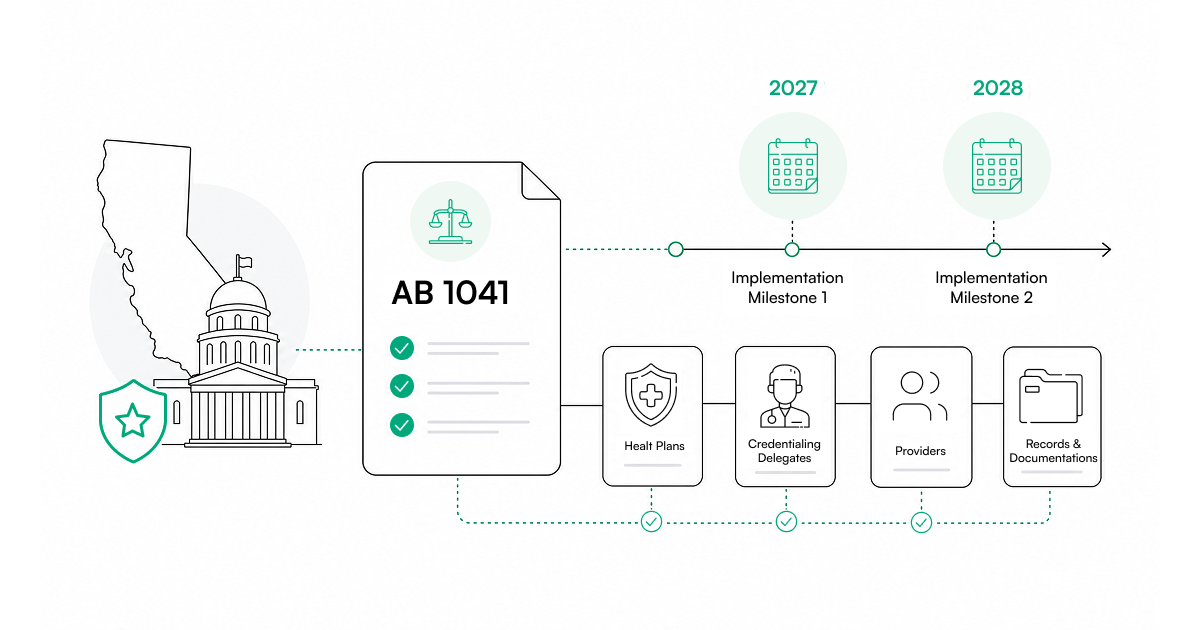
California AB 1041: What Health Plans and Credentialing Delegates Need to Know Before 2027 and 2028

Varun Krishnamurthy
September 28, 2026

Traditional credentialing takes 90-120 days. During that time, providers are hired but unable to work, patients wait longer for care, and organizations lose revenue every day.
But what if you can shorten the provider credentialing time? The results will be almost too good to be true.
The question is, how fast do you need to be, and what will it take to get there?
This guide breaks down what's achievable with process improvements alone, what requires technology, and the realistic timelines at each level.
The typical 90 to 120 days (16 weeks) of traditional credentialing wait are usually spent in:
The first three weeks are spent on data collection from providers. While this could be done in a very short while, it often stretches into two or three weeks.
The delay happens when providers are too busy to confirm the completeness of their CAQH profiles or do not understand credentialing rules. This leads to missing dates, expired licenses, or unfilled sections and eventually, repeated follow-ups. Each follow-up adds another pause to the process.
The next four weeks are usually spent on primary source verification. Delays arise due to sequential verification of one source at a time, each taking 3-7 days.
There are 15 to 20 different sources to verify with. From their education, to their training, state licenses, board certification, work history, malpractice, and federal databases. Each source may take several days to respond, and nothing moves forward until the response arrives.
This is the application preparation and review stage. This stage seems simple, but it often causes delays. Each payer has different requirements, and small formatting or documentation errors can trigger rework. These problems are usually discovered late, which means more waiting.
The committee review stage involves monthly meetings. If you miss a meeting, you have to wait till the next 30 days for the next meeting. So, even if a file is complete and accurate, it may sit idle for weeks waiting for the next meeting, even though no additional work is needed.
Many applications are rejected on the first submission. Industry averages show that only about half of applications are approved right away. Rejections require fixes, resubmission, and another review cycle, which adds several more weeks.
From the breakdown, it's obvious that a chunk of the timeline is spent waiting. You wait for verification responses, for providers to submit missing documents, committee meetings, and for payer responses.
So, traditional credentialing puts a very small part of the process in your control.
But can these delays be prevented with better processes and organization?
Before you even get to how technology can reduce provider credentialing time, you can significantly reduce provider credentialing time by improving your processes.
In fact, healthcare organizations that have optimized credentialing processes experience 30 percent fewer claim denials due to provider enrollment and credentialing issues.
Here are some process-improvement tactics to try:
This simply means putting the best foot forward in the data collection process. This tactic solves the problem of providers submitting incomplete information, discovered only after starting the credentialing process. It also reduces the 2 to 3 weeks estimated data-collection timeline to 3-5 days.
Here are some ways you can front-load data collection:
Create a detailed pre-verification checklist that includes NCQA requirements and payer-specific needs to look out for before submission.
Assign dedicated staff to work with providers during the data collection process. This way, they're held accountable, made to cross-check and complete the data on their CAQH profile.
Check for the CAQH profile completeness before beginning the credentialing process. This could be done by an in-house credentialing team.
Don't start credentialing until you have a hundred percent complete data. You can track data completeness using spreadsheets.
This fixes the delay of monthly meetings. Instead of waiting for 30 days if you miss a meeting, the next meeting could be held in a week for 10+ providers per month, or bi-weekly for fewer. This reduces the 2-4 week committee review timeline to under a week.
To make this work, every application should be reviewed using the same format. This is where a packet comes in.
A packet is a complete set of documents about one provider, put together in one place. It includes the provider's application, licenses, verifications, and any required forms. It's a single folder that the committee reviews instead of searching through emails or systems.
Before the meeting, someone should check each packet to make sure nothing is missing. Only complete packets go to the committee. Another staff member should be responsible for preparing these packets at least two days before the meeting, so that the reviewers have time to look them over.
This tactic helps to prevent the 3 to 4-week delay of resubmission after rejections. The goal is to improve first-pass approval rates above the average of 50-60%. The first step to improving application quality is documenting rejection reasons from the last 20 applications.
The next step is to build payer-specific checklists to ensure they're being adhered to. Also, implement peer review before submission, and create standard prevention protocols for the most common errors.
This tactic can save 3-5 days on average for every 10 percent improvement in first-pass approval rates.
However, it may be hard to maintain quality at 30+ applications per month without automated compliance checks.
As minor as this tactic sounds, it solves the problem of applications sitting idle with no follow-up at all or with manual follow-up. You can track and actively follow up on credentialing applications using a project management tool or a detailed tracking spreadsheet and calendar reminders. You can also have daily in-house meetings with the credentialing team to review applications that have been stuck for more than 5 days.
There should also be an escalation protocol for stalled applications. This speeds up the waiting time by taking out 1-2 weeks of idle credentialing time.
While process improvements significantly reduce the timeline, it still requires a lot of staff time, training, frequent meetings, and may cause burnout in the long run.
Here's what you achieve with process improvements only:
Timeline: 90-120 days reduces to 45-60 daysStaff time: Still about 20-25 hours per providerInvestment: Process changes, training, more frequent meetingsWorks for: Organizations credentialing fewer than 30 providers annually
Even with perfect processes, you'll hit a wall at primary source verification. It still takes the bulk of your credentialing time.
Here's the reason: There are 15 to 20 different sources that have to verify information about each provider. Their medical school, the state medical board, the board certification organization, the DEA, and federal databases all have to confirm they're certified.
Each of these sources takes three to seven days to respond, on average. Most credentialing teams have to check them one at a time because they don't have direct connections to these databases. If you have 20 sources and each takes five days to respond, that's 100 days of waiting.
What you need to hasten primary source verification is technology that directly integrates with and can check all those sources at once, rather than one after another. If you could verify all 20 sources simultaneously, then six to eight weeks could be reduced to 24 to 48 hours. Learn more about manual vs. automated primary source verification and why the difference matters at scale.
However, building and maintaining this system in-house may not be the easier option. Building and maintaining these integrations costs about $50K-$150K+ annually.
Also, most sources don't have public APIs, and so they require you to have special agreements with the sources. So, building your own system only makes economic sense if you're credentialing 500+ providers annually.
If you're wondering what approach is best for your healthcare organization, here's a table to help you decide:
| Approach | Best For | Timeline | Cost |
|---|---|---|---|
| Stay in-house with better processes | Organizations that add fewer than 30 providers per year | 45 to 60 days | Staff training time and more frequent committee meetings. Almost no financial cost. |
| Buy credentialing software | Organizations that add 30 to 200 providers per year, that need timelines under 30 days | 20 to 30 days | $10,000 to $50,000 per year |
| Hire a specialized credentialing company | Organizations that add more than 30 providers per year and need the fastest possible timeline | 48 to 72 hours | Varies by volume |
| Build your own system | Organizations credentialing 500+ providers annually, where credentialing is core to the business | 48 to 72 hours | $500,000 for the initial build, and about $50,000 to $150,000 annually to maintain |
Let's do the maths first.
30 providers x 20-25 hours (typical credentialing time) = 600-750 hours annually of time spent on credentialing.
Let's see how much revenue is lost aside from the lost time.
Each provider waiting to be credentialed = $6,000-$8,000 per month in lost revenue, as they can't see patients yet.
Once you reach this amount of lost revenue, the return on investment from faster credentialing usually outweighs the cost of buying software or hiring a company.
Most organizations don't meet the threshold for building their own system. Creating a platform that connects to 2,000 verification sources across all 50 states is a multi-year project that costs hundreds of thousands of dollars.
Unless credentialing is absolutely central to your business and you're doing it at a massive scale, it doesn't make financial sense. If you're weighing in-house versus outsourced credentialing, that breakdown can help you run the numbers for your specific situation.
Reducing credentialing time to 48-72 hours requires specific infrastructure and operational expertise.
Here's how Assured does it and what customers experience:
Assured has built direct technical integrations with over 2,000 verification sources, which means the platform can check sources simultaneously instead of sequentially.
All of this happens in the first 24 to 48 hours because the requests go out simultaneously.
It also automates ongoing checks against the Office of Inspector General's List of Excluded Individuals and Entities (OIG LEIE), the System for Award Management (SAM.gov), and the National Practitioner Data Bank (NPDB).
The platform also reviews state-specific sanction lists and medical malpractice databases to ensure providers remain compliant over time.
For providers who trained internationally, Assured can verify foreign medical school credentials through international databases, which most in-house teams struggle to do efficiently.
This parallel verification reduces the primary source verification time from six to eight weeks to 24 to 48 hours.
Assured achieves first-pass approval rates of 80 to 90%. This is possible through payer-specific application templates that are constantly updated as requirements change.
Before any application goes out, it runs through automated compliance checks based on NCQA standards and each payer's requirements.
After the automated checks, a credentialing specialist reviews each application manually. They do a final quality check on applications that have been through automated compliance screening. Assured also has the National Committee for Quality Assurance, and its Credentials Verification Organization certification (NCQA CVO), which is the industry standard.
Assured gives you a dedicated provider support representative for your organization. These representatives communicate directly with your providers to collect data upfront, cross-check completeness, and sort inconsistencies.
They respond promptly, within 2 hours, ensuring that escalations are sorted out as quickly as possible. They also ensure proactive follow-up before a delay occurs.
Assured has a typical credentialing timeline of 72 hours.
In fact, here's the review of John Zhao, the CEO of Blossom Health:
"We chose to work with Assured over other vendors because they are the 'gold standard' for provider network management. They have the highest first-pass approval rates for payor enrollments and turnaround times, which ensures that we can get our providers in-network and scheduled to see patients significantly faster than other solutions."
Here's how Assured achieves that three-day turnaround time:
The provider submits their complete data through Assured's system. As soon as the data comes in, the parallel verification process starts.
Requests go out simultaneously to all state medical boards, NPPES, CAQH, board certification organizations, DEA, and federal databases. These verifications run in the background while the next steps happen.
This is where having those 2,000+ direct integrations makes the difference. Most verification sources respond within 24 to 48 hours when you have direct technical connections.
Some come back in hours, some take the full 48 hours, but because they're all running in parallel, you're waiting for the slowest source rather than the sum of all sources. By the end of day two, all verifications are typically complete.
The system pulls all the verified information and generates applications using the payer-specific templates. Automated compliance checks run to catch any errors or missing pieces.
A credentialing specialist reviews each application manually to ensure quality. Any issues get flagged and resolved before submission.
The completed, verified, quality-checked application goes to the payer or to your internal credentialing committee for final approval.
For providers who already have clean, complete CAQH profiles, the timeline can be even faster. If all their information is current and verified in CAQH, Assured can sometimes complete credentialing in as little as two days because much of the verification is already done.
The total timeline, including committee approval, typically runs 10 to 14 days, which is still dramatically faster than the 90 to 120-day industry standard.
Assured works with your review committee to implement the weekly committee review meetings. This works for organizations with credentialing committees. Assured automates packets that will simplify the reviews.
Assured's system generates these packets automatically in a standardized, NCQA-compliant format. Every packet looks the same, has the same sections, and includes the same documentation, which makes committee review faster and more consistent. The system also generates weekly "clean file" lists, which are applications that have passed all verifications and quality checks and are ready for committee approval.
Assured also provides meeting minutes and audit documentation automatically, which is required for compliance but usually creates additional administrative work. The outcome is that committee review happens within seven days instead of waiting up to 30 days for the next monthly meeting.
This weekly committee support is particularly valuable for health systems and larger medical groups that are required by policy or accreditation standards to have committee review. They can't take out the committee step, but they can make it much faster and easier.
Assured helps organizations move through credentialing much faster than the normal process.
Once all provider information is complete, Assured submits applications in an average of 72 hours. If a provider has a clean and up-to-date CAQH profile, credentialing can happen in as little as two days.
Most providers are fully credentialed in 10 to 14 days, including committee review. This timeline covers the full process, not just intake.
Speed only works when the information is correct. Assured focuses on accuracy from the start.
Organizations using Assured see 80 to 90 percent first-pass approval rates, and over 95 percent of the provider data collected the first time is collected correctly.
Assured reviews provider information before submitting it to payors. Licenses, work history, and required documents are checked early. This helps avoid missing details that cause payors to reject or delay applications. Correct data leads to fewer follow-up requests and less rework for staff.
With Assured, providers are able to start working 45 to 60 days sooner. Credentialing and admin teams save 50 to 60 hours of work each week. Time from credentialing to billing is reduced by about 45 days.
This means your organization can bill sooner and collect revenue faster. Staff also spend less time chasing documents and fixing mistakes.
Organizations that use Assured report high satisfaction. 9 out of 10 users give Assured a strong rating, many say they would be very unhappy if they had to switch vendors, and customers often describe Assured as a gold-standard partner.
Teams trust Assured to handle credentialing correctly and on time. They know where each provider stands in the process and do not have to chase updates.
This leads to less stress and a smoother onboarding experience for everyone involved.
Hiring a credentialing company like Assured to handle your provider credentialing will definitely reduce the provider credentialing time significantly. But let's be honest, it may not be right for everyone.
Here are a few factors to consider:
If you're a telehealth or digital health company, you may need providers licensed in multiple states to serve patients nationwide.
Each state has different requirements, payers, and background check databases. What would take an in-house team months to coordinate across multiple states, Assured can do in days.
Behavioral health organizations often have high provider turnover and are constantly bringing on new therapists and psychiatrists. In this case, you can't afford to keep therapists waiting instead of seeing patients.
Larger health systems that are merging, expanding or competing for providers in tight labor markets need fast onboarding to win talent.
If you've recruited a great surgeon and they're choosing between you and a competitor, getting them credentialed faster can make the difference. Providers who sit around for months waiting to start work get frustrated, and some will back out and take other positions.
At 30 providers per year, you're spending 600 to 750 hours of staff time on credentialing.
Each provider's waiting costs you thousands of dollars per month in lost revenue. Paying for specialized credentialing that gets providers working 45 to 60 days faster usually pays for itself through recovered revenue alone. You can use the cost to credential a healthcare provider breakdown to pressure-test the ROI for your organization.
Sometimes it's not about volume, it's about timing. If you're launching a new service line, responding to a surge in patient demand, or in a competitive market where patients will go elsewhere, then credentialing speed directly impacts your ability to generate revenue.
If you're only credentialing 15 providers per year, you probably don't have enough volume to justify the cost.
You can likely get to 45 to 60-day timelines with better internal processes, and that timeline is probably fast enough. The money you'd spend on outsourcing would be better invested elsewhere.
If you only work in one state and your provider count is stable or growing slowly, credentialing is much simpler.
You're dealing with one state medical board, one set of payers, and one state's requirements. Your staff probably know all the requirements, and have relationships with the right people. You don't need the multi-state system that Assured provides.
Some organizations simply don't need faster credentialing. Especially if you plan to hire far enough in advance that 45 to 60 days fits your timeline.
If credentialing doesn't really impact your revenue or operations, there's no reason to pay for speed you don't need.
If you use a specialized credentialing company with full verification infrastructure, you can cut down provider credentialing time from 90 days to 48 to 72 hours.
The cost varies by volume, but it makes sense for organizations that add 30 or more providers per year, especially if you're working across multiple states or growing quickly.
Assured is your best option if you're looking for a specialized credentialing solution that works as a partner.
From a representative for your company, to simultaneous primary source verification, and automated compliance, Assured makes the credentialing process faster and stress-free for your organization.
Book a demo to see how Assured reduces your provider credentialing time.

Assured Health, Inc.
333 Seventh Ave, Suite 1701
New York, NY 10001



.svg)