How to Do Primary Source Verification (PSV) in Healthcare: A Step-by-Step Guide

Varun Krishnamurthy
August 25, 2026
A unified credentialing platform centralizes licensing, primary source verification, payer enrollment, and ongoing monitoring into a single provider record rather than spreading them across multiple tools. When these steps live in separate systems, every handoff, email, and spreadsheet update causes a small delay, and those small delays add up to weeks of lost onboarding time.
This guide covers where that time actually goes, what consolidation changes, and how to tell if a platform is truly unified or just marketing itself that way.
When onboarding stretches to 90 or 120 days, it is easy to blame slow payers or lengthy primary source verification. But the real culprit is usually something less obvious: dead time between steps.
According to industry research, payer credentialing is the number one onboarding bottleneck for 85% of providers. And the financial stakes are significant. Industry data shows that physicians generate an average of $2.4 million annually for their affiliated facilities. That works out to roughly $9,000 in lost revenue per day for every day a provider sits idle due to credentialing delays. Over a typical 120-day delay, a single provider can represent more than $100,000 in unrealized billing, and much of that revenue is permanently lost due to retroactive billing restrictions and timely filing limits.
Here is where the time actually disappears:
Licensing to credentialing. A license gets approved, but the data does not automatically flow anywhere. Someone has to pull it, verify it, and re-enter it into the credentialing system. That handoff alone creates a 2 to 5 day delay.
PSV to committee review. Verifications are complete, but someone now needs to gather the documents, format them, and build a committee-ready packet. Industry data suggests a single credentialing application can demand more than 20 hours of staff time. That manual assembly adds another 1 to 3 days.
Committee approval to payer enrollment. The provider clears credentialing, but verified data has to be reformatted for each payer's template and submission method. Each payer has different requirements, different portals, and different timelines. That transition creates a 3- to 7-day gap.
Enrollment to monitoring. The provider gets approved by payers, but the monitoring system does not recognize them until someone manually adds them. That gap can last days or even weeks, during which compliance risk goes untracked.
Data discrepancies across systems. When provider details don't match across tools, someone has to track down the error. Each discrepancy can take 30 to 60 minutes to resolve and may trigger enrollment rejections. Industry surveys have found that more than half of medical practices reported credentialing-related claim denials increased in recent years, with data mismatches and processing delays among the top causes.
The actual verification work at each stage might take hours. It is the handoffs that stretch the timeline into months.
Using separate systems can technically get the job done, but they rely heavily on manual coordination. A unified credentialing platform reduces the need for constant data transfer and follow-up by automating what happens between steps.
| Workflow Step | Fragmented Systems | Assured |
|---|---|---|
| Provider data entry | Re-entered 3 to 4 times | Entered once, flows through every stage |
| Handoff time between stages | 2 to 5 days per handoff | Zero — stages trigger automatically |
| Primary source verification | Separate tool, manual data feed | Built in, runs in parallel from same record |
| Payer enrollment | Manual reformatting per payer | Auto-generates in each payer's format |
| Ongoing monitoring | Disconnected from credentialing | Continuous, linked to full provider profile |
| Audit documentation | Assembled from 3+ systems | Generated from single source in minutes |
| Staff time on data transfer (200 providers) | 15 to 25 hours per week | Near zero |
The bottom line: separate systems save no waiting time. They only distribute the typing across more tools. A unified platform eliminates the gaps between stages, which is where the real cost accumulates.
It is one thing to discuss centralized credentialing in theory. It is another to see it play out with real numbers.
Tono Health, a virtual dermatology practice operating across 31 states, spent 18 to 24 months with a fragmented credentialing vendor and completed zero credentialing submissions during that time. The inefficiency was so severe that providers who called state boards directly received faster responses than those who used the vendor's system. The downstream consequences were real: patients were unable to receive treatment, and the company estimates it lost millions in revenue.
After switching to a unified credentialing platform with Assured, Tono's experience changed significantly:
CAQH and foundational provider data were cleaned up within the first few weeks, creating a reliable starting point for all downstream processes.
60 credentialing submissions were launched from one centralized system, rather than being managed across disconnected tools.
50 providers were approved. The remaining 10 were delayed by closed payer panels, a payer-side limitation rather than a process failure. Assured's team identified closed panels before submissions, saving Tono time and money by avoiding applications unlikely to succeed.
Weekly status reviews were held in a shared workspace, providing full visibility into each provider's stage across all 31 states.
What actually changed was not that any single step got faster. It was that the handoffs between steps disappeared. Licensing data flowed directly into credentialing. Verified credentials moved straight into payer enrollment. Monitoring began automatically once providers were approved.
As Bryson Tombridge, Tono's CEO, put it: "It was night and day in terms of partnership and collaboration. That's why we were able to have success." (Source: Assured customer interview, August 2025)
Assured covers the full provider lifecycle on a single platform. See how it works for organizations like Tono.
Many platforms describe themselves as "all-in-one." But once you start digging, you realize they really mean "we do a couple of things, and you'll figure out the rest."
If you are evaluating a unified credentialing platform, here is how to tell if it genuinely supports centralized credentialing.
Licensing. Credentialing. Payer enrollment. Network management. Ongoing monitoring. If even one of these requires a separate system or workaround, the handoff problem still exists, and you have not fully streamlined the credentialing process.
You should not have one profile for credentialing and another for enrollment. That is the fastest path to mismatched data, which is one of the leading causes of enrollment rejections and claim denials. A unified system maintains a single, continuous provider profile.
Credentialing should begin as soon as a license is approved. Credentialing clearance should trigger enrollment submissions. If someone has to manually move the file forward each time, you have saved typing time but not waiting time. The waiting time costs $9,000 a day.
This is where "unified" gets tested. If your team still has to rework verified data to meet each payer's submission requirements, the gap between credentialing and enrollment remains. Every payer has unique forms, portals, and data formats. A truly unified platform handles that translation automatically.
An NCQA CVO-certified process means the verification standards have been independently audited against the highest industry benchmarks. This is not just the vendor's own quality claim. Third-party validation matters during delegated credentialing audits and payer reviews.
Always-on screening across OIG, SAM, NPDB, state boards, and 2,000+ sources is fundamentally different from monthly batch checks. Monthly checks can miss sanctions, license lapses, or exclusions that occur between runs, creating compliance gaps that put patients and revenue at risk.
One specialist who understands your states, payers, and workflow is very different from being bounced between separate teams for licensing, enrollment, and monitoring. Fragmented support means repeating the context every time something needs escalation.
Not sure where to start? Our guide to choosing credentialing software breaks down the full evaluation framework.
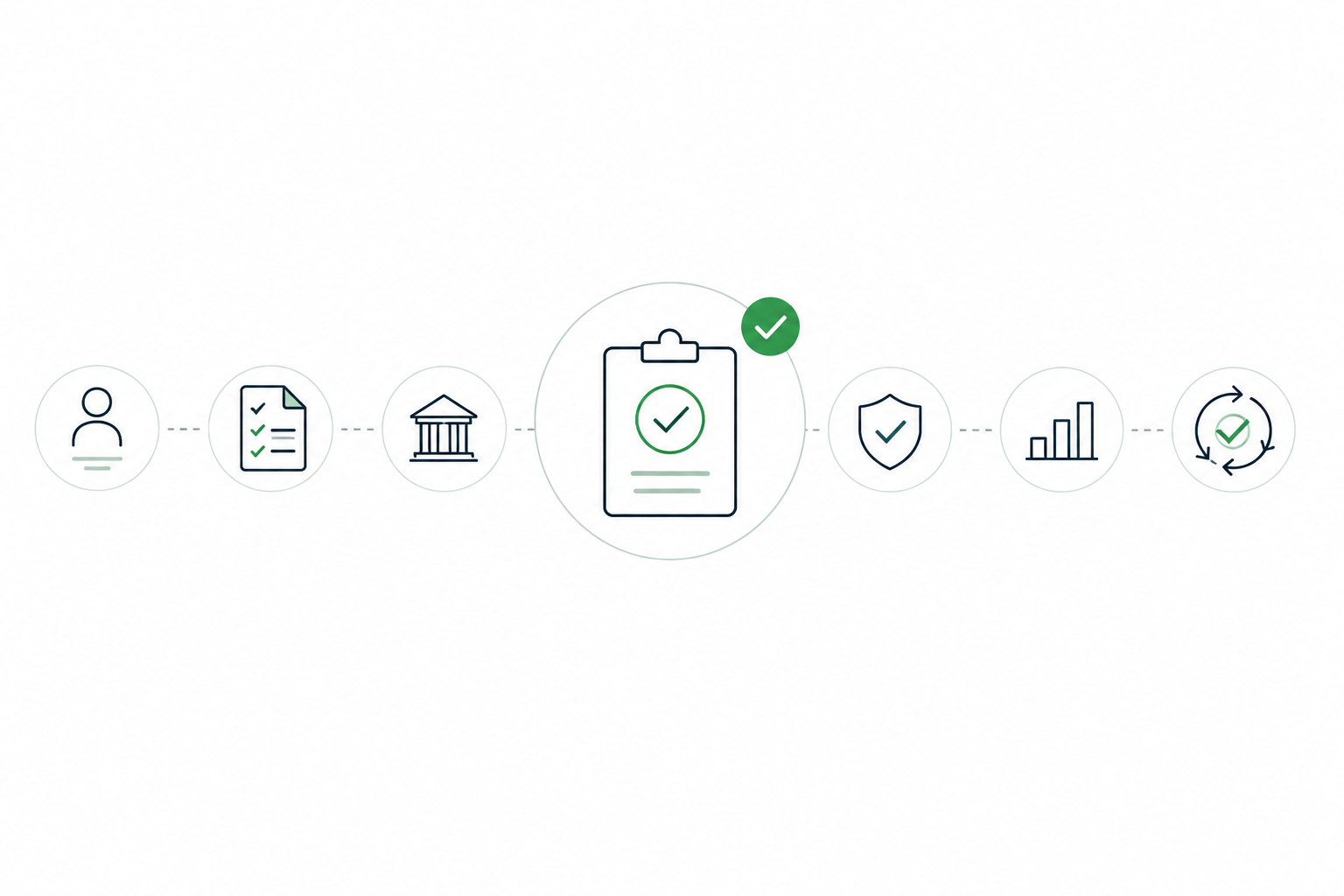
A unified credentialing platform is a single system that manages the full provider lifecycle, including licensing, primary source verification, credentialing, payer enrollment, and ongoing monitoring, from one provider record. Instead of using separate tools for each stage and manually transferring data between them, a unified platform connects the steps so that completing one automatically triggers the next.
This eliminates the handoff delays that typically stretch provider onboarding to 90-120 days.
A unified credentialing platform eliminates redundant data entry and automates the handoffs between licensing, credentialing, payer enrollment, and monitoring. Provider information is entered once and flows through every subsequent stage without being re-keyed into new systems.
This removes the 2 to 7 day delays that typically occur between steps, which is what stretches onboarding to 90 to 120 days. Audit documentation is generated from a single source of truth rather than assembled from multiple disconnected systems. For organizations managing hundreds of providers across multiple states, this can reclaim 15 to 25 hours per week that staff currently spend on manual data transfer alone.
The largest time savings come from eliminating handoffs between stages. Consolidate all provider data into one system so it does not have to be rebuilt at each step. Run primary source verification in parallel while gathering documents, rather than sequentially afterward. Connect credentialing directly to payer enrollment so that committee approvals trigger submissions the same day, without manual reformatting. And implement continuous monitoring so recredentialing does not turn into a separate manual project every three years.
Organizations that have made this shift, like Tono Health, have gone from zero completions over 18 months to 50 approved providers within weeks of switching to a unified platform.
The administrative burden comes from three sources: re-entering data across multiple systems, manually verifying credentials against primary sources, and tracking status across providers, payers, and states simultaneously. The healthcare industry spends tens of billions of dollars annually on administrative transactions between providers and health plans, and providers shoulder the majority of those costs. Unified credentialing platforms address all three burden sources by centralizing data, automating PSV across 2,000+ sources, and providing one dashboard across the full lifecycle.
For organizations that do not want to manage it internally at all, managed CVO services handle the process end-to-end.
Direct software costs are often comparable since one subscription replaces multiple tools. The real impact shows up in time and revenue. If your team is spending 15 to 25 hours per week moving information between systems for 200 providers, that is a serious payroll cost. And when each day a physician is not billing can cost roughly $9,000 in lost revenue, the math shifts quickly.
Over a 120-day delay, that adds up to more than $100,000 in lost billable revenue per provider, depending on specialty and payer mix. Much of this is permanently lost due to retroactive billing restrictions and time limits for filing. For a detailed breakdown, see our guide on the cost of credentialing a healthcare provider.
Assured covers the full provider lifecycle in one platform: licensing, credentialing, payer enrollment, and monitoring, backed by NCQA CVO certification. Book a demo to see how it works.

Assured Health, Inc.
333 Seventh Ave, Suite 1701
New York, NY 10001



.svg)