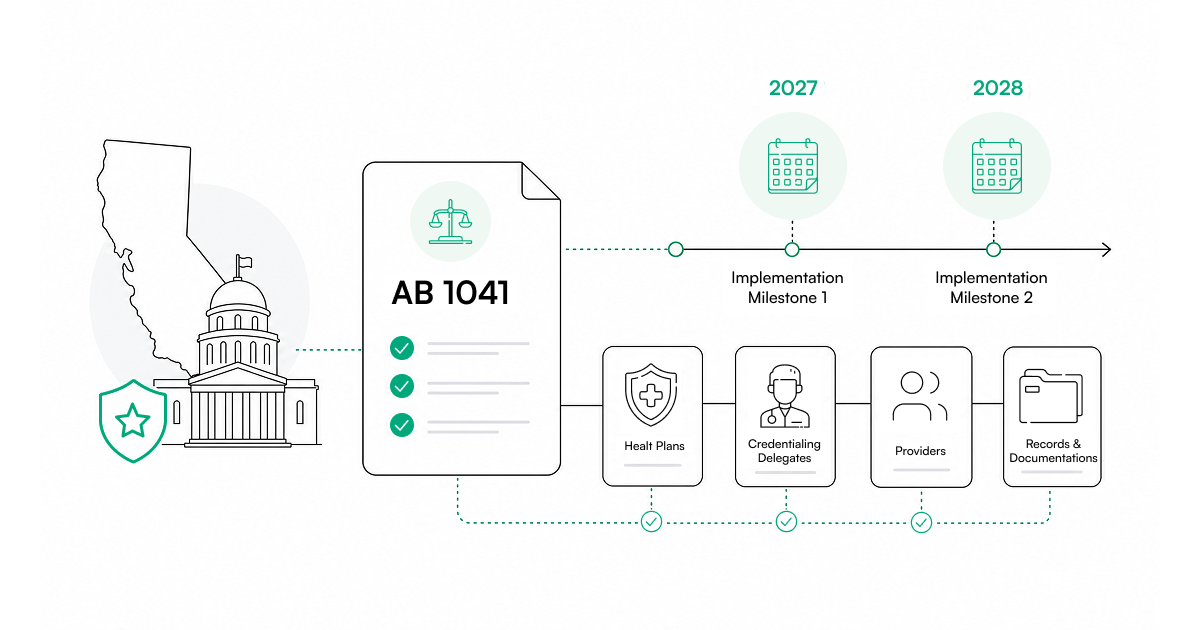
California AB 1041: What Health Plans and Credentialing Delegates Need to Know Before 2027 and 2028

Varun Krishnamurthy
September 25, 2026
Every day a credentialed provider sits ‘not yet enrolled,’ they lose revenue. Payer enrollment backlogs quietly cost healthcare organizations millions a year, from enterprise health systems to multi-state provider groups. We put 8 automated enrollment tools based on submission speed, follow-up reliability, and whether their AI actually delivers in real workflows. Here are our top three picks:
Most vendors call themselves "automated," but the label hides what's actually happening inside the platform. Here, automation means three very different things depending on the tool.
Some tools auto-populate payer application forms using data stored in the platform. That part is real and useful as it saves hours of manual data entry per application. But the tool stops there. Your team still logs into portals, uploads documents, submits, and chases follow-ups by phone and email.
A second tier uses bots and RPA to submit applications through payer portals. That moves further, but bots break when portals change. The monitoring and human escalation behind them is what actually determines whether applications go out clean.
The deepest end of automation is where AI handles the full lifecycle. It reads the payer's form, pulls data from CAQH, NPPES, and state boards, pre-validates every field, submits, follows up on cadence, and flags exceptions before they become rejections.
We built Assured after scaling Dawn Health’s provider network from 0 to 150+ providers across 15 states and dealing with every credentialing and enrollment bottleneck firsthand. Today, as an NCQA-certified CVO, we serve enterprise health systems like Houston Methodist, multi-entity provider groups operating across many states, and growth-stage digital health organizations nationwide. We know the workflows, the payer quirks, and what actually gets providers billing faster.
Here's how the 8 platforms compare at a glance before we get into each one in detail.
| # | Platform | Key Strengths | Best For |
|---|---|---|---|
| 1 | Assured | AI + managed services, 72-hr submission SLA, NCQA CVO, 2,000+ primary sources, sub-24-hr support | Organizations of all sizes and types |
| 2 | Madaket Health | 4,000+ payer library, roster submissions, mature enterprise footprint | Enterprise health systems and large networks |
| 3 | MedTrainer | AI form mapping, credentialing + LMS + compliance in one suite | Clinics, FQHCs, and ambulatory surgery centers |
| 4 | Provider Passport | AI-driven enrollment engine (Credily), RPA follow-ups via TruMation, credentialing + privileging + PDM | Health systems wanting end-to-end AI-native provider management |
| 5 | CredentialStream | Enterprise privileging + enrollment, EHR integration, HITRUST r2 | Hospital systems and academic medical centers |
| 6 | Modio Health | Clean interface, credential storage, enrollment tracking | Small and mid-sized practice groups |
| 7 | CredentialingSpectrum | Auto-populated applications plus contract management | Mid-market practices managing payer contracts |
| 8 | Symplr Provider | Broad GRC suite, hospital-grade enrollment tracking | Large multi-facility health systems |
Best for: Enterprise health systems and growth-stage organizations needing payer enrollment, credentialing, and licensing end-to-end
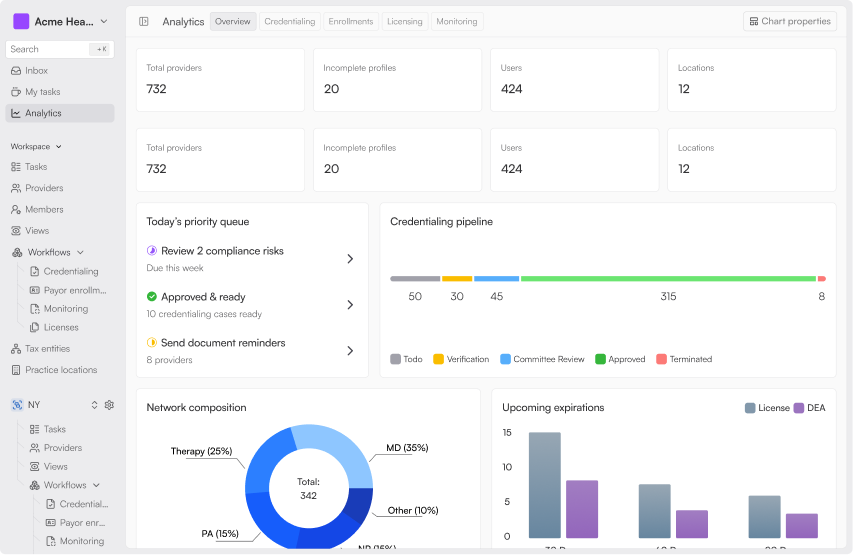
Assured is an AI-powered payer enrollment platform built for enterprise health systems and growth-stage healthcare organizations that need to get providers in-network fast, stay continuously compliant, and scale without adding headcount. The platform automates the full enrollment workflow end-to-end.
We submit applications within 72 hours of receiving provider info, then follow up across payer portals on a fixed cadence until the provider is in-network. The AI reads each payer's specific application, auto-fills from CAQH, NPPES, DEA, and state board data, and runs pre-submission validation against payer rules that change week to week
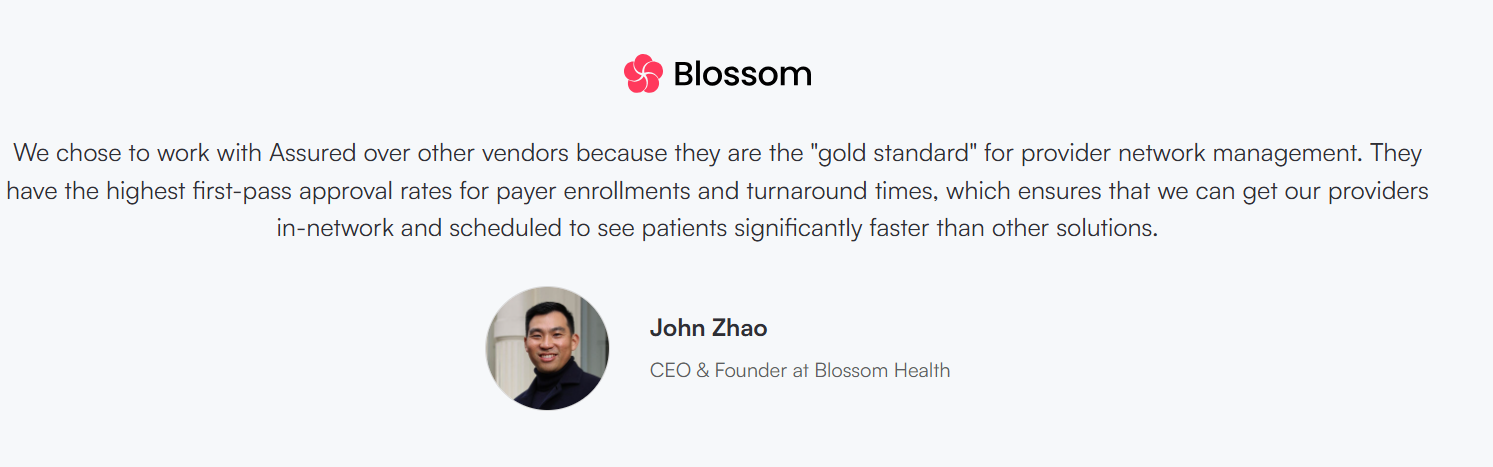
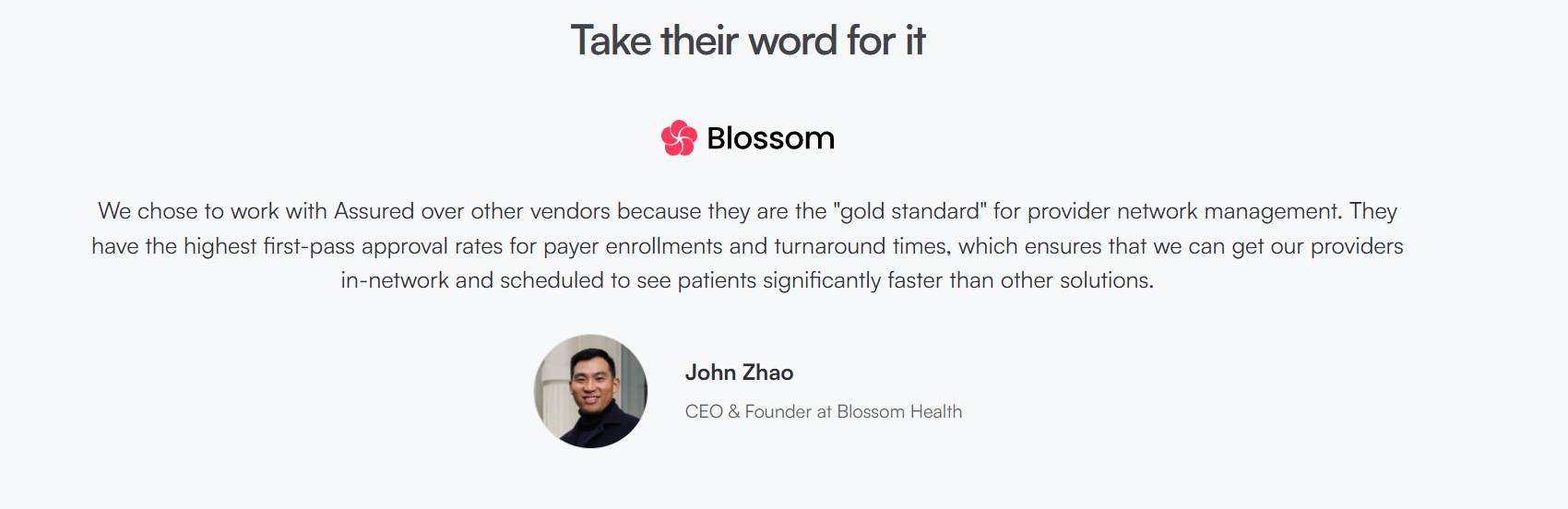
These catch the issues that quietly kill first-pass approvals: closed panels, Optum's 5-TIN limit, telehealth-only licenses that Florida MA payers reject, and missing Medicaid credentials on D-SNP applications. Customers report 80–90%+ first-pass approvals as a result, with John Zhao, CEO of Blossom Health, calling the submission speed "something I don't think is true for other competitors."
See how Assured's AI handles a live payer enrollment, from CAQH pull to portal submission
Payer Enrollment Software Demo | Assured
Usage-based pricing that scales with provider volume. Custom quotes available on request.
Best for: Enterprise orgs and large networks needing breadth of payer coverage in a single system
Madaket Health is built around roster-level submissions and data-sharing agreements with major payers, which cuts redundant data entry across large provider bases enrolling across commercial, Medicare Advantage, and Medicaid MCO plans. It leans less on the AI-driven pre-validation layer newer entrants lead with, and more on scale and payer-network reach for networks managing enrollment at enterprise volume.
Custom enterprise pricing; contact Madaket for a quote.
Best for: Clinics, FQHCs, and ambulatory surgery centers, bundling enrollment with compliance training and credentialing

MedTrainer packages credentialing, payer enrollment, compliance training, policy management, and incident reporting into one healthcare workforce compliance platform. AI form mapping auto-populates payer applications from a central provider record, though submission execution stays with your team.
Tiered subscription based on modules and access level.
Best for: Health systems wanting AI-driven enrollment alongside credentialing, privileging, and provider data management
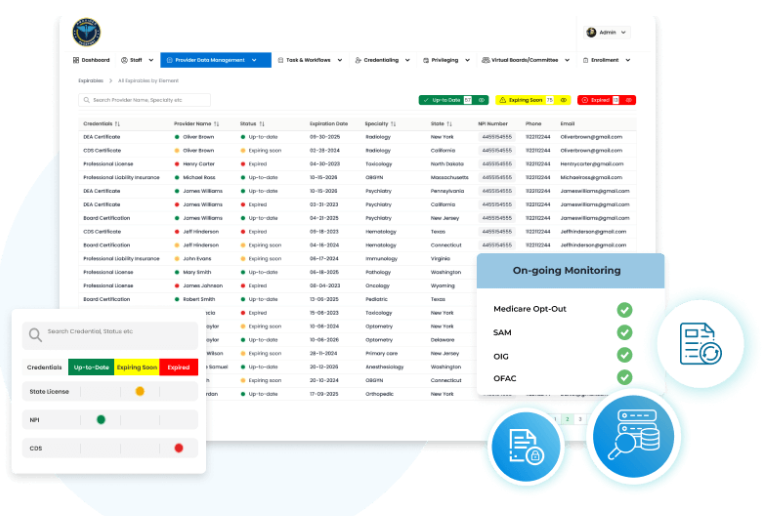
Provider Passport is an AI-first provider management platform covering payer enrollment, credentialing, privileging, and provider data management in one system. Its TruMation RPA layer handles portal submissions, uploads, and status polling without manual intervention.
Custom pricing upon request.
Best for: Hospital systems and academic medical centers needing enrollment integrated with privileging and EHR workflows
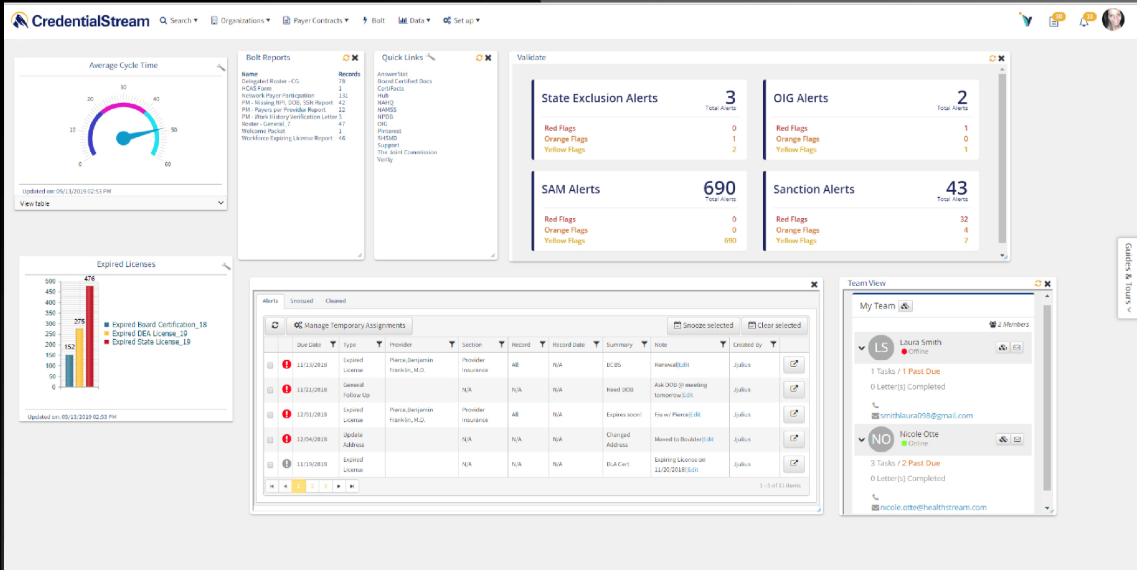
CredentialStream is HealthStream's enterprise credentialing and enrollment platform, built for hospitals and larger health systems with formal medical staff offices, established EHR systems, and committee-based privileging workflows. The enrollment module resides within a connected provider record that spans credentialing, privileging, reappointment, and PSV.
Custom enterprise pricing upon request.
Best for: Smaller practices and mid-sized groups wanting a user-friendly system of record for credentials and basic enrollment tracking
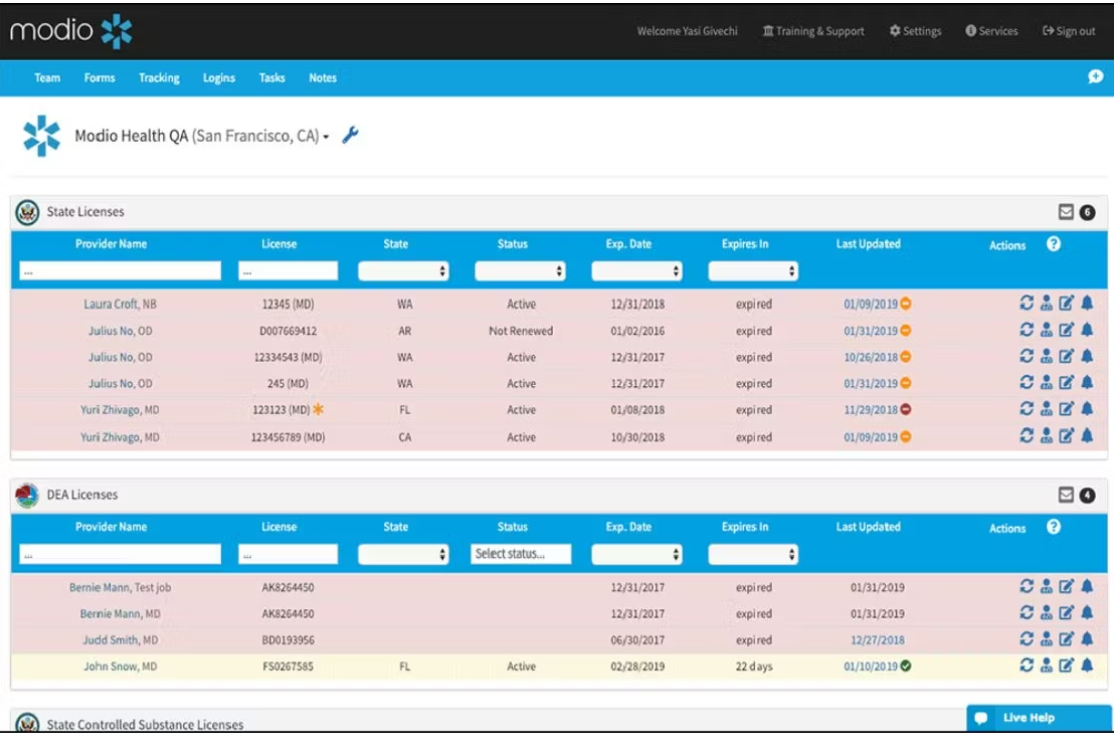
Modio Health's OneView is well-known in the credentialing-first category. On the payer enrollment side, it tracks status and stores applications along with credentialing documents, but it doesn't submit to or follow up with payers on your behalf. Teams typically use it as a warehouse for provider data, tracking enrollment progress within the platform while handling operational work outside it.
Custom pricing.
Best for: Mid-market practices managing payer contracts alongside enrollment in one system
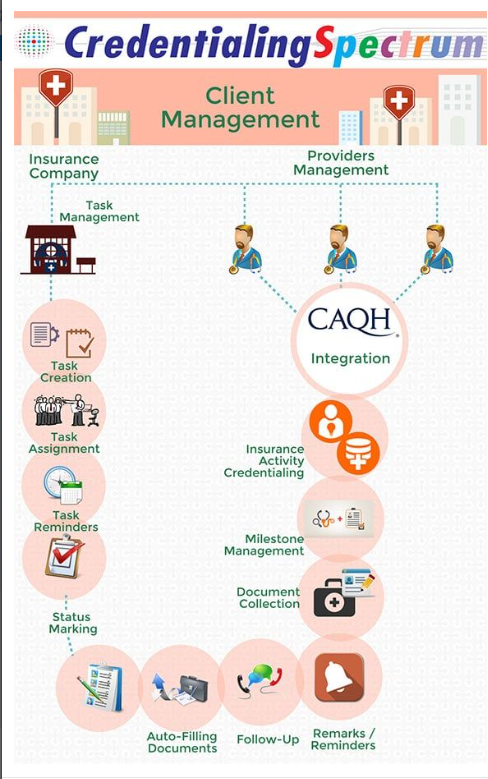
CredentialingSpectrum is a credentialing and payer enrollment platform built for mid-market practice groups. It auto-populates payer applications from stored provider data and layers in contract management, tracking effective dates, renewal timelines, and fee schedules alongside enrollment status.
Custom pricing upon request.
Best for: Large multi-facility health systems needing enrollment within a broader governance, risk, and compliance platform
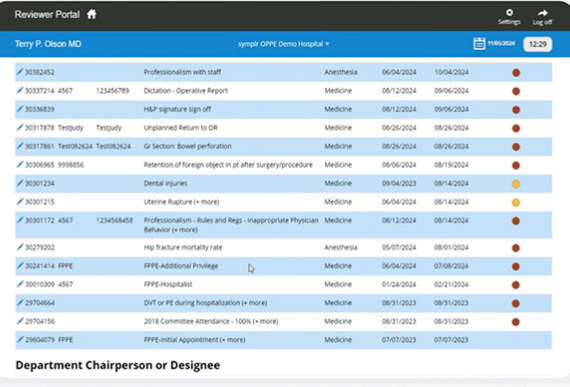
Symplr, which acquired Cactus Software, is the legacy enterprise player in hospital credentialing and enrollment. Its provider module covers credentialing, privileging, payer enrollment tracking, and compliance monitoring, and integrates across the broader Symplr suite.
Custom enterprise pricing based on modules selected.
Speed and multi-state execution are the two pressure points. Your enrollment vendor needs to submit within days, reliably follow up across dozens of payers per state, and handle virtual addresses and payer-specific telehealth rules. Look for platforms with published submission SLAs, sub-24-hour support, and NCQA-certified CVO status. Digital health operators tend to outgrow self-service tools quickly.
Integration is the first screen. Your enrollment platform needs to flow data into the EHR, work with delegated credentialing arrangements, and support roster-level submissions across multiple tax entities. Assured, CredentialStream, and Symplr Provider all serve this segment.
Assured leads on submission speed and AI depth — initiating payer enrollment submissions within 72 hours, automating CAQH management, and handling credentialing, licensing, and monitoring in one system. CredentialStream and Symplr Provider lead on hospital workflows like privileging and committee management.
Prioritize ease of use and cost-efficiency. If your organization is primarily looking for a compliance or LMS-adjacent solution, Modio Health, MedTrainer, and CredentialingSpectrum are worth evaluating. That said, if credentialing speed, payor enrollment, and multi-state licensing are part of the requirement, Assured deserves a look.
Most of the tools on this list handle the basics of payer enrollment. For enterprise health systems and growth-stage organizations alike, the meaningful differences show up in how fast they actually submit, how reliably they follow up, and whether the AI holds up in real workflows.
If you want enrollment applications out the door in 72 hours, ~95%+ first-pass approval rates that compress time-to-revenue, and an NCQA-certified CVO behind every file, book a demo with Assured, and we'll show you exactly how it works.
Credentialing verifies the provider, their education, licenses, board certifications, DEA, NPDB record, and sanctions status. Payer enrollment verifies that the provider is in-network with insurance carriers so the organization can bill for their services.
Submissions happen within days on modern platforms. Industry standard is 90 to 120 business days; Assured submits within 72 hours and conducts follow-ups throughout the entire approval window.
Not entirely. Submission, CAQH management, application auto-fill, and follow-up tracking can all be automated but payer approval can't. Once an application is in a payer's queue, no software controls how fast it moves. The best platforms compress everything on the submission side and follow up proactively on the rest.
Most do, though coverage varies by plan and state. Medicare enrollment specifically has its own workflow (PECOS, MAC regions, revalidations) that not every platform handles with equal depth. However, Assured handles both, with payer-specific application logic, portal automation, and real-time status tracking.
The better platforms detect closures before you submit and flag them during pre-validation. Others submit anyway, and you find out weeks later when the denial comes back. Assured's pre-submission validation specifically checks for closed panels, incomplete documentation, and specialty conflicts before any application goes out, which is a core reason first-pass approval rates run at ~95%+
Ranges from a few thousand a month for smaller practice-focused tools to enterprise contracts well into six figures annually. Usage-based pricing tends to align cost with growth; fixed per-seat or per-application pricing penalizes scale.

Assured Health, Inc.
333 Seventh Ave, Suite 1701
New York, NY 10001