5 Best APIs for Provider Credentialing in 2026

Varun Krishnamurthy
November 2, 2026

ProviderTrust and Assured both verify provider data at the primary source, and both keep monitoring it. But they differ in how much work around that data each one does.
ProviderTrust sells verified data on providers, employees, and vendors and sends it into the systems you already use. Assured runs credentialing, payer enrollment, rosters, and licensing on one platform, with built-in monitoring.
Are you weighing ProviderTrust against a platform like Assured?
ProviderTrust can be a smart buy, and it's easy to see why. It monitors more than 14 million people and entities, and more than 1,000 healthcare organizations already use its data.
But ProviderTrust stops at the data. As its own DynamicNPI FAQ puts it, “It's not a full-service CVO.” So your team still has to complete each credentialing application and prepare the committee file. And then someone has to submit a payer enrollment application to every payer you work with.
That's fine if your team already runs those steps well. But what if your new providers are waiting weeks between a signed offer and their first paid claim? Faster data on its own won't fix that.
So which kind of tool does your team need?
At Assured, we hold NCQA's credentials verification organization (CVO) certification in all 11 of the program's evaluation products. And more than 100 healthcare organizations use our platform, including Houston Methodist.
Birches Health is one of them. It grew from 10 providers in 2 states to 800 across all 50 states in under three years. Using our platform, Birches submitted thousands of credentialing applications, and denials dropped to zero.
Zero denials is a big deal at network scale, because a denied application means you're starting over. And that rework can add 30 to 60 days.
ProviderTrust and Assured overlap in two places: primary source verification and ongoing monitoring. But they differ on the steps in between, from the provider's application through payer enrollment.
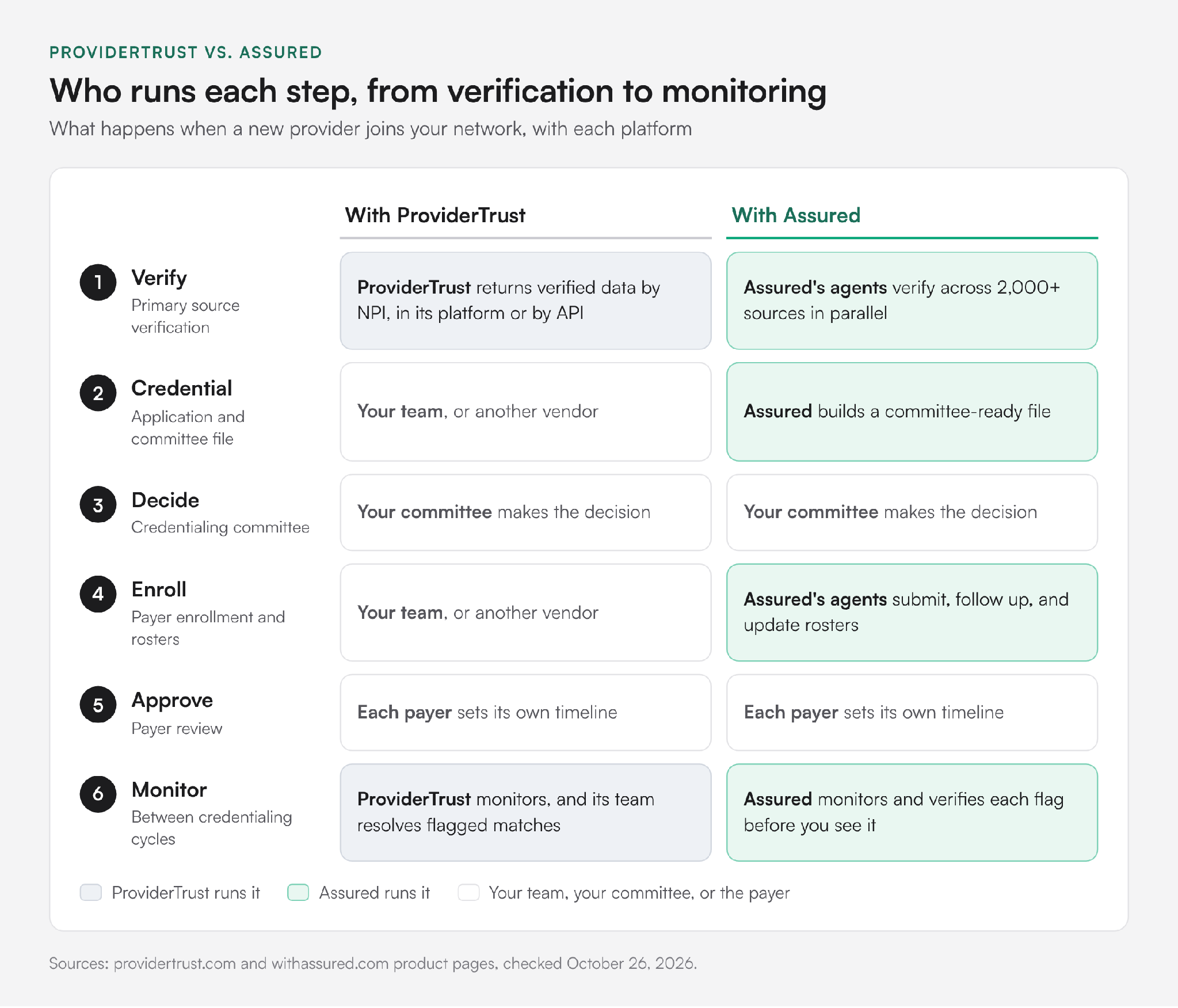
Who runs each step when a new provider joins your network? Your committee and each payer make their own decisions either way.
Best for: Teams that already run credentialing and enrollment and want verified provider, employee, and vendor data in their own systems.
ProviderTrust is a Nashville company founded in 2010 to monitor OIG and state Medicaid exclusions. Today, it sells three kinds of data to more than 1,000 healthcare organizations, covering compliance, credentialing, and workforce data.
ProviderTrust's credentialing data is built mainly on DynamicNPI, a database of more than 4 million verified provider profiles. Enter an NPI, and you'll get a verified profile back in under half a second. From there, it's ready to add to ongoing monitoring.
You can work with that data in ProviderTrust's own platform. Or if you'd rather use your own systems, you can send it there through an API or SFTP connection.
In October 2026, ProviderTrust also connected its data to attested profiles from DataSpring (powered by CAQH) for shared customers. As ProviderTrust co-founder Chris Redhage put it, “This isn't a workflow problem, it's a data problem.”
That's a clear position, and it tells you who ProviderTrust is for. It's a good fit if your team runs its own credentialing workflow and wants better data to run it on.
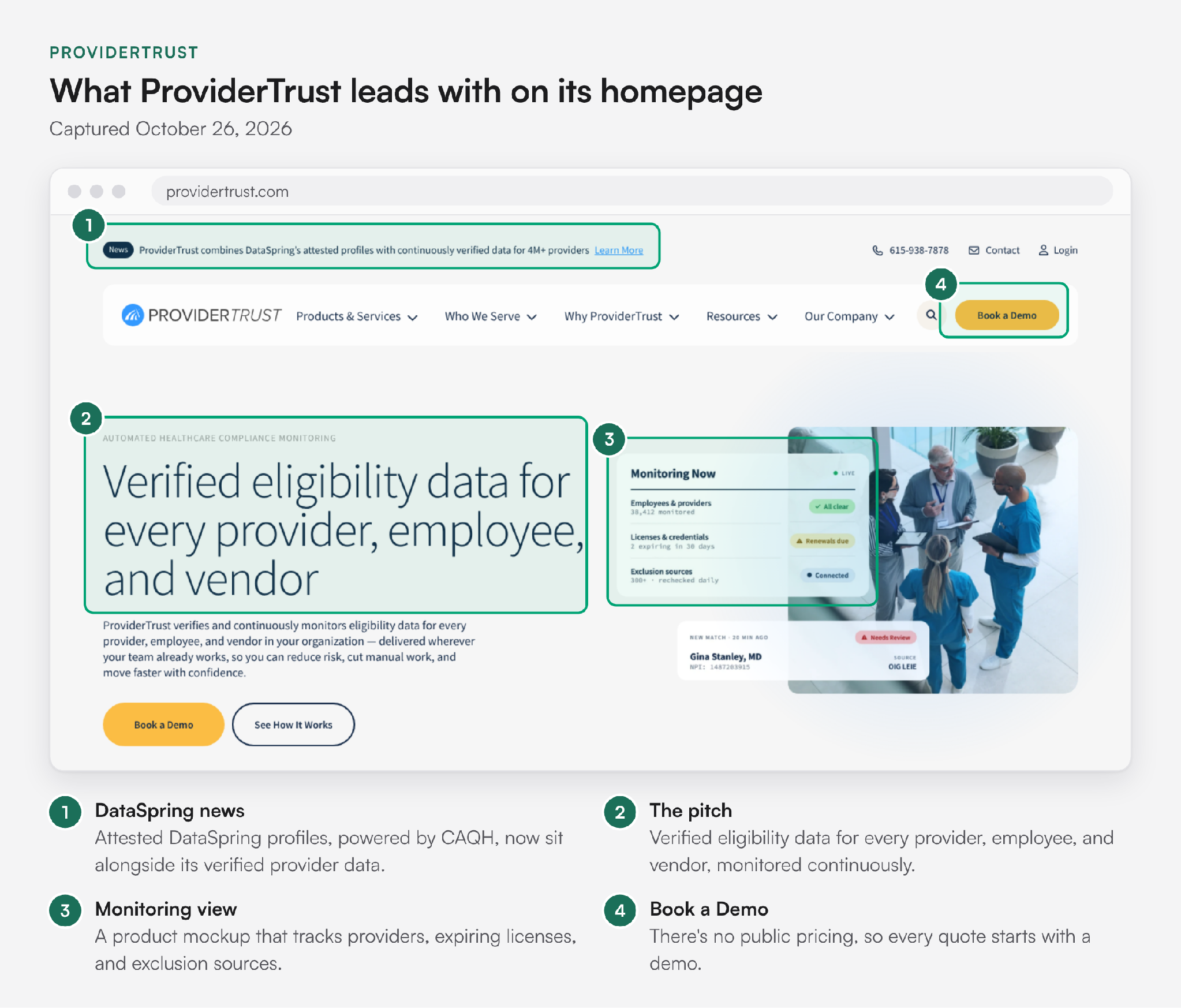
ProviderTrust's homepage leads with verified eligibility data for providers, employees, and vendors.
ProviderTrust's three data products cover verification, screening, and monitoring. It doesn't offer application processing, committee-ready files, payer enrollment, or state license applications. So your team, or another vendor, still has to run those steps.
Best for: Health systems, health plans, and multi-state groups that want credentialing, payer enrollment, rosters, licensing, and monitoring in one place.
Assured is an AI-powered platform that automates provider credentialing, licensing, and payer enrollment for healthcare organizations. Our AI agents verify provider data, build committee-ready credentialing files, submit payer applications, and chase the follow-ups. So your team only has to step in when there's an exception.
That work gets harder in a large network, because hospitals, entities, tax IDs (TINs), locations, and payer contracts all overlap. To keep that straight, our platform connects every provider to the right ones. That way, a single change updates credentialing, enrollment, and payer rosters together. You can also run rosters and individual applications side by side, for delegated and non-delegated payers alike.
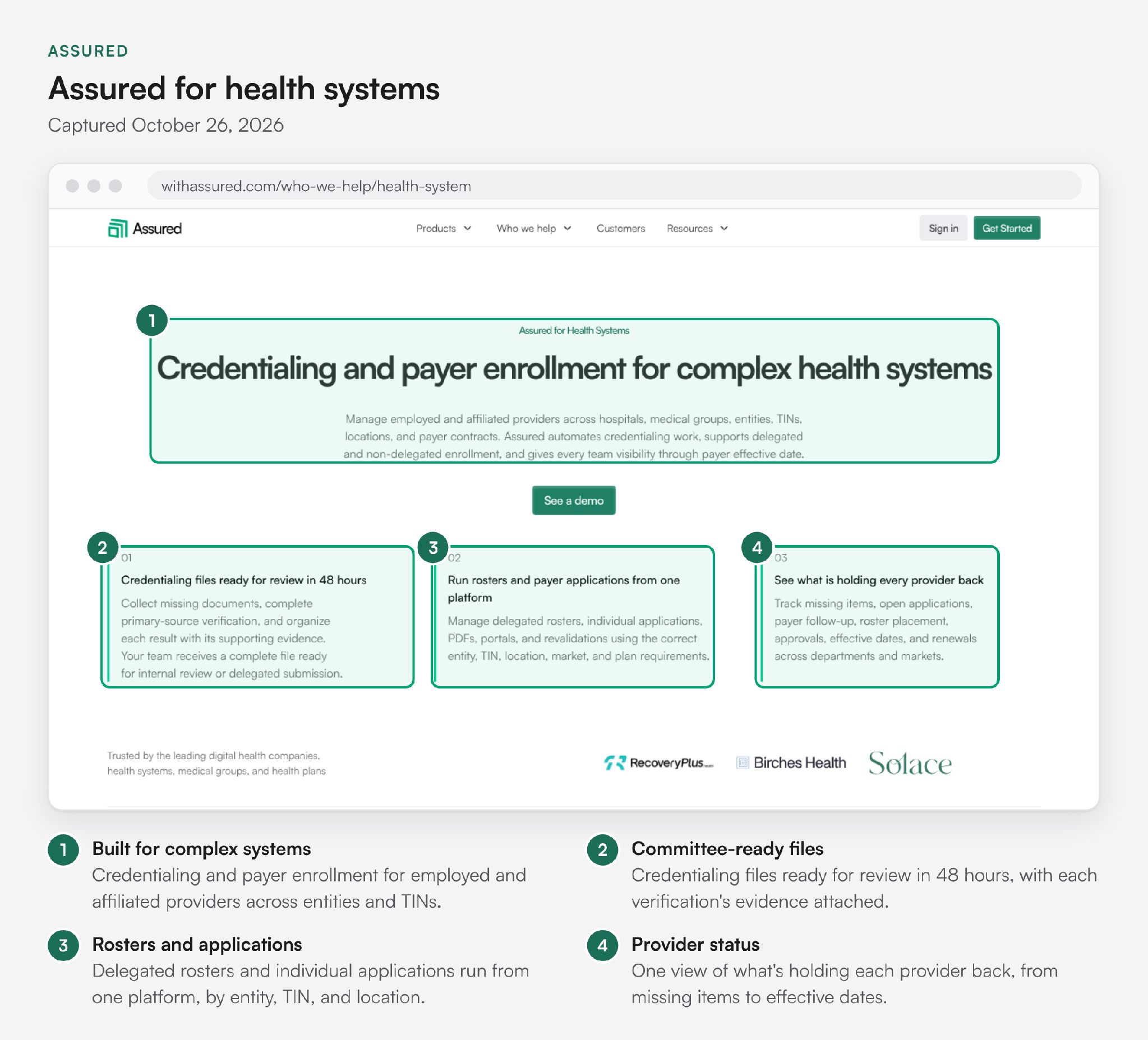
Assured's health system page covers employed and affiliated providers across hospitals, entities, TINs, locations, and payer contracts.
On the credentialing side, your team controls decisions, signatures, and exceptions. By the time a file gets to your committee, every verification shows its source, timestamp, and result. And anything outside NCQA's validity windows gets flagged before that review.
Then there's payer enrollment, and that's where your revenue team feels the delay. Until a payer approves the enrollment, a new provider can't bill that payer in-network.
How long is that wait? Our 2026 benchmark looked at 324 first-time enrollments from the past 12 months, reported by enrollment specialists at 160 organizations. The median enrollment took 69 days from submission to payer confirmation, and one in four took 97 days or longer.
That's why our agents submit payer enrollment applications within 72 hours of getting complete provider information.
Sending applications fast is only half the battle, though. You'll also need them approved the first time. Our overall first-pass approval rate is 95%+, and that's important because a rejection costs you time. In the same benchmark, rejected Aetna submissions took 44 days longer than clean ones.
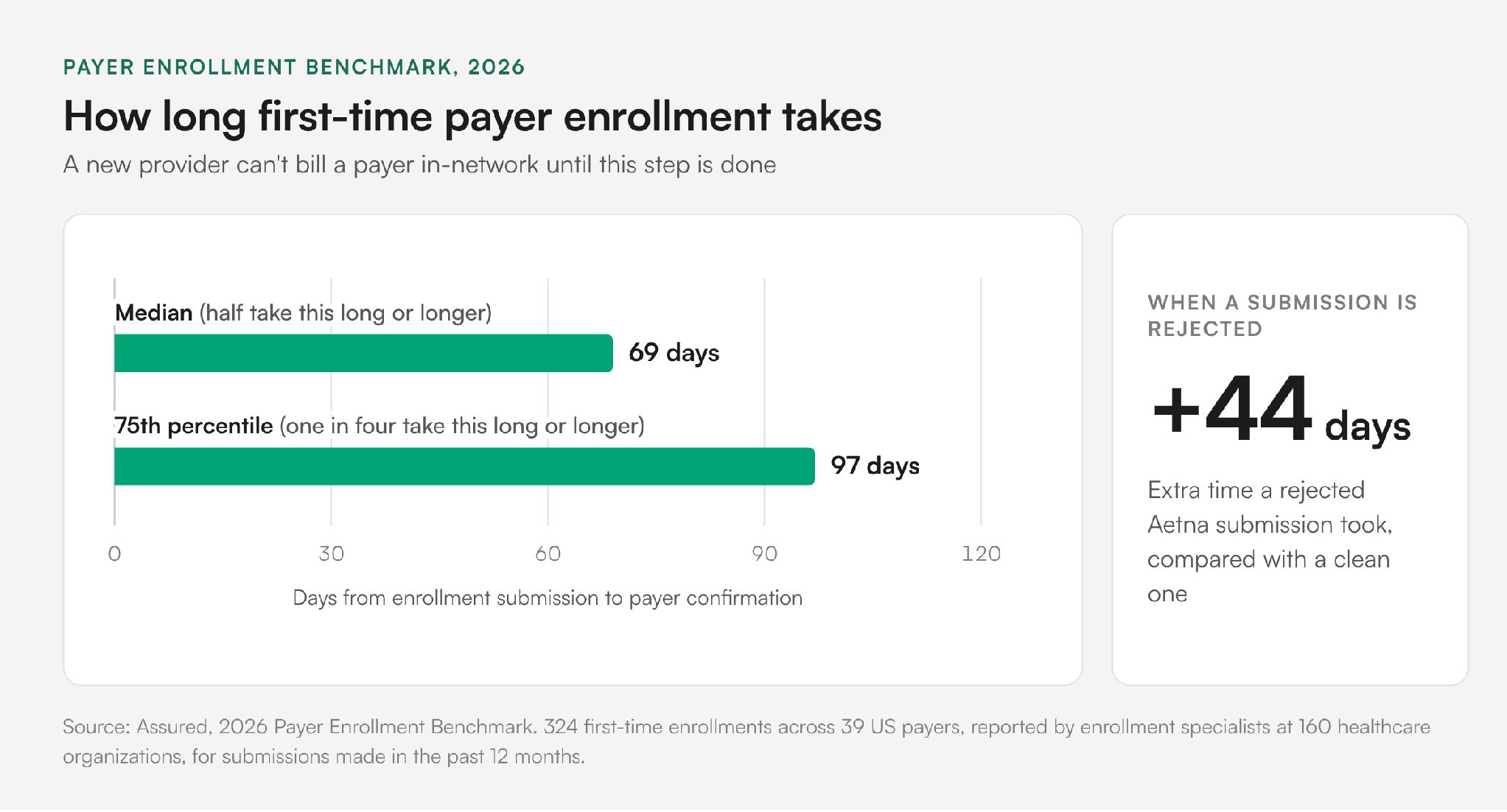
First-time payer enrollment times from our 2026 benchmark, and the extra time a rejected Aetna submission took.
At Assured, we can't control a payer's approval timeline, even when we submit a clean application within 72 hours.
And on the screening side, we've built our platform around providers and the staff types you configure. Vendor screening isn't one of our listed products, so you'd need another tool for that.
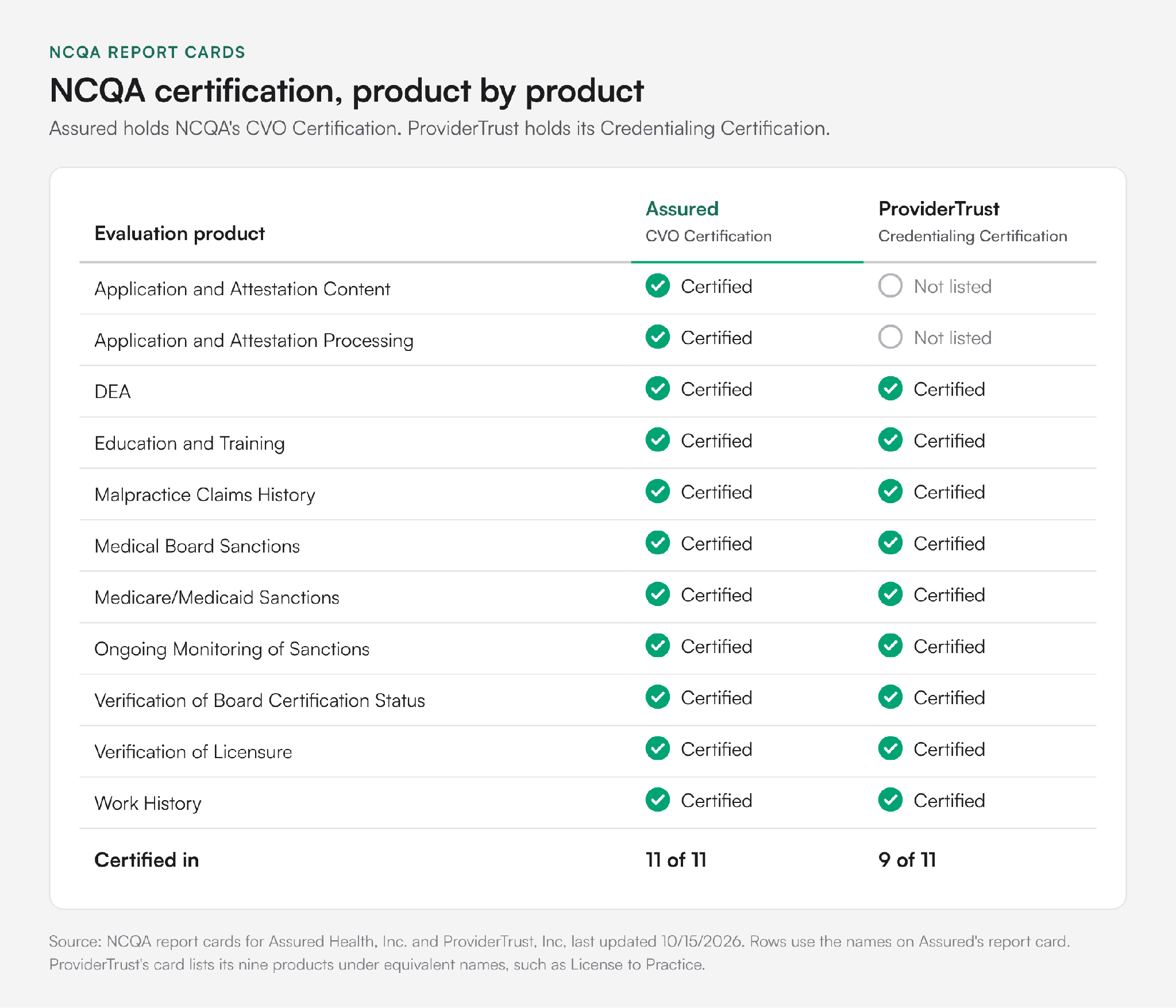
Assured's and ProviderTrust's NCQA report cards, compared product by product.
Choose ProviderTrust if your team already runs credentialing, committee review, and payer enrollment, and wants verified data for that work. It's also the stronger fit if you need to screen employees and vendors with the same data as your providers.
Choose Assured if you're losing weeks between a signed offer and a new provider's first paid claim. Our agents run the credentialing, enrollment, and roster work in that gap. Your team still makes the credentialing decisions and handles the exceptions.
Book a demo to see how Assured works across your hospitals, entities, and payers.
Yes, ProviderTrust pulls license data from more than 600 state licensing boards and returns it through its platform or API. That means you don't have to connect to each board yourself.
Applying for new licenses is a different job, though. For that, you'll need a licensing workflow, like the one in Assured's platform that files IMLC applications for multi-state expansions.
Yes, ProviderTrust can shorten the verification step because it delivers 95% of its verifications within two days.
But verification is only one step before a new provider's first paid claim. The application, committee review, hospital privileges, and payer enrollment still have to happen, and ProviderTrust doesn't run any of them.
Yes, ProviderTrust's workforce data covers background checks, credential verification, and license verification. For example, its one-time pre-employment check typically includes state licenses, OIG and state Medicaid exclusions, and employment and education history. It checks DEA registration too, when the role calls for it.
In April 2026, ProviderTrust also partnered with J.D. Palatine (JDP), a background screening company. That partnership brings JDP's screening and ProviderTrust's verification together in one hiring workflow.
Passport is a ProviderTrust application for ongoing monitoring, and it's separate from the company's pre-employment checks. It runs sanctions checks, exclusion screenings, license verification, or a mix of the three, based on the package you buy.
And in Passport, a “provider” means anyone you're monitoring, including staff, referring physicians, and contractors.

Assured Health, Inc.
333 Seventh Ave, Suite 1701
New York, NY 10001