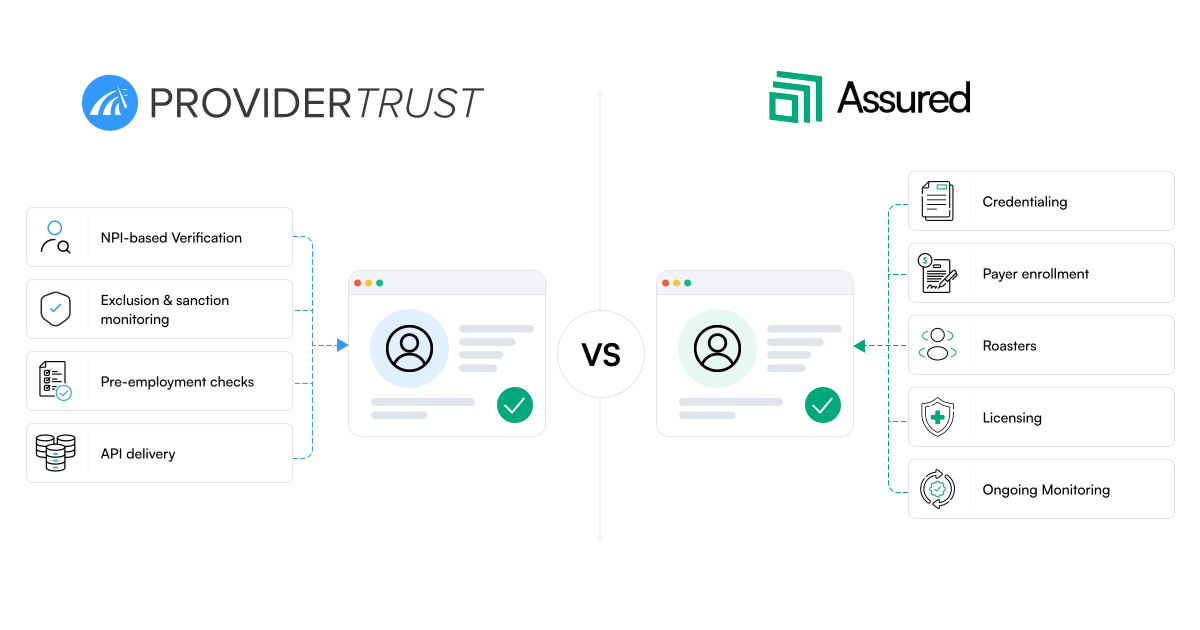
ProviderTrust vs. Assured: Which Is Right for Your Credentialing Team?

Rahul Shivkumar
November 6, 2026

Locum tenens credentialing involves the same core checks as credentialing a permanent hire. But with locums, you end up collecting the same documents and running the same verifications again and again. Reviews also come around more often, and the provider keeps switching from one facility to another. A few habits make that workload much easier to manage:
Say a locum physician finishes an assignment at one hospital and starts a new one at another facility in the same health system. You've already collected their education records, verified their training, and reviewed their malpractice history. But the next facility may ask for the same documents all over again. It may also run its own verifications and set its own review schedule.
Three problems show up again and again:
Now multiply that by dozens of providers going from site to site throughout the year. It's easy to see why locum credentialing becomes such a headache for medical staff offices.
So how do you keep credentialing on track without cutting corners? This guide walks you through a step-by-step process that lets your team reuse eligible work across assignments.
Assured is an NCQA-certified CVO. Our AI-powered platform automates primary source verification across 2,000+ sources and continuously monitors credentials. We work with health systems such as Houston Methodist. We also support credentialing for both locum tenens and permanent providers, using the same verifications and the same credentialing packets. In this guide, we'll show you where automation helps and where your medical staff office and committee still make the final decision.

Locum tenens credentialing is how a healthcare facility verifies that a temporary provider has the qualifications needed to practice there.
If you've credentialed permanent physicians before, the checks will feel familiar. You'll review the provider's license, education, training, board certification where it applies, malpractice history, and any other relevant information.
It also helps to separate two terms that people often use interchangeably.
Credentialing verifies a provider's qualifications and professional background. Privileging determines which clinical procedures and services that provider is authorized to perform at your facility.
So a physician can have a fully verified credentialing file and still need privileges before they can see patients at another hospital.
In an urgent situation, a hospital may grant temporary privileges before regular approval is complete. Those privileges come with their own verification obligations and time limits, which we'll cover in step 1.
A locum could practice in three hospitals over a few months, each with different bylaws and privileging requirements. You may be able to reuse parts of their verified record, but every receiving facility still needs to meet its own requirements.
A permanent hire may have months between accepting an offer and starting work, but a locum might be needed within weeks.
So you're under pressure to work fast, especially when you're still waiting on references, licensing information, or committee approvals.
On top of that, many organizations review locum providers more often than permanent staff, each on its own schedule.
If you need a locum to start sooner, an expedited review can shorten the credentialing process. Temporary privileges can also let an eligible provider begin work before full approval. But neither one removes the checks your hospital has to complete.
With that in mind, let's walk through how to credential a locum provider, starting with the privilege pathway.
Getting a locum from intake to a complete credentialing file comes down to five steps.
Privileging is a separate hospital process, but the pathway you choose decides which credentialing checks have to be done first. So confirm it before you request any documents.
If your hospital is Joint Commission-accredited, the main pathways are regular privileges and two types of temporary privileges. Disaster privileges are a separate option for qualifying emergencies.
Keep in mind that these are only summaries. To decide eligibility, go by your accreditor's full requirements, state law, and your medical staff bylaws.
To grant temporary privileges for an important patient care need, you have to document that need. A locum's temporary status isn't enough on its own.
If you keep bringing the same locum back, temporary privileges shouldn't become your default workaround. In that case, regular credentialing may make more sense.
Either way, privileging decisions belong to your medical staff office and governing body. The rest of this guide sticks to the credentialing side.
Once you've picked the privilege pathway, it's time to pull the documentation together.
You can start with your existing credentialing checklist for permanent staff, then add the items that matter for temporary assignments.
Most importantly, separate the documents an agency or provider can supply from the information your hospital still has to verify.
We'd split the checklist into core items and locum-specific items.
Core items
Locum-specific items
Your hospital has to query the NPDB each time a locum applies for temporary privileges, even if the same locum applied last month. That obligation stays with your hospital, even when someone else runs the query. A CVO can run it as your agent, but only if your hospital is registered with the NPDB.
There are two ways to make that workload lighter:
It's worth agreeing on the split below before your first locum arrives. Otherwise, gaps tend to appear wherever each party assumes someone else has it covered.
The Federation Credentials Verification Service is run by the Federation of State Medical Boards (FSMB). It keeps a permanent, primary-source-verified profile of a physician's core credentials, covering identity, medical education, postgraduate training, exam history, and board actions. If a locum has a profile, they can send it on to another recipient, so the same history doesn't need verifying again. FSMB charges a fee for the initial application and for each additional profile sent.
At intake, ask whether the locum has an active profile. If your policy and accreditor accept it as a verification source, you may not need to re-verify education and training. It does have some limits, though:
A new site can mean a new file, because each facility sets its own verification requirements. So start by sorting every locum file into two groups:
Potentially reusable items: License verification, DEA, board status, exclusion screening, education, training, and malpractice documentation. Keep these in one central record and make sure they stay current. But whether a prior verification counts at a new facility depends on that facility's policy, including how recent it has to be. The NPDB is the exception, because you'll need a new query for each application unless the locum is enrolled in Continuous Query.
Site-specific items: Privilege delineation, orientation, committee approval, and facility health requirements. These usually need to be done fresh at each facility.
When a returning locum starts a new assignment, check their file against the new facility's requirements. Update anything that's expired or changed, like a new state license or malpractice policy, and run a new NPDB query. If the facility requires something to be current, re-verify it, even if it hasn't changed.
Then track these dates for every active locum, with alerts at 90, 60, and 30 days:
Tracking these dates in a spreadsheet gets harder as you add more providers, facilities, and states. And if a privilege lapses mid-assignment, the locum may not be able to keep seeing patients at that facility. That's because under CMS rules, patients must be under the care of a practitioner with privileges.
A lot of locum credentialing is work your team has already done. Someone has to collect documents, verify licenses, check training, review board status, and screen for exclusions. Then they document the results and follow up whenever information is missing. And when the provider starts another assignment, your team ends up doing much of it again.
Assured supports credentialing for both locum tenens and permanent providers, using the same primary source verifications and the same credentialing packets. Your organization still decides how often locum providers are reviewed.
On our platform, that work splits into four parts:
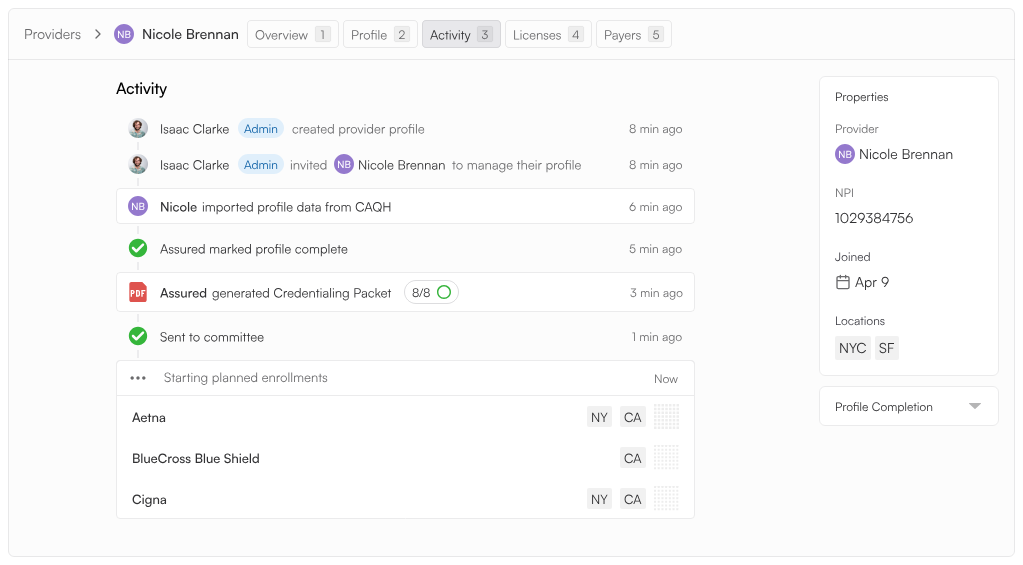
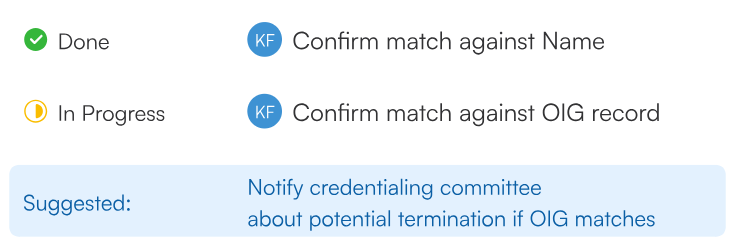
So across your whole locum roster, your team can spot problems before they get in the way of the next assignment.
What should you look for in locum credentialing software?
Three questions are worth asking:
Also, be clear about where the software's role ends.
Credentialing software can verify credentials, prepare packets, and keep a provider's file up to date. But your hospital's medical staff and governing body are still responsible for privileging decisions.
The same goes for NPDB compliance. If you're relying on a vendor to submit queries, confirm that the arrangement satisfies your hospital's obligations.
When you're only credentialing a handful of locums, you can usually keep track of everything by hand.
But as your roster grows, it gets harder to keep up. Providers go from one facility to the next, documents expire, and applications come in at different stages. Meanwhile, someone has to stay on top of what still needs verifying.
You can often make the biggest improvement by getting more organized about the work you've already done.
Keep verified information in one central record, and reuse it wherever the receiving facility's requirements allow. Then make it easy to see what still needs attention for each assignment.
That way, your team spends less time chasing the same documents and more time reviewing qualifications, resolving exceptions, and getting providers ready for approval.
Assured supports credentialing for both locum tenens and permanent providers on the same platform. Our AI agents gather primary-source information, prepare credentialing packets, flag issues, and keep credential records current. So your medical staff office gets a clear picture of where each provider stands. Privileging decisions still stay with your hospital.
If your team spends more time rebuilding locum files than reviewing them, book a demo to see how Assured supports locum credentialing.
Hospital credentialing and privileging usually take 60 to 120 days, though expedited pathways can shorten that depending on the facility. Temporary privileges can let a locum start before committee approval, but the required verifications have to be complete first. The biggest variable is how complete the file is on day one. Once the required information is available, Assured prepares committee-ready packets in under 48 hours. Committee review and privileging approval still follow your hospital's own timeline.
Yes. Assured supports credentialing for locum tenens and permanent providers. We run the same primary source verifications and prepare the same credentialing packets for both. Your organization decides how often locum providers are reviewed. Once the required information is available, we put together committee-ready packets within 48 hours. Your hospital still makes the privileging decisions.
It depends on your bylaws. The Joint Commission's 120-day limit applies to temporary privileges for new applicants who are waiting on approval. For urgent patient care needs, your bylaws set how long temporary privileges last. If you keep needing the same locum, credentialing them through the regular process saves you from regranting temporary privileges every few months.
Credentialing verifies a provider's qualifications (license, education, training, board certification, malpractice history) through primary source verification. Privileging is the facility's decision about which clinical activities that provider can perform at a specific site. So a locum can be fully credentialed and still need separate privileging at each facility. Each facility defines its own privilege categories through its medical staff bylaws.
In most cases, the privileging decision is made at each site. You may reuse verification results if you keep them in a central system, but each facility still sets its own verification requirements. If your health system has a unified medical staff, it may be able to privilege across sites. So check your bylaws and each facility's policy.
No. An agency's file speeds up intake, but your hospital still has to run its own NPDB query and make its own privileging decision. It's a good idea to agree upfront on who supplies documents, who chases references, and who tracks expirations.
The provider loses their privileges to treat patients at your facility until your hospital grants new ones. If you let them keep treating patients anyway, you'll have a compliance problem under CMS's conditions of participation. So for any assignment that might run long, start the regular credentialing process early and set alerts well before expiration.

Assured Health, Inc.
333 Seventh Ave, Suite 1701
New York, NY 10001