ProviderTrust vs. Assured: Which Is Right for Your Credentialing Team?

Rahul Shivkumar
November 6, 2026

CVO credentialing means hiring a credentials verification organization (CVO) to verify each provider's qualifications with the source that issued them. That covers license, education, board certification, work history, malpractice history, and sanctions. The CVO sends back a verified file, but your credentialing committee still makes the decision.
NCQA certifies CVOs for up to 11 verification services, so check which ones a CVO holds before you delegate.
Thinking about handing your primary source verification to a CVO? It can take a lot of checking off a stretched team. And if the CVO is NCQA-certified, you get to skip most of the oversight you'd otherwise owe.
But "NCQA-certified" doesn't tell you which checks are covered. NCQA certifies CVOs across 11 separate verification services, and a CVO can hold anywhere from one to all 11.
Even a CVO certified for all 11 only verifies credentials. Your committee still makes the call, and NCQA checks that you made it on time. A certificate also won't show you what one of your files looks like when an auditor asks for it.
So what does a CVO do, where does its certification stop, and how do you choose one?
We've been through NCQA's CVO survey ourselves. We're certified for all 11 of its verification services, from license-to-practice to ongoing sanctions monitoring.
With our help, Birches Health grew from 10 providers in 2 states to 800 across all 50 states in under three years. Its CEO, Elliott Rapaport, says Birches cut processing time for each provider credential "by up to 75%." And Blossom Health's CEO, John Zhao, says we deliver credentialing "with much faster turnaround and higher first-pass quality."
This guide is the checklist we'd want any buyer to hold a CVO to, including us.
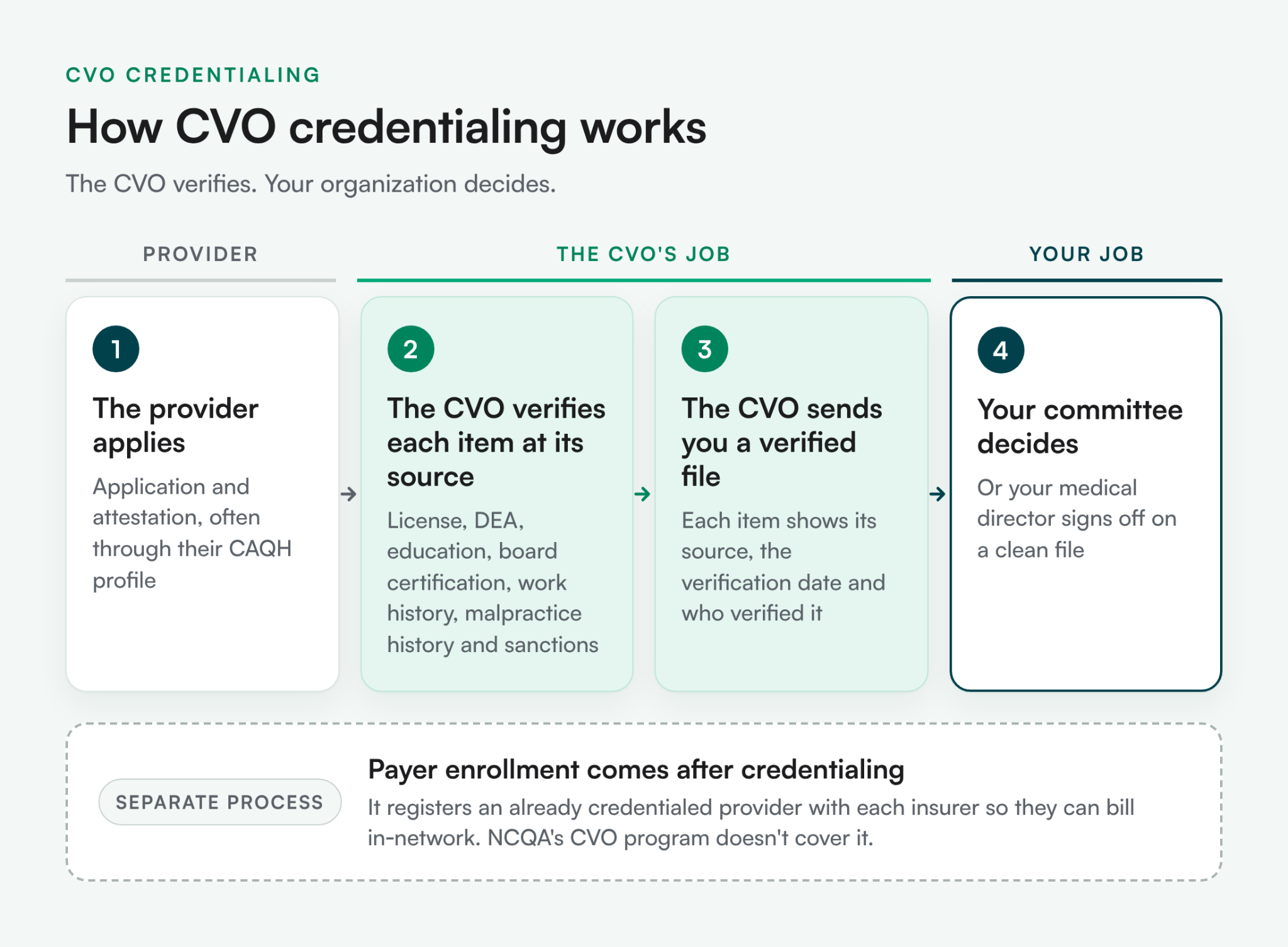
CVO credentialing is when a credentialing verification organization (CVO) checks a provider's qualifications for you and sends back the verified results. NCQA describes CVOs as organizations that verify a practitioner's academic, licensing, and clinical practice history. They check with the primary source, a recognized source, or a contracted agent of the primary source. Health plans, behavioral health organizations, physician groups, and other health care organizations all use them.
The work starts with the provider's application, which often comes in through their CAQH profile. From there, the CVO checks each item with primary source verification (PSV), which is the heart of the job.
PSV means confirming each credential with the issuing body. A medical license gets checked with the state medical board, and board certification gets checked with the certifying board. Sanctions and exclusions get checked against federal lists, like the OIG's List of Excluded Individuals and Entities.
So a photocopy from the provider doesn't count, with one exception. NCQA accepts a copy of a DEA certificate, since the DEA doesn't confirm them by phone or in writing.
Once the CVO sends you the verified file, your organization makes the decision. A credentialing committee reviews the file and decides whether the provider joins your network. For a clean file, a medical director can make that call.
Hospitals work the same way. Under Medicare's hospital rules, the medical staff examines each candidate's credentials and recommends, and the governing body makes the appointment.
Payer enrollment is a separate step that comes later. It registers an already credentialed provider with each insurer, so they can bill in-network.
NCQA CVO certification covers a CVO's verification work and the systems behind it, scored one verification service at a time. It doesn't cover the credentialing decision itself.
NCQA folded its credentialing programs into one suite with two tracks. Credentialing Accreditation is for organizations with a credentialing committee that has the authority to approve a practitioner for the network. Credentialing Certification, the track CVOs go through, is for organizations that verify credentials but don't have that committee.
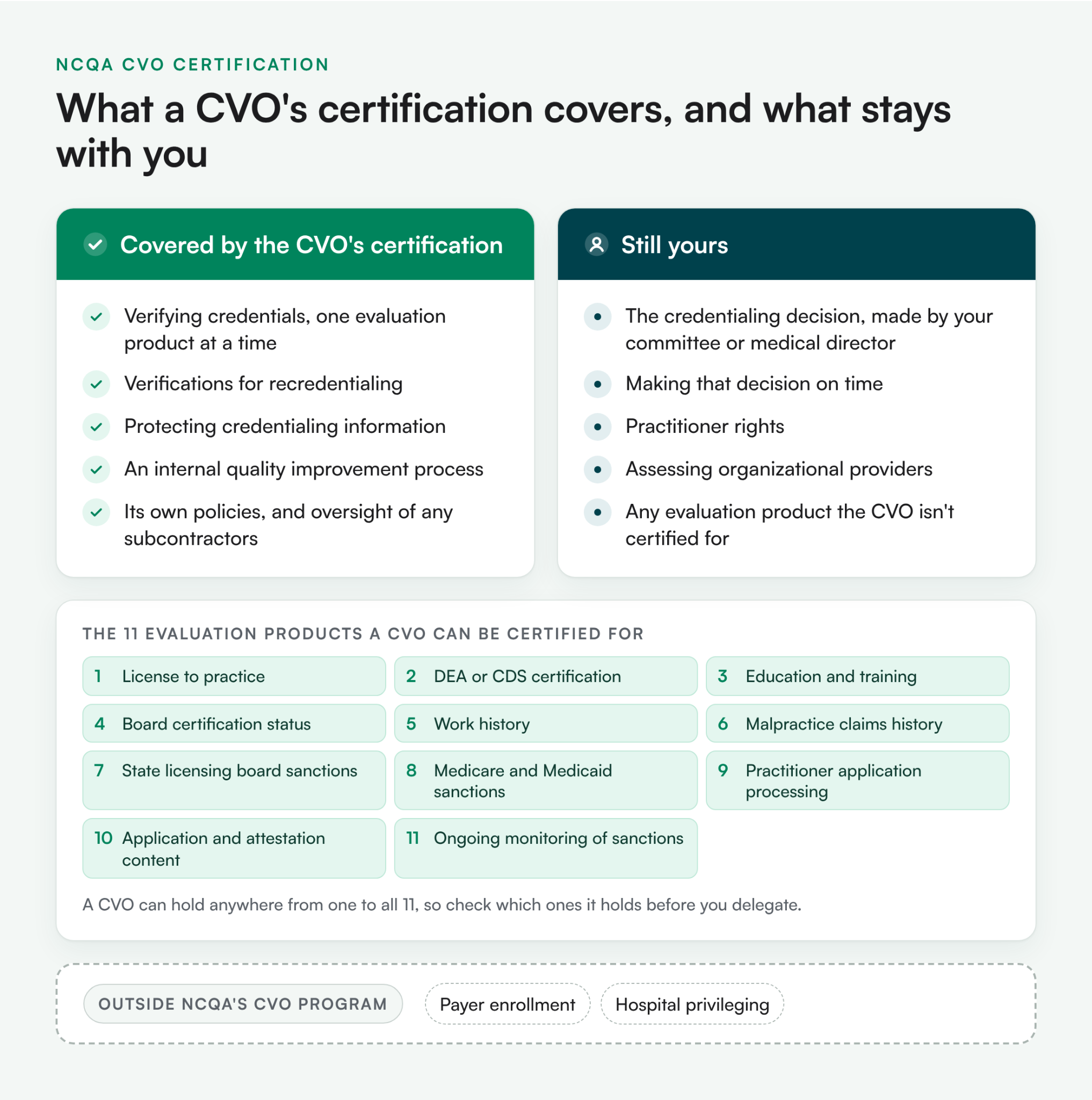
NCQA's CVO standards cover an internal quality improvement process, protecting credentialing information, and verifying credentials. The verification part is split into 11 evaluation products, and a CVO earns certification in each one separately:
NCQA's September 2025 guide says all 11 are required for NCQA-accredited health plans. So if your CVO isn't certified for one of them, verifying it (or overseeing whoever does) stays your job.
Certification now runs on a three-year cycle, and NCQA's 2025 changes also shortened how old a verification can be. Many of the standards have a six-month look-back, and the survey can include an onsite file review. That makes certification strong evidence that a CVO's process works.
But it's a judgment on processes and the files NCQA reviewed, so it doesn't vouch for every file you'll get.
Three standard areas only appear in Credentialing Accreditation, so a CVO's certification says nothing about them.
From NCQA's September 2025 guide to its credentialing programs.
So these three jobs are yours, even with a fully certified CVO:
Anything outside NCQA's programs, such as payer enrollment or hospital privileging, isn't covered at all.
Still, if you're NCQA-accredited or working toward it, NCQA waives most of your oversight of a certified CVO. You skip the pre-delegation evaluation, semiannual reports, yearly evaluation against NCQA standards, and annual audit of the CVO's files. And you get automatic credit for the verifications the CVO completes.
The waiver has limits, though. It only covers the products the CVO is certified in, and you need a written delegation agreement. NCQA gives no automatic credit for de facto delegation, where a vendor does the work without one.
And NCQA's survey still checks whether your credentialing decisions were made on time. So a slow committee is your problem, even with a fast CVO.
If you're weighing a CVO against your own team, the difference is who does the checking and who answers to NCQA. In-house, your staff checks every credential and answers for it all in your NCQA survey. With a certified CVO, the CVO's team does the checking, and NCQA drops most of the oversight for its certified products.
Credentialing software is a third route, and NCQA treats it differently. If a vendor's software only collects information from approved sources, that isn't delegation. So your own staff has to document that they reviewed and verified each item. It only becomes delegation when the vendor reviews the information on your behalf.
In-house tends to work when your network is small and steady, and you credential in a state or two. And it helps if your team has done it for years.
A CVO pays off when you're hiring providers faster than you can verify them, or adding states. It also pays off when you're building a delegated credentialing program with health plans.
Or you can split the work. Keep the committee and provider communication in-house, and send verification and monitoring to a CVO.
If you credential for a hospital, there's a second rulebook. The Joint Commission accepts reports from CVOs "that meet Joint Commission requirements" as primary source verification. Its glossary sets those requirements, and it's on you to confirm a CVO meets them.
Hospitals also have to query the National Practitioner Data Bank (NPDB) when a provider applies for privileges, and every two years after. A CVO can run those queries as your agent, but the duty to query stays with you.
If cost is the deciding factor, we've broken down in-house vs. outsourced credentialing costs separately.
If a CVO makes sense for you, start with its NCQA certification. Then check what a certificate can't tell you, like timing, monitoring, the files themselves, and the contract.
Look the CVO up in NCQA's Report Cards directory, which NCQA built for finding contracting and delegation partners. Check its status and which of the 11 evaluation products it holds. They should cover every check you plan to hand over.
If you're a health plan, also ask which year's standards its last survey used. That decides whether you get automatic credit for information integrity, NCQA's rules on protecting records from inappropriate changes. NCQA only gives that credit when the CVO was certified under its 2025 standards or later. Otherwise, you'd have to oversee that part yourself.
If you're still building a shortlist, our roundup of NCQA-certified CVOs compares eight of them.
You and the CVO each have an NCQA clock, and they stop at different points. The CVO's 90-day window for most verifications runs until it reports them to you. Yours counts back from your committee's decision date, and it's 120 days for most credentials under NCQA's accreditation standards.
Say a CVO checks a provider's malpractice history on March 2 and sends you the file on March 6. That puts the CVO well inside its 90-day window. But your committee now has until June 30, 120 days after March 2, to decide. So if the file waits for a July meeting, someone has to run that check again before the vote.
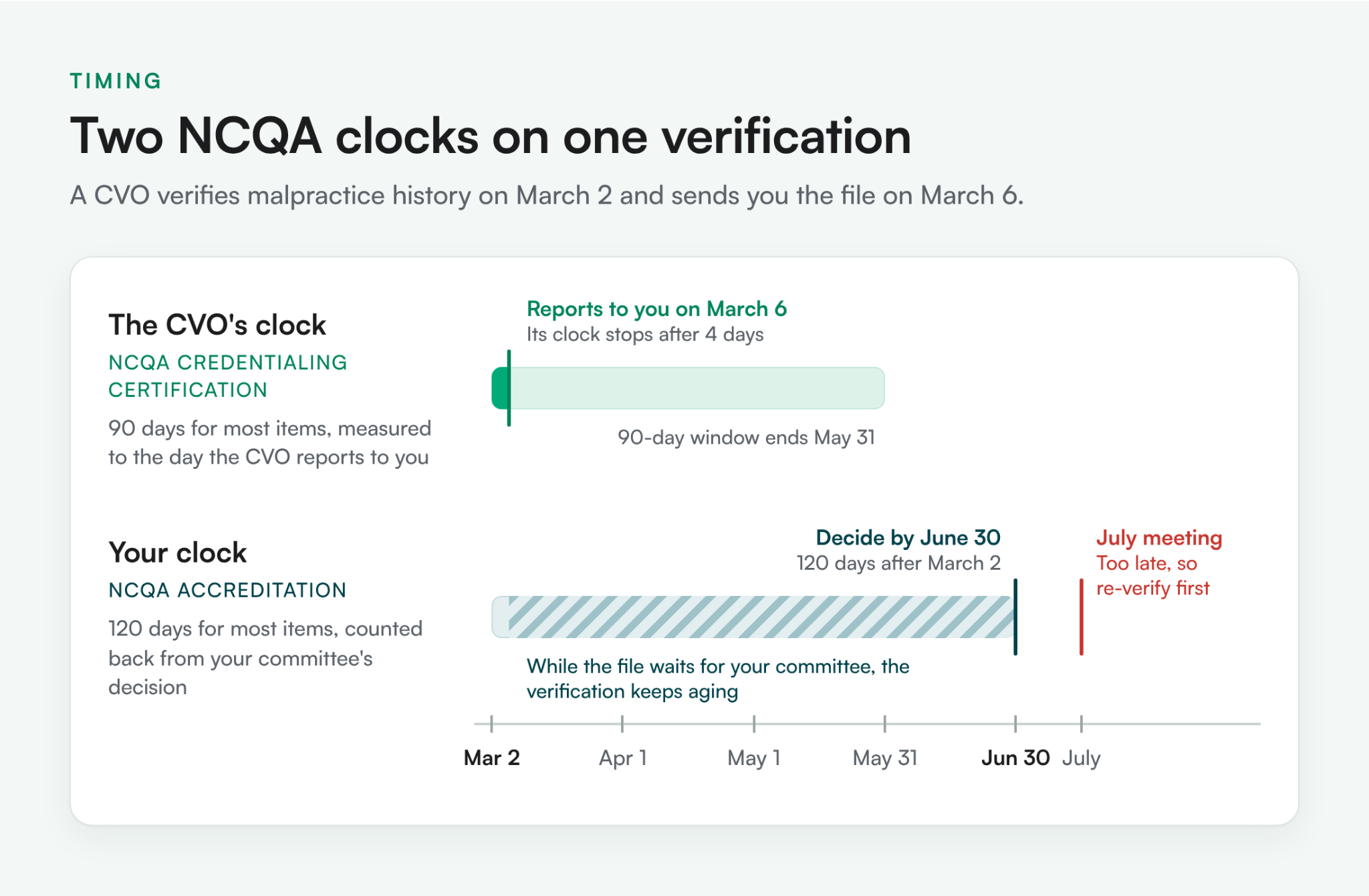
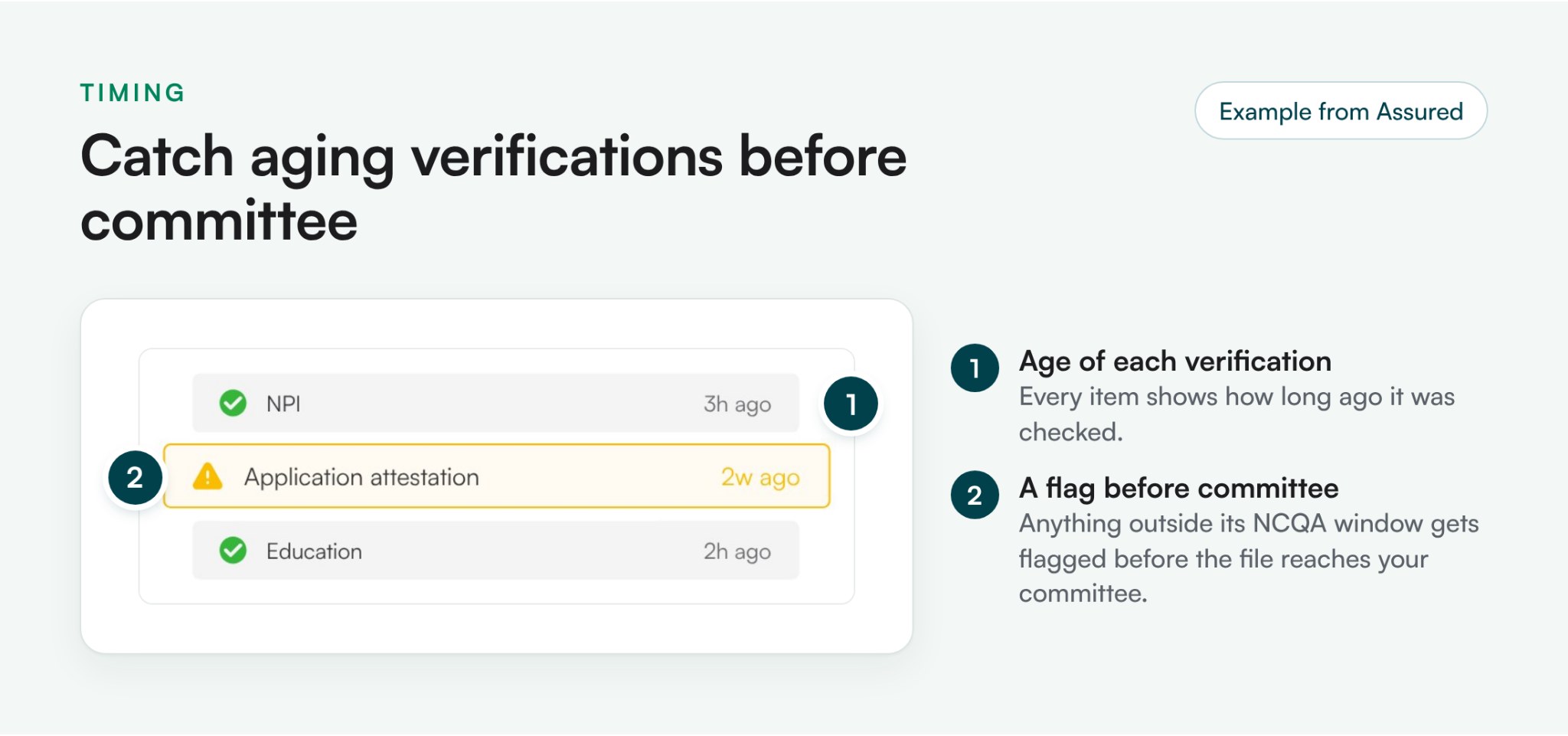
Ask the CVO what happens when a verification ages out before your committee meets. At Assured, our platform flags any verification that's outside its NCQA timeframe before the file goes to committee.
Ongoing monitoring of sanctions is one of the 11 products, so check that the CVO is certified for it. NCQA currently requires a review at least monthly, or within 30 days of a new alert from a monitoring service. The rule covers sanctions, exclusions, license limitations, and expiration dates.
Ask which lists the CVO checks, too. NCQA accepts sources like the OIG's LEIE, SAM.gov, and the National Practitioner Data Bank. Since October 2025, it treats a state Medicaid agency as an optional source. But your state Medicaid contract can still require one. From July 2026, NCQA also wants license sanctions monitored in every state where a provider practices, starting with newly credentialed providers.
Then ask what the CVO sends you when it finds something, and how quickly. That matters, because OIG says the potential penalty for a missed exclusion is still yours, even when a contractor does the screening.
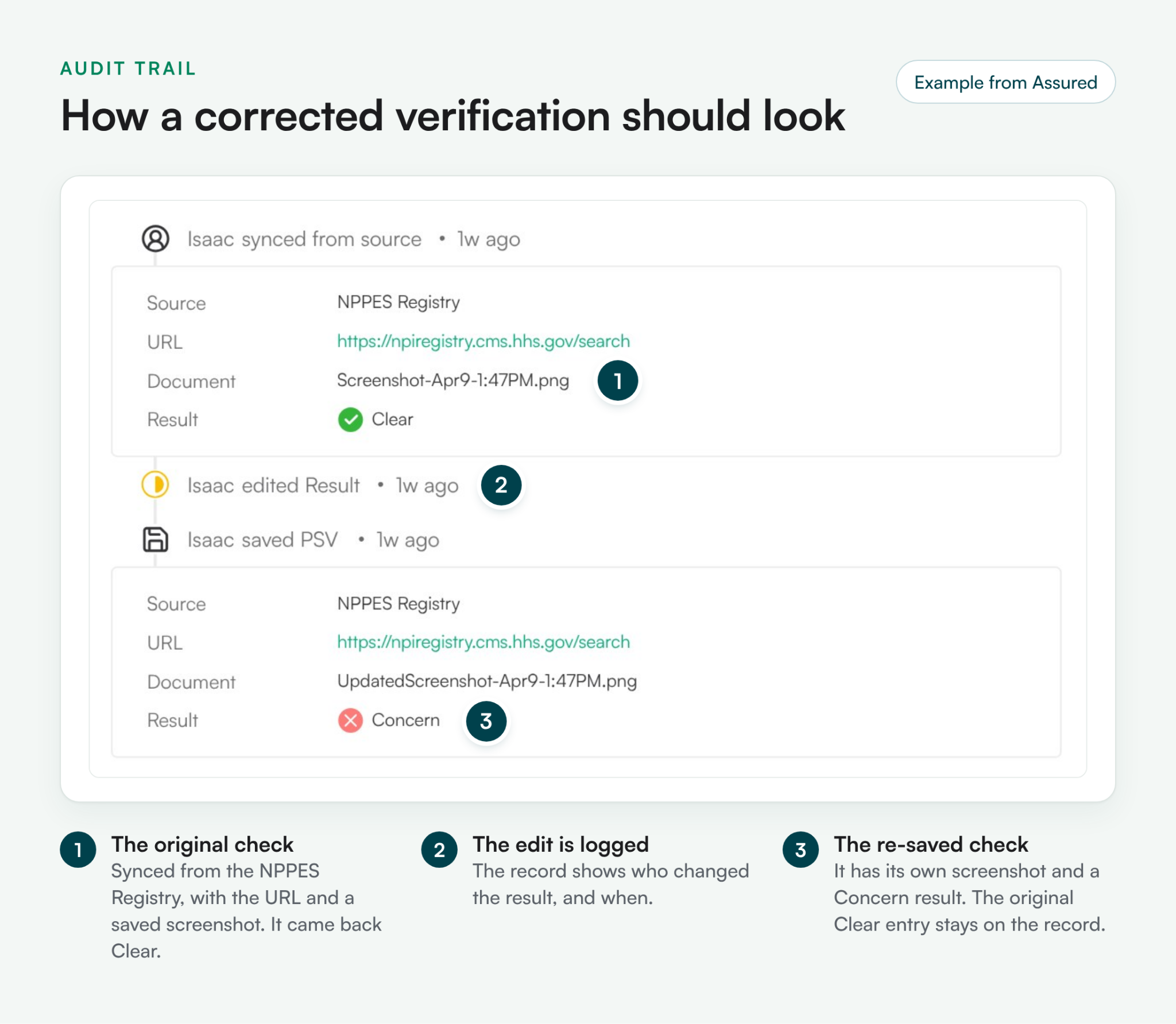
Pick a provider type you credential a lot, and ask the CVO to open one finished file with you. Every element in your scope should show its source, the verification date, who verified it, and the evidence the CVO saved. Then ask to see a corrected entry, so you can check that the original stays on the record next to the change.
For Health Plan Accreditation surveys from July 1, 2027, NCQA requires delegation agreements to address its information integrity rules. So check that yours already does. If the CVO passes any verification to a subcontractor, the agreement also has to say who oversees that work.
Ask for proof of its errors and omissions coverage, too. And agree up front on how you'd get your files and audit history back if you ever leave.
Medicare Advantage plans have one more box to check. CMS requires the contract to say whether the plan reviews credentials itself or approves and keeps auditing the delegate's process.
Since certification doesn't cover your committee or practitioner rights, the contract has to spell out who does what. Write down who contacts a provider when a source disagrees with their application. Then name who presents files to your committee and who starts recredentialing before the 36-month deadline. NCQA counts that cycle to the month, so a late start shows up in your survey.
When you walk through a CVO's file, you're looking at its audit trail—the record that proves each verification happened. NCQA's documentation rules ask for the source, the verification date, the verifier's signature or initials, and the report date for each item. A strong trail also saves what the source showed, like a screenshot of the licensing board's lookup page.
The same rules apply to automated checks. A CVO can pull data from a primary source through an API, but NCQA still requires documentation that a staff member reviewed it.
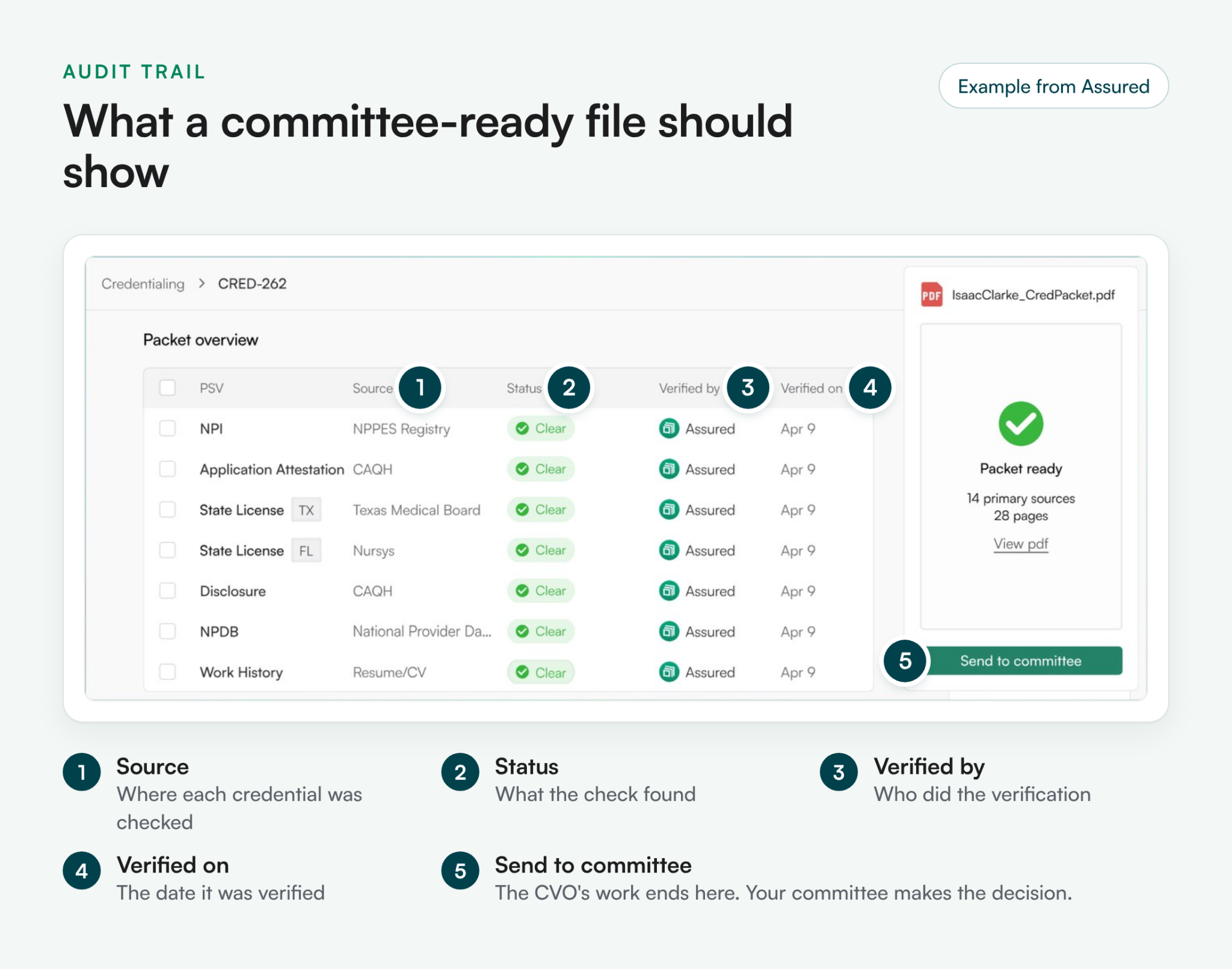
In Assured's credentialing platform, every verification is saved with its source, timestamp, result, and supporting evidence on the provider's record. We keep that history alongside committee activity, recredentialing, and monitoring, so it's all in one record when an auditor asks.
NCQA is just as strict about changes to a record. It added rules for investigating and tracking changes after it investigated reports of altered records. Some organizations had changed dates, verification reports, and even verifier initials while preparing for surveys.
Since 2025, NCQA's information integrity standard requires staff training and an annual audit for inappropriate documentation and updates. That audit covers verification records, committee minutes, and monitoring reports. If it finds problems, a follow-up audit must occur within three to six months.
A good trail also records what didn't go to plan. In December 2021, a security incident took down the Maryland Department of Health's licensing systems. Nobody could primary-source verify a Maryland license until the systems came back on February 4, 2022. NCQA said it wouldn't penalize organizations for the gap. But it told them to document the state's guidance in each affected practitioner's file.
Dates matter too, since NCQA measures timeliness from the committee's decision date, or the medical director's for a clean file. And because NCQA requires credentialing before a provider sees members, you can't backdate an effective date to their start date. Keep every file at least through the survey look-back period.
If a CVO can't show you this for one file in a demo, don't expect it to on audit day.
A CVO can take most of the verification work off your team, and NCQA certification is the right place to start. Just remember that certification shows a CVO's processes held up in a survey for specific evaluation products. Your committee's decision, its timing, and anything uncertified are still yours.
So before you sign anything, ask to walk through one complete file and its audit trail.
If you'd like to see ours, book a demo with Assured. We'll walk you through a committee-ready file, from the first source check to the moment it reaches your committee.
CAQH credentialing means using a provider's CAQH profile as their credentialing application. CAQH, which rebranded as DataSpring in 2026, runs the CAQH Provider Data Portal. Providers keep their details there on a 120-day attestation cycle and choose which organizations can see them. NCQA accepts the profile as the application, though it gives no automatic credit for it. And because it's the provider's own information, each credential still gets verified at the source.
The difference is who does the credentialing. In delegated credentialing, a health plan gives another organization, like a large provider group, the authority to credential providers on the plan's behalf. The plan signs a delegation agreement and stays responsible for overseeing that work. In non-delegated credentialing, the plan credentials each provider itself, so every application goes through its own review queue.
The two types are initial credentialing and recredentialing. Initial credentialing happens before a provider joins your network, since NCQA requires credentialing before they see members. Recredentialing repeats the verifications later, and NCQA requires it every three years. Our guide to recredentialing requirements walks through that 36-month cycle step by step.
An organization becomes an NCQA-certified CVO by passing NCQA's certification survey. To apply, it must have offered verification services for at least six months. It must also perform verification for at least 50% of contracted practitioners, according to NCQA. It also needs $1 million to $2 million in errors and omissions insurance. NCQA puts the typical timeline at 12 months from application to decision.

Assured Health, Inc.
333 Seventh Ave, Suite 1701
New York, NY 10001